CSS Pakistan Affairs | Intersectionality in Pakistan’s Feminist Movement
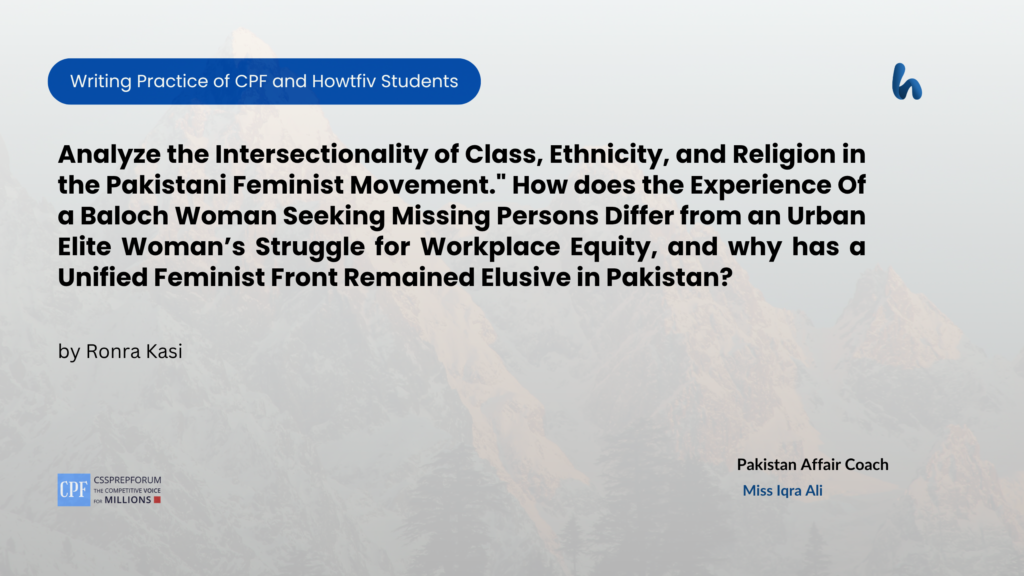
The following question of CSS Pakistan Affairs is solved by Ronra Kasi under the supervision of Howfiv’s Pakistan Affairs and Current Affairs Coaches: Miss Iqra Ali and Sir Ammar Hashmir. She learnt how to attempt 20 marks question and essay writing from Sir Syed Kazim Ali, Pakistan’s best CSS and PMS English essay and precis teacher with the highest success rate of his students. This solved question is attempted on the pattern taught by Sir to his students, scoring the highest marks in compulsory and optional subjects for years.
Outline
1- Introduction
2-Historical Evolution of Pakistani Feminist Movement: From WAF to Aurat March
3-Intersectionality of Class, Ethnicity, and Religion
- 3.1-Class Divide: How Economic Privilege Shapes Feminist Priorities
- Case in Point: A woman in DHA Karachi campaigns against office harassment, while a woman in rural Punjab fights for her right to inherit agricultural land under customary Watta Satta marriages
- 3.2-Ethnic Fragmentation: Baloch, Pashtun, and Sindhi Women Outside the Mainstream
- Case in point: Mahrang Baloch and Voice for Baloch Missing Persons (VBMP), documented by Human Rights Watch, represent a feminism rooted in survival, invisible to mainstream platforms
- 3.3- Religion as Both Barrier and Framework
- Case in point: CEDAW (ratified 1996) is rejected as Western in conservative communities where faith-rooted rights language carries far more legitimacy
4- Baloch Woman Seeking Missing Persons vs Urban Elite Woman’s Struggle for Workplace Equity
- 4.1- Struggle for Survival vs. Struggle for Recognition
- Case in point: Sammi Deen Baloch walked from Quetta to Islamabad demanding her father’s return; an elite Karachi woman files an HCCPA complaint for a denied promotion
- 4.2- Access to Legal and Institutional Mechanisms
- Case in point: Elite women access NCSW, Harassment at Workplace Act 2010, PECA; whereas thousands of Balochistan cases filed with the Commission remain unresolved after over a decade, with no prosecutions
- 4.3- Media Visibility and the Politics of Who Gets to Speak
- Case in point: Baloch protests face media blackouts and journalist intimidation; Mahrang Baloch’s 2023 long march to Islamabad received a fraction of the coverage given to simultaneous Aurat March events in Lahore and Karachi
5-Why a Unified Feminist Front Has Remained Elusive in Pakistan
- 5.1- Ideological Fractures: Secular vs. Islamic Feminism
- Case in point: Secular feminists use CEDAW (ratified 1996), and universal rights language; Islamic feminists reject this as culturally alien; 2019-2020 Aurat March backlash, privately sympathetic Muslim women publicly distanced themselves due to secular sloganeering
- 5.2- Class and Urban-Rural Disconnect
- Case in point: A domestic worker in Rawalpindi and an Ivy League-educated lawyer both identify as feminists but share no common platform, leadership space, or political strategy; whereas International donor-funded NGOs (USAID, UN Women) shape agendas from Geneva and New York
- 5.3- State Repression and Political Co-optation
- Case in point: Feminist activists accused of being “foreign agents”: a label used to justify surveillance and social pressure that discourages open coalition-building; WAF (1981) was Pakistan’s closest attempt at a broad coalition. dismantled under political pressure post-1990s
6- Roadmap for the Unified Feminist Front Attainable in Pakistan
- 6.1-Build an Intersectional Platform Led from the Margins
- Case in point: South Africa’s post-apartheid feminist coalitions deliberately centered Black and rural women in leadership, producing more durable and politically credible movements; Allocate leadership, funding, and media space to Baloch, Pashtun, Sindhi, and working-class women
- 6.2-Develop a Shared Language Bridging Islamic and Rights-Based Frameworks
- Case in point: Indonesia’s Musawah movement successfully bridges Islamic jurisprudence and modern rights frameworks — a replicable model for Pakistan’s secular-religious divide; Mainstream Dr. Riffat Hassan’s scholarship on Quranic foundations for women’s rights
7-Conclusion
Answer to the Question
Introduction
Pakistan’s feminist movement has grown steadily since the Women’s Action Forum emerged in 1981 to resist the Hudood Ordinances under Zia-ul-Haq. Yet decades later, this movement remains internally divided rather than unified. Strikingly, the reason lies in a simple but uncomfortable truth: Pakistani women do not share the same problems. To illustrate, a woman in the Defence Housing Authority, Karachi, and a woman in a mud house in Dera Bugti live in what might look like two different countries. For instance, the American scholar Kimberlé Crenshaw’s theory of intersectionality, introduced in 1989, argues that race, class, and gender do not operate independently; they overlap and compound one another. In Pakistan, class, ethnicity, and religion intersect in exactly this way, producing layered and often contradictory feminist experiences. The inescapable conclusion is that until these internal fractures are honestly acknowledged, a unified feminist front will remain more aspiration than reality.
Historical Evolution of Pakistani Feminist Movement: From WAF to Aurat March
Historically speaking, Pakistan’s feminist movement traces its organized origins to 1981, when the Women’s Action Forum was established in direct response to General Zia-ul-Haq’s Islamization policies, particularly the Hudood Ordinances and the Law of Evidence, which effectively limited a woman’s legal testimony. WAF united urban, educated women across Karachi, Lahore, and Islamabad in street protests: a remarkable act of public defiance under martial law. Furthermore, the movement then evolved through the 1990s with NGO-driven advocacy focusing on legal reform. By 2018, the first Aurat March in Karachi marked a new, younger, more assertive wave, reclaiming public space through slogans, placards, and collective visibility in a way WAF’s formal lobbying never attempted.
Intersectionality of Class, Ethnicity, and Religion
- Class Divide: How Economic Privilege Shapes Feminist Priorities
Upon a closer examination, the feminist movement in Pakistan has never spoken in one voice, and class is the primary reason. Urban, educated, upper-class women largely drive institutionalized feminism through NGOs, social media campaigns, and the Aurat March, which began in Karachi in 2018. In fact, their demands center on workplace harassment laws, the right to public space, and legal reforms under frameworks like the Protection Against Harassment of Women at the Workplace Act 2010. Meanwhile, working-class and rural women grapple with land inheritance, bonded labor, and access to basic healthcare. Therefore, the structural gap between these two realities means that what counts as a feminist issue depends entirely on where a woman stands economically in this deeply unequal society.
- Ethnic Fragmentation: Baloch, Pashtun, and Sindhi Women Outside the Mainstream
Along the same lines, Pakistani feminism has largely been shaped by Punjabi and urban Urdu-speaking women, leaving ethnic minorities at the periphery of the movement. On the other hand, Baloch women face a completely different political reality. Since the escalation of enforced disappearances in Balochistan, documented by the Voice for Baloch Missing Persons and Human Rights Watch, women like Mahrang Baloch have led movements demanding the recovery of forcibly disappeared family members, not workplace equity. Similarly, Pashtun women within the Pashtun Tahafuz Movement have centered their activism around state violence and displacement. In a word, these ethnic-minority feminist expressions are rarely incorporated into mainstream feminist discourse, which continues to reflect the concerns of the Punjab-centric political and cultural elite at the expense of everyone else.
- Religion as Both Barrier and Framework: Negotiating Feminism in an Islamic Republic
Further to the above, religion adds another layer of complexity to Pakistani feminism. Pakistan was founded on an Islamic identity, and any feminist movement operating here must negotiate its relationship with religious interpretation. It bears emphasis that conservative groups like Jamaat-e-Islami have historically framed feminist demands as un-Islamic and Western-imported. In no uncertain terms, the controversy over Aurat March slogans in 2019 exposed this tension sharply, drawing condemnation from religious political parties. However, religion is not only an obstacle; many Pakistani women articulate feminist demands through an Islamic lens, citing Quranic verses on inheritance rights and Islamic jurisprudence that protects women’s property. Thus, this faith-rooted feminism is quieter but deeply embedded in communities where secular language holds no cultural legitimacy whatsoever.
Baloch Woman vs. Urban Elite Woman
- The Struggle for Survival vs. the Struggle for Recognition
In addition to the above, a Baloch woman seeking missing persons is fighting for physical survival, her own and her family’s. In particular, the enforced disappearances in Balochistan, documented extensively by Human Rights Watch and Amnesty International since 2011, have created a category of grief that has no formal legal remedy in Pakistan. Moreover, women like Sammi Deen Baloch have walked from Quetta to Islamabad to demand answers from the state; unfortunately, their feminism is inseparable from questions of state accountability. On the contrary, an urban elite woman in Karachi may be fighting a denied promotion or workplace harassment, real and legitimate grievances, but operating within a system that at least nominally acknowledges her citizenship. To sum up, the Baloch woman is fighting to be seen as a citizen at all.
- Access to Legal and Institutional Mechanisms
Additionally, the urban elite woman has access to lawyers, the court system, and bodies like the National Commission on the Status of Women. It is imperative to recognize that she can file a complaint under the Harassment at Workplace Act 2010 or under PECA if harassed online. On the contrary, the Baloch woman seeking a missing person enters a legal black hole. The Commission of Inquiry on Enforced Disappearances, established in 2011, has received almost 10,283 cases but has been repeatedly criticized by the HRCP for its lack of enforcement power and slow pace. As a direct consequence, when the legal system is itself the alleged perpetrator, formal mechanisms become inaccessible or dangerous. Therefore, this institutional gap means the two women are not traveling on the same feminist road at all.
- Media Visibility and the Politics of Who Gets to Speak
In the same vein, the Aurat March receives national and international media coverage, its slogans trend on social media, and its participants are interviewed by major outlets. More importantly, this visibility gives urban feminist voices the power to set national agendas. Baloch women’s protests, by contrast, have often been met with media blackouts and intimidation of journalists covering the region. For instance, Mahrang Baloch’s long march to Islamabad in late 2023 gained some traction, but coverage remained limited compared to events in Lahore or Karachi. Without a shadow of doubt, his disparity is not accidental: it reflects how geography, ethnicity, and security narratives combine to silence some feminist voices while amplifying others, ensuring the movement’s loudest voices are rarely its most marginalized ones.
Why a Unified Feminist Front Has Remained Elusive
- Ideological Fractures: Secular vs. Islamic Feminism
Moving down the ladder, there is no shared agreement within Pakistani feminist circles on what feminism should look like in an Islamic republic. Additionally, Secular feminists, many leading NGOs, and appearing in internationally funded forums, speak a language of universal rights drawn from CEDAW, which Pakistan ratified in 1996. Compounding this further, Islamic feminists argue that this framework is culturally alien and that rights are better claimed through Quranic arguments. On account of this, when the Aurat March’s secular slogans triggered a national backlash in 2019 and 2020, many Muslim women who privately supported feminist causes distanced themselves publicly because the language felt foreign to their identity. All things considered, a unified front requires a shared vocabulary, and Pakistani feminism has not found one that bridges this divide without alienating either side.
- Class and Urban-Rural Disconnect
Hand in hand with this, NGO-based feminism in Pakistan is largely funded by international donors, USAID, UN Women, and European development agencies, which, consequently, reflects agendas shaped in Geneva and New York as much as in Multan or Khuzdar. it s worth noting that rural women’s organizations, where they exist, rarely have the resources or visibility to shape national feminist discourse. Stemming from this reality, the result is a top-down movement that speaks for women, but it does not always speak with them. Now, withstanding this, a domestic worker in Rawalpindi and a Harvard-educated lawyer arguing before the Supreme Court may both call themselves feminists, but their demands and political strategies differ fundamentally. Against this backdrop, without genuine inclusion of working-class and rural women in leadership, unity remains cosmetic.
- State Repression and Political Co-optation
Of critical importance here is that the Pakistani state has at various times both repressed and co-opted feminist movements. For instance, the Women’s Action Forum, formed in 1981 to resist Zia-ul-Haq’s Hudood Ordinances, represented perhaps the closest Pakistan came to a broad-based feminist coalition. However, since the 1990s, the movement has fragmented under pressure from competing political parties that use women’s rights as electoral tools without genuinely advancing them. More recently, state surveillance of activists under PECA and accusations of being foreign agents have created a climate of self-censorship. Taken together, these factors suggest that when feminist coalition-building becomes dangerous rather than merely difficult, many women choose silence over solidarity, and the unified front recedes further from reach.
Roadmap for the Unified Feminist Front Attainable in Pakistan
- Build an Intersectional Platform Led from the Margins
Despite the aforementioned challenges, the feminist movement needs to deliberately decenter its urban, elite leadership and create structures where Baloch, Pashtun, Sindhi, and working-class women shape the agenda rather than being invited as token voices. Provided that this means allocating leadership positions, research funding, and media platforms to women from the margins, not as an act of charity, but as a strategic necessity. It’s worth noting that a movement that can simultaneously address a Baloch mother’s search for her disappeared son and a Karachi professional’s workplace harassment will be far harder to dismiss as elitist, irrelevant, or foreign-imported. Ultimately, intersectional representation is not a weakness; it is the only form of feminism that Pakistan’s diverse reality actually demands.
- Develop a Shared Language That Bridges Islamic and Rights-Based Frameworks
Equally significant, Pakistani feminist scholars and activists must invest in building a shared vocabulary that allows women from different religious and ideological backgrounds to recognize each other as part of the same struggle. In particular, scholars like Dr. Riffat Hassan have demonstrated that Islamic jurisprudence contains genuine foundations for women’s rights, in property, consent, and inheritance, that predate modern rights frameworks entirely. Strikingly, mainstreaming this scholarship through public dialogue, school curricula, and community-level training can allow a woman in a village madrassa and a woman in an urban law firm to find common ground. Taken together, these factors suggest that without this bridge, the secular-religious fault line will continue to fracture the movement before it can consolidate into any lasting political force.
Conclusion
To put it succinctly, Pakistan’s feminist movement carries both its greatest strength and its deepest contradiction. In the long run, its strength lies in the sheer diversity of women who are fighting, from the streets of Islamabad to the camps of displaced Pashtun families to the protest marches outside military headquarters in Balochistan. Moreover, its contradiction is that this diversity has not yet been turned into solidarity. Class privilege, ethnic marginalization, and competing religious frameworks continue to keep Pakistani women in separate rooms, each fighting her own battle without the support of the others. Of particular significance is that the path forward is not to erase these differences but to build a movement honest enough to hold them together. What emerges from this analysis is that when Pakistani feminism learns to center its most silenced voices rather than its loudest ones, it will become something the state and society will find far more difficult to ignore.

CSS Solved Past Papers’ Essays
Looking for the last ten years of CSS and PMS Solved Essays and want to know how Sir Kazim’s students write and score the highest marks in the essays’ papers? Then, click on the CSS Solved Essays to start reading them.
CSS Solved Essays
CSS Solved Islamiyat Past Papers
Want to read the last ten years’ Islamiyat Solved Past Papers to learn how to attempt them and to score high? Let’s click on the link below to read them all freely. All past papers have been solved by Pakistan’s top CSS Islamiyat coaches having the highest score of their students.
CSS Solved Islamiyat
CSS Solved General Science & Ability Past Papers
Want to read the last ten years’ General Science & Ability Solved Past Papers to learn how to attempt them and to score high? Let’s click on the link below to read them all freely. All past papers have been solved by Pakistan’s top CSS GSA coachez having the highest score of their students.
CSS Solved General Science & Ability
CSS Solved Pakistan Affairs Past Papers
Want to read the last fifteen years’ Pakistan Affairs Solved Past Papers to learn how to attempt them and to score high? Let’s click on the link below to read them all freely. All past papers have been solved by Pakistan’s top CSS Pakistan Affairs coaches having the highest score of their students.
CSS Solved Pakistan Affairs
CSS Solved Current Affairs Past Papers
Want to read the last fifteen years’ Current Affairs Solved Past Papers to learn how to attempt them and to score high? Let’s click on the link below to read them all freely. All past papers have been solved by Pakistan’s top CSS Current Affairs coaches having the highest score of their students.
CSS Solved Current Affairs