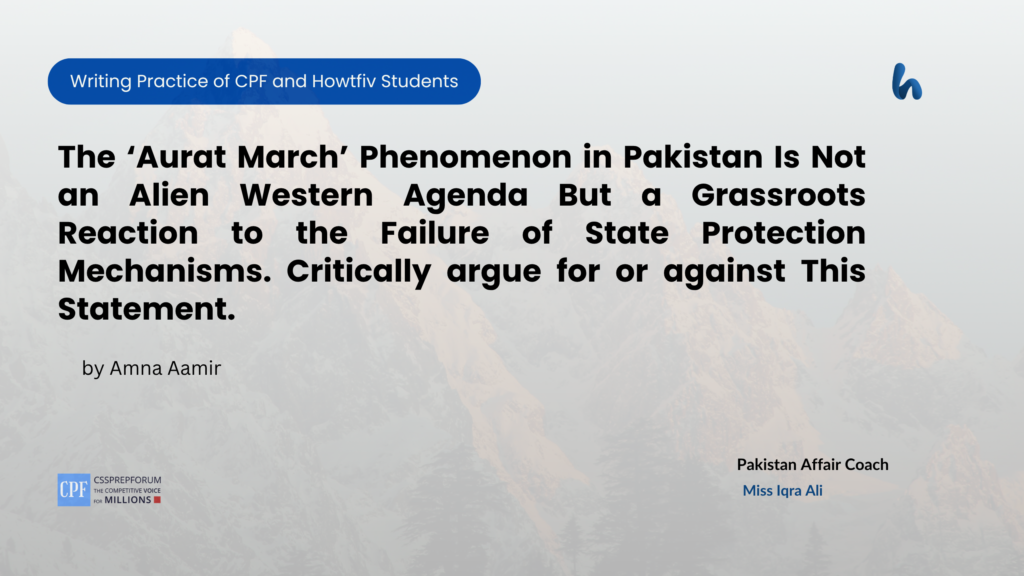
CSS Pakistan Affairs | Aurat March as a Reaction to the Failure of State Protection Mechanisms
The following question of CSS Pakistan Affairs is solved by Amna Aamir under the supervision of Howfiv’s Pakistan Affairs and Current Affairs Coaches: Miss Iqra Ali and Sir Ammar Hashmir. She learnt how to attempt 20 marks question and essay writing from Sir Syed Kazim Ali, Pakistan’s best CSS and PMS English essay and precis teacher with the highest success rate of his students. This solved question is attempted on the pattern taught by Sir to his students, scoring the highest marks in compulsory and optional subjects for years.

Outline
1- Introduction
2- Decoding the Statement: “Aurat March Is Not an Alien Western Agenda but a Grassroots Reaction to the Failure of State Protection Mechanisms”
3- Arguments Supporting Aurat March as a Reaction to State Protection Failures
3.1- Socio-Legal Institutional Gaps
- Low Conviction Rates
- The state’s criminal justice system has an extremely low conviction rate (estimated below 5%) for gender-based violence (GBV), rape, and domestic abuse.
- Police Inefficiency
- The lack of gender sensitivity in police stations (Thana culture) and a shortage of functional women-led police desks discourage victims from seeking legal help.
3.2- Delayed and Ineffective Legislative Implementation
- The De Jure vs. De Facto Gap
- While laws exist (e.g., Protection against Harassment of Women at the Workplace Act, anti-honor killing laws), their enforcement in rural and semi-urban areas remains weak.
3.3- Economic Vulnerability and Lack of State Safety Nets
- Infrastructure Failures
- The state has failed to guarantee equal wages, safe public transport, and workplace security, forcing working-class women to mobilize for basic economic survival.
4- Deconstructing the Backlash: The “Alien Western Agenda” Critique
- 4.1- Controversial Slogans and Cultural Alienation
- Controversial manifestos and slogans (such as “Mera Jism Meri Marzi”) are interpreted as expressions of Western radical individualism rather than local rights.
- 4.2- The Urban-Elite Hegemony vs. Subaltern Realities
- The structural concentration of the movement’s leadership within urban, English-speaking circles creates a perceived disconnect from the immediate material needs (clean water, inflation, maternal healthcare) of rural women.
- 4.3- The Right-Wing Counter-Mobilization
- The rise of the Haya March (Modesty March) on International Women’s Day, showcasing an alternative vision of women’s rights framed strictly within traditional and religious boundaries.
6- Recommendations
- To Indigenize Rights Discourse
- To Execute Socio-Economic Safety Nets under Constitutional Mandates
7- Conclusion
Answer to the Question
Introduction
The sudden emergence of the Aurat March in 2018 completely disrupted the traditional landscape of rights-based activism in Pakistan. It marked a sharp shift away from the quiet, boardroom-centric discussions of conventional non-governmental organizations (NGOs) and brought raw, vocal demands directly onto the streets of urban centers. This public mobilization has split public opinion into two distinct camps. On one side, traditional centric group quickly dismiss the entire phenomenon as an imported Western project designed to undermine local moral structures. Similarly, on the other side, rights collectives argue that the march is a direct, desperate response to deep-seated local failures. While the Aurat March faces massive public resistance due to a sharp urban-class divide and highly controversial slogans, it is at its core a localized, grassroots reaction to a state that has consistently failed to protect its women. Despite the friction, its real victory lies in its undeniable agenda-setting power, which has permanently dragged once-taboo gender issues into mainstream lawmaking and media debates.
Decoding the Statement: “Aurat March Is Not an Alien Western Agenda but a Grassroots Reaction to the Failure of State Protection Mechanisms”
To fully comprehend this statement, one must look at the basic contract between a citizen and the state. The primary duty of any sovereign state under the social contract is to provide security, dignity, and justice to all its citizens. Article 25 of the 1973 Constitution clearly states that all citizens are equal and that the state cannot discriminate based on sex. The state is legally bound to act as a protector. When official institutions fail, a dangerous governance deficit occurs. In sociological terms, social movements do not just appear out of nowhere because of foreign influence; they naturally rise from the grassroots level to fill the political vacuum left by institutional apathy. When women cannot find safety at home, in the workplace, or in the legal system, public protest becomes their only functional option. Therefore, the Aurat March is not a foreign conspiracy, but a highly localized reaction to the deep gap between the state’s protective laws and the dangerous ground realities faced by Pakistani women.
Arguments Supporting Aurat March as a Reaction to State Protection Failures
A- Socio-Legal Institutional Gaps
- Low Conviction Rates
To begin with, the primary component behind the Aurat March is the severe failure of Pakistan’s criminal justice system to offer any real deterrence against crimes targeting women. This institutional failure creates an environment of absolute impunity where perpetrators of gender-based violence (GBV) face zero fear of accountability. For instance, human rights organizations consistently report that the actual conviction rate for rape and severe domestic abuse in Pakistan stands at an alarming less than 5%. This low percentage is a direct result of poorly handled police investigations, a lack of secure forensic evidence collection, and endless judicial delays. Therefore, this systemic impunity is exactly what pushes women out of silent suffering and onto the pavement, proving that the march is a desperate, grassroots call for functional local justice.
- Police Inefficiency
Additionally, the local police infrastructure operates as a major barrier that prevents female victims from accessing state protection. The traditional law enforcement system is heavily defined by a hostile, patriarchal Thana Culture that treats female complainants with institutional skepticism. Specifically, statistics show a severe shortage of functional, women-led police help desks across the country, leaving the vast majority of police stations entirely managed by untrained male officers. As a result, going to a police station as a female victim often means facing secondary harassment, skepticism, and victim-blaming instead of relief. Consequently, when the primary law enforcement agency feels actively unsafe for citizens, state protection has fundamentally failed, making Public Street protests the only functional safety valve left for the public.
B- Delayed and Ineffective Legislative Implementation
- The De Jure vs. De Facto Gap
Moreover, a deep gap between de jure laws and de facto realities on the ground leaves women completely unprotected in rural and semi-urban areas. While Pakistan has plenty of progressive laws on paper, the state fails to enforce them outside major urban centers. To illustrate, the Protection against Harassment of Women at the Workplace Act 2010 and strict anti-honor killing laws exist legally (de jure), but they do not exist practically (de facto) in tribal and rural areas. In these spaces, local administrations step aside and allow parallel, illegal customary councils (Jirgas) to dictate women’s lives and pass anti-women verdicts. Thus, this legislative gap shows that passing laws is completely meaningless without administrative enforcement, which directly forces grassroots collectives to organize and demand physical state protection.
C- Economic Vulnerability and Lack of State Safety Nets
- Infrastructure Failures
Furthermore, the state has failed to secure basic mobility and economic survival for the female workforce. Without financial safety nets, women are left completely exposed to systemic exploitation in both the formal and informal sectors. For example, provincial labor departments consistently fail to monitor or enforce equal wages, public transport remains notoriously unsafe for female commuters, and workplace daycare infrastructure is practically non-existent. This lack of facilities forces working-class women to risk their physical safety every single day just to earn a basic living. Therefore, these women are not mobilizing because of abstract, imported Western theories; rather, they are marching because the state has left them economically exposed and physically vulnerable in their everyday lives.
Deconstructing the Backlash: The “Alien Western Agenda” Critique
- Controversial Slogans and Cultural Alienation
On the other hand, critics from conservative quarters strongly argue that the Aurat March is an alien Western agenda aimed at dismantling Pakistan’s traditional Islamic family structure. This viewpoint asserts that the movement introduces radical individualist values that directly contradict the collectivist and religious framework of Pakistani society. To support this claim, critics point directly to controversial slogans like “Mera Jism Meri Marzi” (My Body, My Choice) used during the annual marches. These phrases are literal translations of Western radical feminist slogans, which make them sound highly offensive and culturally alien to the local population. Nevertheless, while the choice of words was textually problematic, the underlying demand was entirely local, focusing on protection against domestic rape and honor killings. Hence, the conservative backlash misinterprets a local demand for basic bodily safety as a foreign cultural attack due to poor slogan translation.
- The Urban-Elite Hegemony vs. Subaltern Realities
Furthermore, opponents claim that the movement represents an urban-elite hegemony that has no connection to the real struggles of mainstream Pakistani women. This critique argues that the movement is a top-down project designed by wealthy elites to promote lifestyle liberalization rather than structural rights. For instance, the primary faces, organizers, and spokespersons of the Aurat March are almost exclusively upper-middle-class, English-speaking urban women. This demographic concentration creates a massive perception gap, making rural women feel that the March priorities are disconnected from their immediate material needs. However, this argument falls flat because the official manifestos of the march consistently demand clean water, inflation relief, and maternal healthcare for rural women. Thus, the accusation of elite hegemony is a narrative used by conservative quarters to divide the movement, even though the core demands cover all social classes.
- The Right-Wing Counter-Mobilization
Subsequently, right-wing groups have launched organized counter-movements to challenge the ideological space claimed by the Aurat March. This counter-mobilization aims to show that the traditional population rejects secular feminism and demands an alternative model of empowerment. Specifically, this took physical shape through the Haya March (Modesty March), which religious-political parties now organize right across the street on International Women’s Day. This counter-march gathers thousands of women who present an alternative vision of rights framed strictly within traditional, complementary, and religious boundaries. Yet, while the Haya March claims to oppose the Aurat March, it actually validates the debate by proving that traditional women also feel the need to come out and publically demand their rights. Therefore, this counter-mobilization proves that gender discourse has become completely indigenized, as both sides are now using the streets of Pakistan to fight for their social status.
Recommendations
- To Indigenize Rights Discourse
The National Commission on the Status of Women (NCSW) must take the lead in indigenizing the rights discourse. Specifically, civil society groups should be actively steered to frame their demands for inheritance, labor rights, and safety using local cultural histories and clear Islamic jurisprudence frameworks (like Huquq-ul-Ibad), thereby stripping away the “foreign proxy” excuse.
- To Execute Socio-Economic Safety Nets under Constitutional Mandates
The Ministry of Poverty Alleviation and Social Safety must use the Benazir Income Support Programme (BISP) infrastructure to secure working women under Articles 34 and 35 of the Constitution. In doing so, the state can legally register informal agricultural and brick-kiln female workers into provincial social security rolls and tie state relief directly to minimum wage enforcement.
Conclusion
In conclusion, the Aurat March is an undeniable symptom of a broken domestic social contract, not a foreign conspiracy. The economic exploitation, the physical violence, and the institutional neglect that women protest every year are entirely homegrown realities. The bitter deadlock between secular organizers and conservative counter-protesters can only be broken if the state stops acting as a passive observer. Ultimately, by actively enforcing the Principles of Policy which mandate the active protection of the family, the mother, and women’s full inclusion in national life the state can finally turn raw street anger into functional, protective governance.

CSS Solved Past Papers’ Essays
Looking for the last ten years of CSS and PMS Solved Essays and want to know how Sir Kazim’s students write and score the highest marks in the essays’ papers? Then, click on the CSS Solved Essays to start reading them.
CSS Solved Essays
CSS Solved Islamiyat Past Papers
Want to read the last ten years’ Islamiyat Solved Past Papers to learn how to attempt them and to score high? Let’s click on the link below to read them all freely. All past papers have been solved by Pakistan’s top CSS Islamiyat coaches having the highest score of their students.
CSS Solved Islamiyat
CSS Solved General Science & Ability Past Papers
Want to read the last ten years’ General Science & Ability Solved Past Papers to learn how to attempt them and to score high? Let’s click on the link below to read them all freely. All past papers have been solved by Pakistan’s top CSS GSA coachez having the highest score of their students.
CSS Solved General Science & Ability
CSS Solved Pakistan Affairs Past Papers
Want to read the last fifteen years’ Pakistan Affairs Solved Past Papers to learn how to attempt them and to score high? Let’s click on the link below to read them all freely. All past papers have been solved by Pakistan’s top CSS Pakistan Affairs coaches having the highest score of their students.
CSS Solved Pakistan Affairs
CSS Solved Current Affairs Past Papers
Want to read the last fifteen years’ Current Affairs Solved Past Papers to learn how to attempt them and to score high? Let’s click on the link below to read them all freely. All past papers have been solved by Pakistan’s top CSS Current Affairs coaches having the highest score of their students.
CSS Solved Current Affairs