CSS Pakistan Affairs | Political Instability and Economic Instability in Pakistan
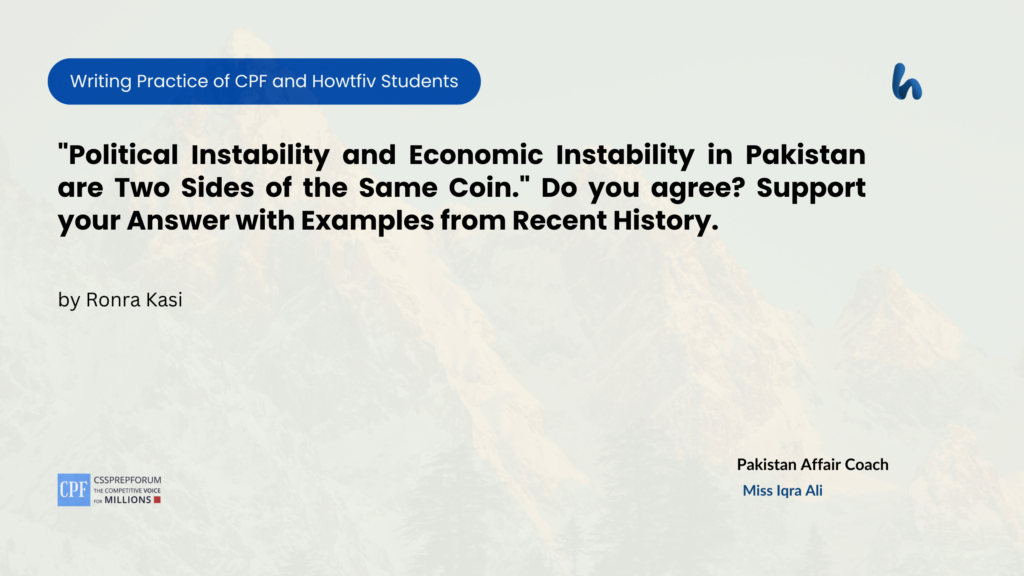
The following question of CSS Pakistan Affairs is solved by Ronra Kasi under the supervision of Howfiv’s Pakistan Affairs and Current Affairs Coaches: Miss Iqra Ali and Sir Ammar Hashmir. She learnt how to attempt 20 marks question and essay writing from Sir Syed Kazim Ali, Pakistan’s best CSS and PMS English essay and precis teacher with the highest success rate of his students. This solved question is attempted on the pattern taught by Sir to his students, scoring the highest marks in compulsory and optional subjects for years.

Outline
1-Introduction
2- Analyzing the Interconnection Between Political Instability and Economic Instability
3- How Political Instability and Economic Instability are Two Sides of the Same Coin in Pakistan
- 3.1-Government Removal Triggers Immediate Currency Collapse
- Case in Point: According to the Pakistan Economic Crisis Report, when the present government took office following the ouster of the then Prime Minister in 2022, rapid outflows from foreign reserves and currency devaluations ensued immediately, with the Rupee hitting an all-time low in May 2022.
- 3.2-Political Uncertainty Deters Foreign Investment
- Case in Point: According to the PSSR Journal, frequent government changes, which produce inconsistent fiscal policies, with incoming administrations reversing their predecessors’ decisions, directly undermine Pakistan’s ability to attract foreign and domestic investment, as investors require stability and predictability.
- 3.3-Constitutional Crises Delay Critical IMF Negotiations
- Case in Point: According to the BTI 2026 Country Report, amid soaring double-digit inflation and the prospect of default in 2023, the politically fragile PDM government only managed to secure a $3 billion IMF loan in July 2023, a stabilization program delayed by prolonged political upheaval following the then-PM’s ouster in April 202
- 3.4-Debt Servicing Exceeds Revenue Under Political Dysfunction
- Case in Point: In fiscal year 2022-23, Pakistan’s debt servicing obligations of Rs. 5.2 trillion exceeded the entire federal government’s revenue, a direct consequence of years of poor governance and politically motivated spending decisions.
- 3.5-Disputed Elections Deepen Economic Uncertainty
- Case in Point: According to Asia Maior Think Tank, the February 2024 general election was marred by widespread allegations of vote manipulation and delays in ballot counting, with international observers calling for investigations, prolonging the political uncertainty that keeps economic confidence suppressed.
- 3.6-Political Instability Identified as a Direct Cause of the Economic Crisis
- Case in Point: Pakistan’s 2021–2024 economic crisis was officially attributed to multiple causes, including political instability alongside excessive external borrowing, poor governance, rising global fuel prices, and the 2022 floods.
- 3.7-Structural Reforms Blocked by Political Self-Interest Successive
- Case in Point: According to South Asian Voices, Pakistani governments have avoided key structural reforms, including land reform, broadening the tax base, and cutting wasteful spending, opting instead for IMF bailouts; by September 2024, Pakistan had entered its 25th IMF program.
- 3.8-Security Instability as the Third Compounding Variable
- Case in Point: Alongside political and economic instability, Pakistan’s deteriorating security situation, with 757 people killed in insurgency-related violence in the first eight months of 2024 alone, further undermines the conditions necessary for economic recovery.
4-Conclusion
Answer to the Question
Introduction
Pakistan has faced serious problems for many decades, but political and economic instability stand out as the two biggest. Accordingly, these two problems are not separate; rather, they are deeply connected and feed into each other. In particular, North argued that weak institutions: weak courts, weak parliament, weak rule of law, are the root cause of both political and economic failure. Strikingly, Pakistan’s institutions have never been strong or independent enough to hold leaders accountable. Further to this, when the government is unstable, the economy suffers; similarly, when the economy is in crisis, politics becomes even more chaotic. As an illustration, Pakistan has had 29 prime ministers since 1947, and not one of them completed a full five-year term. Moreover, every new government brings new policies, new priorities, and new teams, which wastes time and creates confusion. Meanwhile, ordinary Pakistanis face rising prices, unemployment, and a currency that keeps losing value. What is more, the country keeps borrowing from the IMF, 25 times so far, but the root problems are never fixed. The inescapable conclusion is that Pakistan cannot fix one without fixing the other; they are part of the same crisis.
Analyzing the Interconnection Between Political Instability and Economic Instability
Political instability and economic instability in Pakistan are not two separate problems; instead, they are directly and permanently connected to one another. What suffers the most when the government falls or is ousted is the economy; as a direct consequence, investors lose confidence, the currency drops, and foreign reserves shrink. Contingent upon this, when the economy collapses, prices rise, jobs disappear, and poverty spreads; for instance, public anger grows, and governments lose their grip on power. Further to this, a back-and-forth relationship means that one crisis triggers the other, creating a loop that is very difficult to break. In Pakistan, weak political institutions have never been strong enough to absorb economic shocks or implement necessary reforms. At the same time, a weak economy has never been able to provide the stability and public satisfaction that a government needs to survive and govern to function effectively. Undeniably, this interconnection is the central reason why Pakistan remains trapped. Taken together, these factors suggest that until the political system stabilizes, the economy cannot recover, and until the economy recovers, the political system cannot stabilize.
How Political Instability and Economic Instability are Two Sides of the Same Coin in Pakistan
- Government Removal Triggers Immediate Currency Collapse
In the first instance, when a government is removed outside the ballot box, the economy feels the shock before the dust even settles. As an illustration, according to the Pakistan Economic Crisis Report, following the then-Prime Minister’s ouster in April 2022, Pakistan experienced an immediate erosion of investor confidence, a rapid drain from foreign exchange reserves, and a currency freefall that pushed the Rupee to a record low by May 2022. Beyond this, Pakistan’s Finance Minister at the time admitted the rupee’s fall was not due to economic fundamentals, but was caused by political turmoil. Of particular significance here, markets do not wait for political transitions to conclude formally; rather, they price in uncertainty the moment institutional norms collapse. Ultimately, the currency shock that followed was not a financial coincidence; it was a confident verdict on a state where political survival perpetually overrides economic stability.
- Political Uncertainty Deters Foreign Investment
Along the same lines, a predictable policy environment is not a luxury for investors; instead, it is a precondition. Moreover, foreign investors need to feel satisfied and secure before investing money in a country; when governments keep changing, no one knows which rules and policies will last. For instance, as documented in the PSSR Journal, Pakistan’s recurring cycle of government turnover has generated chronic policy reversal, with incoming administrations routinely undoing the economic decisions of their predecessors. Tax structures change; privatization plans are shelved; industrial policies are abandoned mid-implementation. Further to this, frequent government changes result in inconsistent fiscal policies, with incoming governments often reversing the actions of the previous one. Accordingly, uncertainty about the country’s political future causes foreign investors to lose confidence and withdraw their investment, reducing demand for the rupee and pushing its value down further. In fact, the signal sent is not merely that Pakistan is risky, but that it is ungovernable in any consistent sense. Therefore, Political instability does not merely accompany economic decline; it structurally prevents the recovery that consistent governance alone could enable.
- Constitutional Crises Delay Critical IMF Negotiations
Hand in hand with this, the true cost of political dysfunction often lies not in what governments do, but in what they fail to do, and when. Similarly, when a country is in economic trouble, it needs to negotiate quickly with lenders such as the IMF. According to the BTI 2026 Country Report, amid soaring double-digit inflation and the prospect of default in 2023, the politically fragile PDM government only managed to secure a $3 billion IMF loan in July 2023, a stabilization program delayed by prolonged political upheaval following the then-PM’s removal in April 2022. To be sure, the delay was not technical; instead, it was political. Evidently, every month of delay meant more pressure on the rupee, higher inflation, and more hardship for ordinary citizens. Undoubtedly, a government without stable parliamentary backing could not credibly commit to the structural reforms IMF negotiations demanded. The inescapable conclusion is that every month of political paralysis is a month of extended suffering for households already crushed by inflation and unemployment.
- Debt Servicing Consumes Development Capacity Under Political Dysfunction
Moving ahead, no fiscal reality captures the depth of Pakistan’s governance failure more starkly than the debt-servicing crisis of 2022-23. In that year, Pakistan’s debt obligations consumed resources on a scale that left virtually no fiscal space for development, welfare, or growth-oriented investment. In no uncertain terms, this was not the result of a single external shock; rather, it was the accumulated consequence of decades of politically motivated borrowing: successive governments taking on debt not to invest in productive capacity, but to fund patronage networks, subsidize politically connected industries, and postpone structural reforms that would have threatened elite interests. That said, it means the government had almost nothing left for hospitals, schools, infrastructure, or public services after paying its debts. Unfortunately, the debt did not accumulate despite poor politics; it piled up because of it.
- Disputed Elections Deepen Economic Uncertainty
Compounding this further, an election that produces a disputed government rather than a settled one does not end political uncertainty; nevertheless, it extends it. In addition, a weak government cannot push through difficult economic reforms; subsequently, Pakistan’s citizens experienced a severe loss of faith in the ruling elite’s ability to lead the country out of its crisis. For instance, according to Asia Maior Think Tank, the February 2024 general elections were marred by widespread allegations of vote manipulation, delayed ballot counting, and international calls for an independent investigation. For economic actors, whether local investors, foreign businesses, or multilateral institutions, a contested electoral outcome signals that the rules governing political competition cannot be relied upon. Foreign investors, credit rating agencies, and bilateral partners all factor political legitimacy into their risk assessments. Further to this, when the government is seen as illegitimate, any painful economic step is met with protests, strikes, and resistance. Therefore, this shows how a flawed election directly weakens the government’s ability to stabilize the economy
- Political Instability Officially Identified as a Direct Cause of Economic Crisis
Under these circumstances, what makes Pakistan’s economic crisis particularly damning is the role of political instability in producing it. Furthermore, Pakistan’s economic downturn was attributed to political and economic instability, persistent deficit financing, severe income inequality, and the 2022 floods. Compounding this further, economists and international institutions consistently identify this political churn as a root cause of economic weakness. As the situation unfolded, for instance, the 2021-2024 economic collapse has been attributed to a convergence of factors, massive external borrowing, poor governance, rising global energy prices, and the catastrophic 2022 floods, with political instability consistently listed as a structural cause, not background noise. Undeniably, no long-term economic plan can work when leadership changes this frequently; each new government resets priorities, replaces teams, and wastes the early months simply taking stock. In a word, governance failure, rooted in deliberate political dysfunction, created the conditions under which every other shock hit harder and lasted longer than it would have otherwise.
- Structural Reforms Blocked by Political Self-Interest
In addition to the above, the most consequential damage from political instability is not the crises it triggers and the solutions it prevents. Accordingly, Pakistan’s successive governments have avoided key structural reforms such as land reform, widening the tax base, and reducing wasteful government spending. Instead, they return to the IMF to borrow loans. As an illustration, according to South Asian Voices, Pakistani governments have avoided key structural reforms, including land reform, broadening the tax base, and cutting wasteful spending, opting instead for IMF bailouts; by September 2024, Pakistan had entered its 25th IMF program. The reason is not ignorance; rather, these reforms threaten the very interest groups that keep governments in power. In fact, powerful landowners, military-linked businesses, and political elites resist reforms that would reduce their privileges or increase their tax burden. To put it succinctly, no elected government is strong or stable enough to take on these interests; the result is a permanent loop: borrow, avoid reform, crisis, borrow again.
- Security Instability as the Third Compounding Variable
Last but not least, Political and economic instability do not operate in isolation; instead, they feed into a third compounding force: security breakdown. In addition, the security situation in Khyber Pakhtunkhwa and Balochistan has deteriorated due to the rising influence of groups, including the Tehreek-e-Taliban Pakistan (TTP) and the Baloch Liberation Army (BLA). As an illustration, with 757 people killed in insurgency-related violence in the first eight months of 2024 alone, Pakistan’s deteriorating security environment compounds an already fragile economic situation. Contingent upon this, foreign investors do not commit capital to regions where the state’s monopoly on force is contested. In no uncertain terms, domestic businesses cannot plan when supply chains face active disruption. Accordingly, security instability raises the cost of doing business, deters tourism, strains an overstretched defence budget, and signals to international partners that Pakistan’s governance challenges are structural rather than temporary. To sum up,it is not a separate problem from political or economic dysfunction; it is the same crisis wearing a different face.
Conclusion
The unescapable conclusion is that political instability and economic instability in Pakistan are two sides of the same coin. Undeniably, every time a government has fallen, been removed, or lost legitimacy, the economy has felt the consequences almost immediately, through currency collapse, falling investment, and rising inflation; every time the economy has deteriorated, public anger has grown, governments have weakened, and political disorder has followed. Strikingly, the two problems keep feeding each other, and Pakistan has been stuck in this loop for decades. Twenty-five IMF bailouts prove that borrowing money has never fixed the real problem; the real problem is political. Compounding this further, powerful elites, weak institutions, and short-lived governments have consistently blocked the structural changes the country desperately needs; now, withstanding this, the heaviest price has always been paid by ordinary Pakistani citizens, through poverty, unemployment, food insecurity, and a declining standard of living. On the whole, breaking this cycle requires more than economic fixes or another IMF loan; it requires genuine political stability, accountable institutions, and leaders who are willing to prioritize the long-term interests of the country over their own short-term political survival.

CSS Solved Past Papers’ Essays
Looking for the last ten years of CSS and PMS Solved Essays and want to know how Sir Kazim’s students write and score the highest marks in the essays’ papers? Then, click on the CSS Solved Essays to start reading them.
CSS Solved Essays
CSS Solved Islamiyat Past Papers
Want to read the last ten years’ Islamiyat Solved Past Papers to learn how to attempt them and to score high? Let’s click on the link below to read them all freely. All past papers have been solved by Pakistan’s top CSS Islamiyat coaches having the highest score of their students.
CSS Solved Islamiyat
CSS Solved General Science & Ability Past Papers
Want to read the last ten years’ General Science & Ability Solved Past Papers to learn how to attempt them and to score high? Let’s click on the link below to read them all freely. All past papers have been solved by Pakistan’s top CSS GSA coachez having the highest score of their students.
CSS Solved General Science & Ability
CSS Solved Pakistan Affairs Past Papers
Want to read the last fifteen years’ Pakistan Affairs Solved Past Papers to learn how to attempt them and to score high? Let’s click on the link below to read them all freely. All past papers have been solved by Pakistan’s top CSS Pakistan Affairs coaches having the highest score of their students.
CSS Solved Pakistan Affairs
CSS Solved Current Affairs Past Papers
Want to read the last fifteen years’ Current Affairs Solved Past Papers to learn how to attempt them and to score high? Let’s click on the link below to read them all freely. All past papers have been solved by Pakistan’s top CSS Current Affairs coaches having the highest score of their students.
CSS Solved Current Affairs