CSS Solved Pakistan Affairs | India’s Control Over Upstream Rivers Poses a Threat to the National Security of Pakistan
India’s control over upstream rivers is a critical national security threat for Pakistan, posing a severe geopolitical challenge that CSS and PMS aspirants must master. As the upper riparian state, India’s hydro-engineering projects on the Indus, Jhelum, and Chenab rivers grant it strategic leverage to manipulate downstream water flows. This control directly jeopardizes Pakistan’s agrarian economy, energy security, and ecological stability, effectively weaponizing water during bilateral tensions. For future policymakers, understanding this dynamic is vital to recognizing how upstream water disruption can trigger severe internal water scarcity, economic paralysis, and an existential security crisis for Pakistan.

Question Breakdown
This topic requires aspirants to analyze transboundary water politics through a national security lens by unpacking three critical dimensions. First, examine India’s structural leverage as the upper riparian state, focusing on how its hydro-engineering projects on the Western Rivers allow for the manipulation of downstream flows. Second, evaluate the multi-dimensional impact on Pakistan, directly linking water disruption to agrarian economic collapse, energy deficits, and ecological degradation. Finally, assess the strategic vulnerability, analyzing how water is weaponized during bilateral tensions to threaten Pakistan’s state sovereignty and internal stability.
Outline
1. Introduction
2. An Overview of Pakistan and India Water Distribution: The Indus Waters Treaty (1960)
3. How India’s Upstream Control Threatens Pakistan’s National Security
3.1- India’s Historical Weaponization of Water Establishes a Credible and Persistent Threat to Pakistan’s National Security
- ✓ 1948 Water Stoppage Exposed Pakistan’s Permanent Riparian Vulnerability
Case in Point: India’s unilateral suspension of water flow on April 1, 1948, executed before any legal framework existed, demonstrated that upstream dominance could be weaponized without military deployment and without legal accountability
- ✓ Modi’s “Blood and Water” Declaration Marked a Deliberate Shift from Technical Dispute to Strategic Water Coercion
Case in Point: Following the 2016 Uri attack, Prime Minister Modi publicly linked water flow to bilateral hostility, signaling that India views treaty compliance as a revocable diplomatic courtesy contingent upon Pakistan’s political behavior.
3.2-Pakistan’s Permanent Lower Riparian Status Renders Its Economic and Food Security Contingent Upon Indian Restraint
- ✓ Pakistan’s Economic Dependence on the Indus Basin Makes Any Disruption an Existential Threat
Case in Point: With approximately 34.7% the national labour force, the majority of cultivated land, and 25% of GDP all sustained by the Indus Basin, any sustained reduction in water flow would simultaneously collapse agriculture, displace millions, and destabilize state institutions
- ✓ India’s Upstream Control Can Engineer Agricultural Collapse in Pakistan Without Military Action
Case in Point: Pakistan possesses no reciprocal upstream leverage over India, meaning it has no comparable deterrent to threaten in response to hydrological aggression, leaving it structurally defenceless against water-based coercion
3.3- India’s Deliberate Politicization of the IWT as an Instrument of Strategic Pressure Undermines Pakistan’s Legal and Diplomatic Security
- ✓ India’s Exploration of Unilateral IWT Withdrawal Exposed Pakistan’s Primary Legal Shield
Case in Point: India’s formal establishment of a governmental review committee to explore IWT withdrawal signaled that treaty compliance is a policy variable subject to Indian political calculation, not a binding legal obligation
- ✓ India’s Linkage of Water Rights to the Kashmir Dispute Converts the IWT into a Tool of Geopolitical Coercion
Case in Point: By conditioning treaty compliance upon political outcomes in Kashmir, India relocated Pakistan’s water security from the domain of enforceable international law into the domain of high politics , where power asymmetries overwhelmingly favour India
3.4-India’s Upstream Dam Construction on the Western Rivers Constitutes a Structural Threat to Pakistan’s Water Sovereignty
- ✓ Baglihar Dam’s Low-Level Outlets Vest India with Operational Capacity to Manipulate Water Flow into Pakistan
Case in Point: The World Bank’s neutral expert ruling (2007) permitted Baglihar’s low-level outlets to remain validating India’s right to construct upstream infrastructure with direct strategic implications for Pakistan’s downstream water supply
- ✓ India’s Blueprint to Construct 135 Dams on the Western Rivers Represents a Systematic Erosion of Pakistan’s Treaty-Protected Water Rights
Case in Point: A network of 135 upstream dams would grant India the capacity to store water during Pakistan’s critical pre-sowing periods and release it during harvests, disrupting the agricultural calendar that Pakistan’s food security entirely depends upon
- ✓ Kishenganga Project’s Inter-Tributary Diversion of the Jhelum River Directly Undermines Pakistan’s Downstream Hydrological Security
Case in Point: Although Pakistan challenged the Kishenganga project before the Permanent Court of Arbitration, the court permitted it to proceed, confirming that legal mechanisms can impose partial limits but cannot reverse hydro logical consequences once upstream infrastructure is operational
4. How Pakistan Can Protect Its National Security from the Threats Imposed by Upper Raparian India
- ✓ Establish a Permanent Water Diplomacy Track Insulated from Terrorist Disputes
Case in Point: India’s suspension of Permanent Indus Commission meetings following the 2016 Uri attack demonstrated that without a structurally insulated diplomatic channel, Pakistan’s water security remains hostage to every bilateral crisis
- ✓ Build Domestic Water Storage Capacity to Reduce Dependence on Real-Time Indian Flow
Case in Point: Pakistan’s storage capacity of approximately 30 days of annual river water, compared to over 900 days in the United States, means that any upstream manipulation of flow timing translates almost immediately into an agricultural crisis with no buffer period for legal or diplomatic response.
5. Critical Analysis
6. Conclusion
Answer to the Question
Introduction
The control of water has historically functioned as both a resource and a weapon, and nowhere is this duality more consequential than in the relationship between Pakistan and India. In fact, due to the structural asymmetry of the 1947 partition, Pakistan emerged as a lower riparian state whose rivers, the Indus, Jhelum, and Chenab, originate beyond its sovereign borders, flowing through Indian-administered territory before entering Pakistani soil. Apparently, this geographical reality has never been politically neutral. In particular, Stephen P. Cohen observes in The Idea of Pakistan (2004) that Pakistan’s very existence has been shaped by vulnerabilities that its adversaries have shown consistent willingness to exploit. The Indus Waters Treaty of 1960, mediated by the World Bank, provided a temporary legal framework to manage this asymmetry, yet India’s expanding upstream infrastructure, its selective compliance with treaty obligations, and its deliberate conflation of water rights with the Kashmir dispute have collectively exposed its limitations.
- An Overview of Pakistan and India Water Distribution: The Indus Waters Treaty (1960)
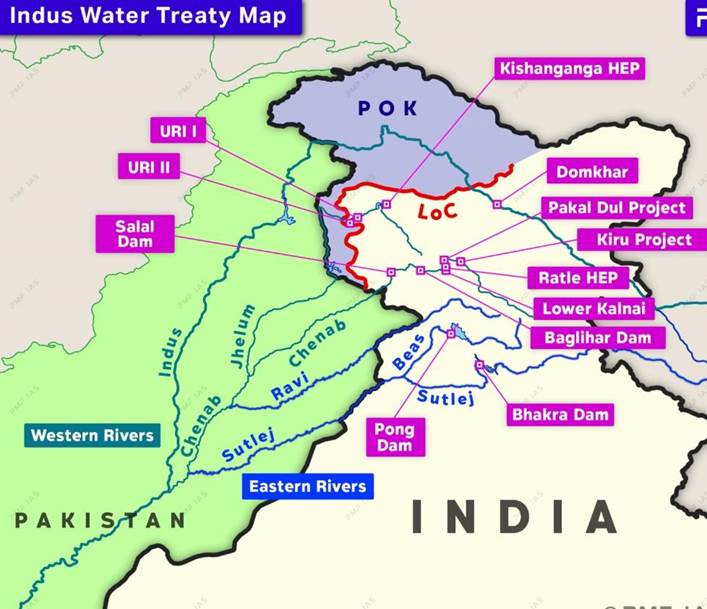
The Indus Waters Treaty, signed on September 19, 1960, between Pakistan and India under World Bank mediation, remains one of the most enduring transboundary water agreements in international legal history. The treaty divided the six rivers of the Indus system into two categories: the three Eastern Rivers, the Ravi, Beas, and Sutlej, were allocated to India, while the three Western Rivers, the Indus, Jhelum, and Chenab, were allocated to Pakistan, with India permitted limited non-consumptive uses for hydroelectric generation and navigation. The treaty also established the Permanent Indus Commission, comprising one commissioner from each country, mandated to meet annually, exchange hydrological data, and resolve disputes through a structured escalation mechanism ranging from bilateral negotiation to neutral expert determination and, ultimately, to arbitration by the Permanent Court of Arbitration. India’s accelerating dam construction on the Western Rivers, its selective compliance with data-sharing obligations, and its increasingly explicit threats to revisit or withdraw from the treaty have exposed the IWT as a framework whose protective capacity for Pakistan is eroding at the very moment when India’s upstream infrastructure and political resolve to exploit it
3. How India’s Upstream Control Threatens Pakistan’s National Security
1- Historical Weaponization: Persistent Threat to Pakistan
India’s deliberate suspension of water flow in 1948, reinforced by Modi’s explicit “Blood and Water” declaration, demonstrates that water has already been wielded as a coercive instrument against Pakistan, establishing a credible and recurring threat to its national security that cannot be dismissed as merely hypothetical.
- 1948 Water Stoppage Exposed Pakistan’s Permanent Riparian Vulnerability:
Initially, India’s upstream control over the Indus River system was first weaponized on April 1, 1948, when India unilaterally suspended water flow to Pakistan barely months after independence. At this point, no legal framework existed to constrain India’s action, meaning it acted on raw geographical power alone. The consequences were immediate; Pakistani agricultural lands dependent on these canals faced severe disruption, exposing how completely Pakistan’s survival was tied to rivers physically controlled by a hostile neighbor. This episode established a dangerous precedent: that upstream dominance could be activated as a political weapon without military deployment and without legal accountability. Therefore, the 1948 water stoppage is not merely a closed historical chapter but a live warning, confirming that geographical asymmetry is itself an enduring and actionable instrument of national insecurity for Pakistan.
- Strategic Water Corrosion: Blood and Water Threat
Similarly, when Prime Minister Modi publicly declared that “blood and water cannot flow together” in the aftermath of the 2016 Uri attack, India crossed a critical threshold by transforming a technical bilateral dispute into an explicit state-level threat. Additionally, the timing of this declaration was particularly alarming; it signaled that Pakistan’s water security is directly hostage to the volatility of the bilateral relationship and that India is prepared to politicize water during moments of political crisis. Crucially, this threat carries strategic weight only because India controls the upstream geography. Without physical dominance over the rivers feeding Pakistan’s economy, such a declaration would be empty rhetoric. Thus, Modi’s statement must be understood not as political posturing but as a deliberate doctrine, one that is operationally credible precisely because India’s upstream position provides the infrastructure to translate it into devastating reality.
2-Pakistan’s Permanent Lower Riparian Status Renders Its Economic and Food Security Contingent Upon Indian Restraint
Additionally, Pakistan’s permanent status as the lower riparian state, a structural reality embedded at Partition through Britain’s allocation of critical headworks to India, renders its agricultural economy, food security, and national survival perpetually contingent upon Indian restraint rather than an enforceable sovereign right.
According to the “Centre for Strategic and International Studies (CSIS):
| INDICATOR | FIGURE |
| Agriculture’s Share of GDP | 25% |
| Share of National Export | 24.4% |
| Labour Force in Agriculture | 37.4% |
| Crop Irrigated by Indus System | 90% |
| Pakistan’s Water Storage Capacity | 94% |
| Pakistan’s water Storage Capacity | 30 Days of River Flow |
- Pakistan’s Economic Dependence on the Indus Basin Makes Any Disruption an Existential Threat
At the same point, Pakistan’s economy is almost entirely built upon the Indus Basin, a river system that sustains approximately 37.4% of the national labour force, irrigates the vast majority of its cultivated land, and underpins 25% of its GDP. This concentration of economic activity along rivers that originate in Indian-controlled territory means that any deliberate reduction in water flow does not constitute a mere economic disruption but an assault on the foundational conditions of national survival. Moreover, a sustained reduction would simultaneously devastate agricultural output, displace millions of rural workers, trigger food price inflation, and strain state institutions well beyond their absorptive capacity. Therefore, unlike conventional military threats that can be deterred through defense investment, this economic vulnerability cannot be meaningfully reduced without restructuring Pakistan’s entire productive economy, a transformation that is neither financially feasible nor politically achievable within any realistic time frame.
- India’s Upstream Control Can Engineer Agricultural Collapse in Pakistan Without Military Action
Moreover, India’s geographical command over the upper reaches of the Indus system grants it the practical capacity to engineer crop failure, food insecurity, and mass displacement in Pakistan without deploying a single soldier, making water control a weapon of strategic destruction far more insidious than conventional military force. Historical precedent from comparable cases confirms that sudden agricultural collapse triggers not only famine but also cascading state instability, mass unemployment, rural displacement, civil unrest, and the erosion of governmental legitimacy, for the reason that 90% of Pakistan’s crops are irrigated by the Indus system, and 94% water is withdrawn for agriculture. India could theoretically produce these consequences through upstream manipulation without attracting the international legal or military accountability that conventional warfare demands. Furthermore, Pakistan possesses no reciprocal lever; it controls no upstream resource upon which India’s population is equally dependent, leaving it with no comparable deterrent and no symmetrical means of strategic response.
3- India’s Deliberate Politicization of the IWT as an Instrument of Strategic Pressure Undermines Pakistan’s Legal and Diplomatic Security
Besides this, India’s calculated conflation of the Indus Waters Treaty with the Kashmir dispute, which is compounded by its exploration of unilateral treaty withdrawal and deliberate concealment of upstream projects, has systematically dismantled the legal architecture upon which Pakistan’s only formal protection against upstream domination rests.
| Action | River | Nature OF Violation |
| Stopped the flow from the Baghlihar Dam | Chenab | Short term punitive action |
| Off-Season Reservoir Flushing | Salal and Baghlihar Projects | Without informing Pakistan: Violating Treaty Provisions |
| Advanced 4 Hydro- Projects | Kashmir Rivers | Exploiting Removal of Treaty-Imposed Constraints |
| Approved Dulhasti Stage II (January 2026) | Chenab | Unilateral Suspension Project Approval |
- India’s Exploration of Unilateral IWT Withdrawal Exposed Pakistan’s Primary Legal Shield
Furthermore, India’s formal establishment of a government review committee to explore unilateral withdrawal from the Indus Waters Treaty exposed Pakistan to the catastrophic prospect of losing the sole binding legal framework that constrains Indian upstream behaviour. Crucially, this was not rhetorical posturing. In particular, Article XII(3) itself says that a treaty can not be ratified unilaterally but by mutual consent only, putting the IWT in abeyance is illegal, and India has no legal basis within the treaty’s own tenet. If India proceeds with withdrawal, Pakistan would be left relying on customary international water law, whose enforcement mechanisms are significantly weaker and whose application to the Indus system remains legally contested. Therefore, India’s exploration of IWT withdrawal represents the most acute legal dimension of its upstream threat, a move that would strip Pakistan of its only formal protection at precisely the moment when India’s upstream infrastructure is most capable of inflicting irreversible harm.
- India’s Linkage of Water Rights to the Kashmir Dispute Converts the IWT into a Tool of Geopolitical Coercion
On the other hand, India’s systematic failure to notify Pakistan of new upstream projects six months before commencement, as unambiguously required under the Indus Waters Treaty, is not a procedural lapse but a deliberate strategy to exploit its upstream position free from legal accountability. Because India sits upstream, by the time Pakistan becomes aware of an undisclosed project through independent observation rather than mandatory notification, the infrastructure is already substantially built and the hydrological reality already altered, rendering legal remedies retrospective rather than preventive. This pattern of non-disclosure also denies Pakistan the ability to compile the evidentiary record necessary for effective international arbitration, since legal challenges require documented proof of treaty violations that Pakistan cannot gather if it is denied timely notification. Thus, India’s concealment of upstream projects ensures that its geographical dominance operates in both the physical and legal dimensions simultaneously.

4- India’s Upstream Dam Construction: Threat to Pakistan’s Water Sovereignty
Likewise, India’s systematic construction of dams on the Western Rivers, most notably the Baglihar and Kishenganga projects, grants it the unilateral technical capacity to manipulate the timing and volume of water entering Pakistan, thereby converting shared treaty-governed rivers into instruments of strategic pressure.
- Baglihar Dam’s Low-Level Outlets Vest India with Operational Capacity to Manipulate Water Flow into Pakistan
In addition, the Baglihar Dam, constructed by India on the Chenab River in Indian-administered Kashmir, incorporates low-level outlets that grant India the operational capability to either withhold water during Pakistan’s critical sowing seasons or release sudden surges capable of triggering downstream flooding. Pakistan formally contested this design feature before the World Bank, but the neutral expert’s ruling permitted the outlets to remain, establishing a legal precedent that effectively validated India’s right to construct upstream infrastructure with direct strategic implications for Pakistan’s water supply. Hence, this outcome confirmed that even the IWT’s own dispute resolution mechanisms are insufficient to neutralize the threat posed by upstream dam construction. The Baglihar case, therefore, stands as conclusive evidence that India’s upstream control constitutes a permanently entrenched national security threat, one that international arbitration has demonstrated it cannot adequately remedy.
- India’s Blueprint to Construct 135 Dams on the Western Rivers Represents a Systematic Erosion of Pakistan’s Treaty-Protected Water Rights
In fact, India’s announced plan to construct 135 dams across the Western Rivers, the three rivers allocated predominantly to Pakistan under the Indus Waters Treaty, represents not an isolated infrastructural ambition but a systematic and cumulative erosion of Pakistan’s treaty-protected water rights. Each additional dam expands the network of chokepoints through which India can regulate, delay, or deny water flows into Pakistan, converting treaty-governed rivers into a managed supply line running through hostile territory. The cumulative effect would grant India’s control over seasonal flows, enabling it to store water during Pakistan’s critical pre-sowing periods and release it during harvests, deliberately disrupting the agricultural calendar upon which Pakistan’s food security depends. Unlike a single dam dispute, a network of 135 upstream structures creates a web so complex that Pakistan’s slow arbitration mechanisms cannot realistically contest each project individually.
- Kishenganga Project’s Inter-Tributary Diversion of the Jhelum River Directly Undermines Pakistan’s Downstream Hydrological Security:
At the same time, the Kishenganga project involves India’s inter-tributary diversion of the Jhelum River, one of the three western rivers exclusively allocated to Pakistan under the Indus Waters Treaty. Because the Jhelum originates in Indian-administered Kashmir before entering Pakistani territory, India’s upstream position grants it the physical ability to reduce the river to a fraction of its natural flow before it even crosses the border. Pakistan challenged this project before the Permanent Court of Arbitration, which, while placing some restrictions on India, nonetheless permitted the project to proceed. This outcome exposed a critical structural gap. The IWT’s legal mechanisms are capable of imposing partial limits but cannot reverse horological consequences once upstream infrastructure is built and operational. Therefore, Kishenganga illustrates precisely how India’s upstream control constitutes a national security threat that geography, engineering, and law combine to make practically irreversible.
4. Suggestions: How Pakistan Can Protect Its National Security From the Threats of Upper Riparian India
- Build Domestic Water Storage Capacity to Reduce Dependence on Real-Time Indian Flow
First of all, Pakistan’s most urgent national security investment is the rapid development of large-scale domestic water storage infrastructure. With a storage capacity of merely 30 days of annual river water, compared to over 900 days in the United States, any upstream manipulation by India translates almost immediately into an agricultural and humanitarian crisis, leaving Pakistan no buffer period to pursue legal or diplomatic remedies. The Dimer-Bhasha Dam must be treated as a national security imperative rather than an infrastructural aspiration, supplemented by distributed provincial storage systems across the Indus Basin. Reducing real-time dependence on Indian-controlled upstream flows fundamentally alters the strategic calculus, transforming Pakistan from a state vulnerable to destabilization within a single agricultural season into one capable of absorbing upstream disruption while mounting an effective legal response.
- Strengthen Pakistan’s Domestic Water Governance
Second, no external diplomatic framework can substitute for disciplined domestic water management. Pakistan currently loses an estimated 40 to 60 percent of its available water through unlined canals, waterlogging, and the absence of modern irrigation technology, a self-inflicted dimension of water insecurity that India need not engineer. Resolving persistent inter-provincial water disputes, particularly between Punjab and Sindh, and establishing a genuinely independent federal water regulatory authority are prerequisites for any coherent national water security strategy. Modernizing irrigation infrastructure through canal lining and precision agriculture would effectively expand Pakistan’s functional water supply without requiring a single additional liter from India. Critically, Pakistan’s credibility in international legal forums will always be proportional to the credibility of its own water stewardship at home.
Conclusion
To summarize, India’s control over the upstream rivers of the Indus system is not a passive geographical reality. It is an active instrument of strategic dominance over a state whose survival depends upon flows it cannot control or legally compel with adequate reliability. The historical record of 1948, the engineering record of Baglihar and Kishenganga, the structural inheritance of Partition, and the deliberate politicization of the IWT collectively confirm that this dominance has been recognized and internationalized as a tool of coercive power. The Indus Waters Treaty alone has proven insufficient to neutralize a threat that is simultaneously physical, legal, and diplomatic. However, through insulated water diplomacy, expanded storage capacity, and reformed domestic governance, Pakistan can progressively reduce the strategic leverage that India’s upstream position currently provides and must begin doing so without further delay.
CSS Solved General Science & Ability Past Papers
Want to read the last ten years’ General Science & Ability Solved Past Papers to learn how to attempt them and to score high? Let’s click on the link below to read them all freely. All past papers have been solved by Pakistan’s top CSS GSA coach having the highest score of their students.
General Science & Ability Solved Past Papers
CSS Solved Pakistan Affairs Past Papers
Want to read the last ten years’ Pakistan Affairs Solved Past Papers to learn how to attempt them and to score high? Let’s click on the link below to read them all freely. All past papers have been solved by Pakistan’s top CSS PA coach having the highest score of their students.
Pakistan Affairs Solved Past Papers