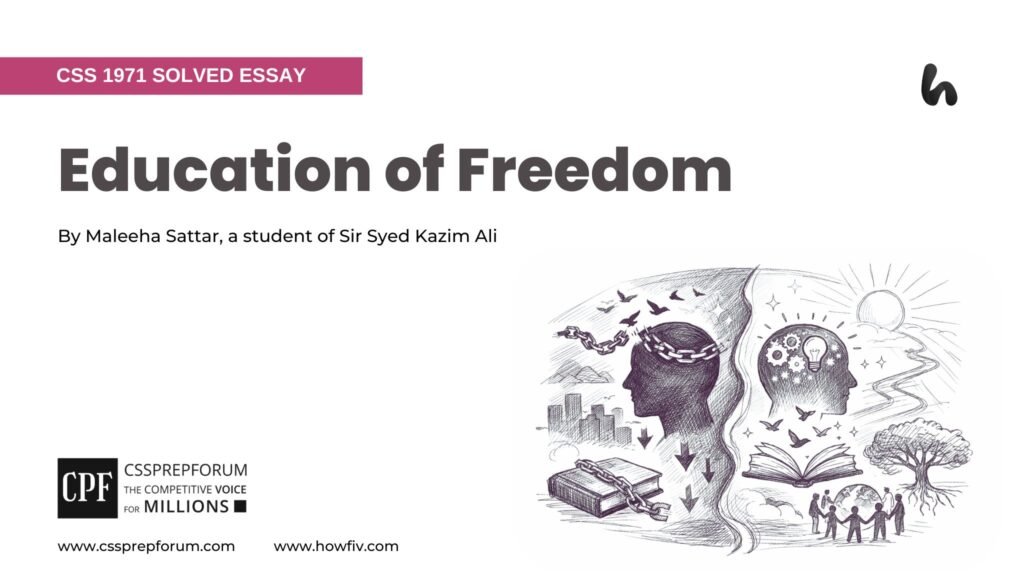
Looking for the CSS 1971 essay “Education of Freedom“. Cssprepforum is Pakistan’s largest community with all CSS past paper essays and CSS solved essays. Continue reading!
Maleeha Sattar, a student of Sir Syed Kazim Ali, has attempted the CSS 1971 essay “Education of Freedom” using Sir Kazim’s proven essay writing pattern and strategy. As Pakistan’s leading CSS and PMS English Essay and Precis coach, Sir Syed Kazim Ali has been the only English mentor with the highest success rate of his students in Essays and Precis for over a decade. The essay is uploaded to help other competitive aspirants learn and practice essay writing techniques and patterns to qualify for the essay paper.

Outline
1-Introduction
While some regard education as a means of transmitting information, securing employment, and maintaining social order, in reality, the true education of freedom lies in liberating individuals intellectually, morally, and socially by cultivating critical thinking, moral responsibility, intellectual independence, creativity, and democratic consciousness, thus enabling them to live as free, enlightened, and responsible members of society.
2-Understanding education, its purpose, and role
3-What is meant by the education of freedom?
- ✓ Education of freedom refers to a form of education that liberates individuals intellectually, morally, and socially.
- ✓ It develops the capacity to think independently, make responsible choices, and live as free and responsible members of society.
- ✓ Unlike mechanical education, it does not produce blind followers but conscious, reflective, and self-aware human beings.
4-Why education must go beyond memorization and obedience
- ✓ Mere accumulation of facts does not guarantee wisdom or freedom.
- ✓ Education that encourages only rote learning and passive obedience creates intellectual dependence.
- ✓ A truly liberating education prepares individuals not only to know but also to understand, question, and act responsibly.
5-Why the education of freedom is essential in modern society?
- ✓ Modern societies demand citizens who can think critically, resist manipulation, and defend justice.
- ✓ In an age of propaganda, misinformation, prejudice, and authoritarian tendencies, education of freedom is necessary for both personal dignity and social progress.
6-On what grounds do opponents argue that education should emphasize discipline and obedience?
- ✓ Counterargument: Education should primarily transmit established knowledge and social discipline to maintain order and stability.
- Refutation: Social order built on blind obedience produces conformity, not wisdom; true stability arises when citizens are guided by understanding and responsibility rather than fear and submission.
- ✓ Counterargument: Too much intellectual freedom in education may encourage rebellion, confusion, and disrespect for authority.
- Refutation: Freedom in education does not mean lawlessness; instead, it teaches individuals to distinguish between legitimate authority and unjust domination, enabling responsible rather than reckless freedom.
7-How does the education of freedom liberate individuals intellectually, morally, and socially?
- ✓ Education develops critical thinking and intellectual independence.
- ✓ Education frees individuals from irrational beliefs and misinformation.
- ✓ Education cultivates ethical reasoning and moral judgment.
- ✓ Education prepares citizens to participate in democratic governance.
- ✓ Education enables individuals to challenge social injustice and inequality.
- ✓ Education nurtures imagination and innovation.
- ✓ Education promotes understanding of diverse cultures and perspectives.
- ✓ Education enables individuals to shape their lives and identities.
8-Case studies proving the claim
- ✓ The Enlightenment Era
- Education and intellectual freedom transforming European societies
- ✓ Post-War Democratic Societies
- Education promoting democratic participation and civic responsibility
9-What measures can be taken to promote an education of freedom?
- ✓ To reform education systems to emphasize critical thinking over rote memorization
- ✓ To introduce civic education and ethical reasoning in curricula
- ✓ To encourage creative and inquiry-based learning environments
- ✓ To promote academic freedom and open intellectual debate
10-Conclusion

Education has long been regarded as a cornerstone of human development and social progress. Traditionally, many societies have treated education as a mechanism for transmitting established knowledge, preparing individuals for employment, and preserving social order through discipline and conformity. From this perspective, education primarily serves to maintain stability by producing individuals who follow existing norms and authority. However, such a narrow understanding of education overlooks its deeper transformative potential. Education is not merely the accumulation of information nor the mechanical reproduction of accepted ideas. Instead, its higher purpose lies in cultivating the intellectual, moral, and social capacities that enable individuals to think independently, act responsibly, and participate meaningfully in society. This broader vision is displayed in the concept of education of freedom, an approach to learning that liberates the human mind from ignorance, prejudice, and blind obedience. In the modern world, where societies face challenges, such as misinformation, ideological manipulation, and authoritarian tendencies, the importance of liberating education becomes even more pronounced. Undoubtedly, by encouraging inquiry, critical reasoning, ethical reflection, and openness to diverse perspectives, education of freedom transforms individuals from passive recipients of knowledge into active and responsible citizens. This essay analytically argues how the education of freedom liberates individuals intellectually, morally, and socially.
Before understanding the meaning of education of freedom, comprehending what education truly means and what role it plays in human development is essential. In its broader sense, education is not simply the transmission of information from teacher to student; however, it is a transformative process through which individuals acquire knowledge, develop intellectual abilities, and shape their moral character. Additionally, the primary purpose of education is to cultivate the human mind so that individuals can think rationally, evaluate ideas critically, and act responsibly in society. Moreover, education plays a vital role in preparing individuals to understand their social environment, participate constructively in community life, and contribute to collective progress. Thus, when education fulfills this purpose, it becomes a powerful instrument for personal growth and social advancement.
Speaking specifically, education of freedom is a form of learning that liberates individuals intellectually, morally, and socially by developing their capacity to think independently and act responsibly. Instead of producing passive recipients of information, it cultivates reflective, self-aware individuals capable of questioning assumptions and forming reasoned judgments. Such education encourages learners to understand ideas, not just memorize them, and to evaluate authority, not merely accept it blindly. Moreover, it nurtures a sense of responsibility in individuals, enabling them to exercise their freedom in ways that respect justice, truth, and the welfare of others. Thus, education of freedom not only equips individuals with knowledge but also shapes free-minded citizens who possess the intellectual courage and moral awareness necessary to live as responsible members of society.
Building upon this understanding, it becomes clear why education must extend beyond memorization and passive obedience. Indeed, the mere accumulation of facts does not guarantee wisdom, independence, or responsible citizenship. Undeniably, educational systems that emphasize rote learning often train students to reproduce information without understanding its meaning or implications. As a result, individuals may become intellectually dependent on authority, lacking the confidence and ability to question ideas or challenge misinformation. In contrast, a truly liberating education encourages learners to analyze, interpret, and critically evaluate knowledge. It teaches them not only what to think but also how to think. And by fostering curiosity, inquiry, and reflection, such education enables individuals to develop intellectual autonomy and responsible judgment. Therefore, education that goes beyond memorization and obedience becomes a powerful means of empowering individuals to understand reality, resist manipulation, and participate thoughtfully in society.
Having established the importance of liberating education, considering the arguments presented by its critics is also necessary. Opponents often contend that the primary purpose of education should be the transmission of established knowledge and the cultivation of discipline to maintain social stability. From this perspective, excessive intellectual freedom in classrooms may encourage questioning of authority, potentially weakening respect for institutions and social order. However, such a view overlooks the fact that stability founded on blind obedience is fragile and unsustainable. For instance, the political philosopher, John Stuart Mill, argued in “On Liberty” that societies that discourage independent thought risk intellectual stagnation and moral decline. This insight suggests that genuine social stability arises not from unquestioning conformity but from citizens who understand laws, evaluate policies critically, and act responsibly. Therefore, education must balance discipline with intellectual freedom instead of suppressing independent thinking altogether.
Furthermore, critics also argue that excessive intellectual freedom in education may lead to rebellion, confusion, and disrespect for authority. According to this view, students who are encouraged to question established norms and institutions may reject discipline and challenge legitimate authority, creating instability within society. Nevertheless, this concern arises from a misunderstanding of what freedom in education actually entails. Education of freedom does not promote lawlessness or reckless defiance; instead, it teaches individuals to differentiate between legitimate authority and unjust domination. To elaborate, the philosopher Paulo Freire, in “Pedagogy of the Oppressed,” argued that liberating education develops individuals’ critical consciousness, enabling them to understand social realities and act responsibly to improve them. Thus, intellectual freedom in education does not weaken society but strengthens it by producing thoughtful citizens capable of exercising freedom responsibly and with moral awareness.
After addressing the objections, examining how the education of freedom actually liberates individuals is essential. First and foremost, liberating education develops critical thinking and intellectual independence in individuals. Instead of merely accepting information presented by authority, individuals learn to analyze arguments, evaluate evidence, and form reasoned conclusions. This ability allows them to distinguish truth from falsehood and resist manipulation by propaganda or misinformation. For example, the educational psychologist Jean Piaget emphasized that true education enables learners to discover knowledge independently instead of passively absorbing it from teachers. And his theory of cognitive development highlights that intellectual growth occurs when individuals actively question and interpret their environment. Therefore, by encouraging inquiry and reflection, education of freedom transforms learners from passive recipients of information into independent thinkers capable of making informed judgments about the world around them.
In addition, education of freedom liberates individuals from irrational beliefs, superstition, and misinformation. Throughout history, ignorance and lack of knowledge have often allowed false ideas and prejudices to dominate societies. When individuals are not trained to evaluate evidence or question inherited assumptions, they may accept misleading narratives as unquestionable truth. But liberating education challenges this condition by encouraging rational inquiry, scientific thinking, and open discussion in individuals. To validate this point, Philosopher Immanuel Kant famously described enlightenment as humanity’s emergence from self-imposed immaturity, emphasizing that individuals must use their reason to overcome ignorance and blind belief. This perspective emphasizes the role of education in freeing the human mind from intellectual dependence. Therefore, education of freedom empowers individuals to reject misinformation, embrace evidence-based reasoning, and develop a clearer understanding of the realities shaping their lives.
Furthermore, the education of freedom also nurtures ethical reasoning and moral judgment in individuals. Indeed, true freedom cannot exist without a moral framework that guides individuals in using their liberty responsibly. Within this framework, an education that develops moral awareness enables individuals to reflect on questions of justice, fairness, and human dignity rather than simply following rules imposed by authority. Moreover, through exposure to ethical debates, philosophical ideas, and social realities, learners begin to understand the consequences of their actions on others and on society as a whole. According to Lawrence Kohlberg’s theory of moral development, “Education plays a vital role in advancing individuals through higher stages of moral reasoning, where decisions are guided by universal ethical principles rather than blind obedience.” Therefore, the education of freedom shapes individuals who not only think independently but also act with integrity, responsibility, and respect for others’ rights.
Next, the education of freedom prepares individuals to participate responsibly in democratic governance. In fact, democratic societies depend on citizens who can understand public issues, evaluate political arguments, and make informed decisions about leadership and policy. Without such awareness, democratic systems may become vulnerable to manipulation, populism, and authoritarian tendencies. From this perspective, liberating education equips individuals with civic knowledge, analytical skills, and a sense of public responsibility, enabling them to engage actively in political and social life. According to the United Nations Educational, Scientific, and Cultural Organization’s (UNESCO) report on ‘Global Citizenship Education’, countries that emphasize civic education and critical thinking in their educational systems tend to exhibit higher levels of democratic participation and political awareness among citizens. Thus, the education of freedom strengthens nations’ democratic institutions by cultivating informed and responsible citizens who can safeguard their justice, accountability, and the rule of law.
Moreover, the education of freedom empowers individuals to recognize and challenge social injustice and inequality. Truly, societies often contain structures of discrimination based on class, race, gender, or religion, which may persist when people lack the awareness or courage to question them. In this respect, a liberating education encourages individuals to examine these inequalities critically and advocate for fairness and human dignity. By exposing learners to historical struggles for justice and contemporary social issues, education nurtures empathy, courage, and a commitment to equality among them. For illustration, Nelson Mandela famously stated, “Education is the most powerful weapon which you can use to change the world”, reflecting his belief that education enabled oppressed communities in South Africa to challenge Apartheid and fight for equality. Thus, the education of freedom becomes a powerful force for social transformation by empowering individuals to confront injustice and work toward a more equitable society.
Besides, the education of freedom also nurtures imagination and innovation in individuals. When education encourages questioning, creativity, and exploration, individuals develop the ability to generate new ideas and solutions to complex problems. Conversely, rigid systems of rote learning often suppress curiosity and discourage experimentation, limiting intellectual growth. But liberating education creates an environment where learners feel confident to question assumptions, explore possibilities, and express original ideas. According to the World Economic Forum’s ‘Future of Jobs’ Report (2023), creativity, critical thinking, and problem-solving are among the most essential skills required for modern innovation and economic development. Hence, education that promotes intellectual freedom not only liberates the human mind but also enables individuals to contribute creatively to scientific progress, technological advancement, and social development.
Equally important, the education of freedom fosters in individuals a deep understanding of and respect for diverse cultures, beliefs, and perspectives, preparing them to engage constructively in an increasingly interconnected world. However, without education that cultivates openness and empathy, such diversity may lead to misunderstanding, prejudice, and conflict, which a liberating education can counter by exposing learners to multiple viewpoints and encouraging dialogue, helping them appreciate differences while recognizing shared human values. For example, UNESCO’s ‘Global Citizenship Education’ study in 2021 found that students exposed to multicultural and inclusive curricula exhibit higher levels of tolerance, empathy, and cross-cultural cooperation. Therefore, the education of freedom not only broadens individuals’ intellectual horizons but also cultivates a spirit of mutual respect and peaceful coexistence among diverse communities.
Finally, education of freedom empowers individuals to shape their lives and identities with confidence and self-awareness. When individuals possess knowledge, critical thinking skills, and moral clarity, they can make informed choices about their careers, beliefs, and personal aspirations. Nonetheless, individuals who lack liberating education often remain constrained by social pressures, inherited prejudices, or limited opportunities. So, education that promotes intellectual independence enables people to understand their abilities, define their goals, and pursue meaningful paths in life. According to the United Nations Development Programme’s (UNDP) Human Development Report, education significantly expands individuals’ capabilities by increasing their freedom to choose the kind of life they value. Therefore, education of freedom not only enriches the human mind but also empowers individuals to live authentically, make responsible decisions, and contribute constructively to society.
Stepping ahead, the Enlightenment era provides a powerful historical example of the liberating power of education. During this period, the spread of education, scientific inquiry, and philosophical debate transformed European societies by encouraging individuals to question traditional authority and dogmatic beliefs. For instance, thinkers such as Voltaire, John Locke, and Immanuel Kant promoted reason, critical inquiry, and intellectual independence as the foundations of human progress. Moreover, historians widely acknowledge that Enlightenment ideas about education, reason, and liberty directly influenced major political transformations, such as the American and French Revolutions, which emphasized rights, equality, and democratic governance. Thus, this historical experience proves that when education liberates the human mind from ignorance and blind authority, it empowers societies to pursue justice, freedom, and institutional reform.
Similarly, the development of post-war democratic societies after the Second World War is another example validating this case. Undeniably, to prevent the re-emergence of authoritarianism, educational reforms were introduced at that time to promote civic awareness, democratic values, and critical thinking. Specifically, schools began to emphasize human rights education, civic responsibility, and open intellectual debate as essential components of democratic life. According to the Organisation for Economic Co-operation and Development’s (OECD) ‘Education and Civic Engagement’ Report (2018), countries that integrate civic education and democratic values into their curricula tend to exhibit higher levels of political participation and trust in democratic institutions. Therefore, education of freedom not only strengthens individual autonomy but also contributes to the development of stable, responsible, and participatory democratic societies.
Moving forward, to cultivate an education of freedom, the first and foremost step is to reform education systems to emphasize critical thinking over rote memorization. Traditionally, education often focuses on the passive acquisition of facts, which limits students’ ability to analyze, evaluate, and synthesize information. By shifting this focus, students should be able to question assumptions, solve problems independently, and approach challenges with inferential judgment. To achieve this, such reforms should include interactive teaching methods, problem-based learning, and assessments that prioritize understanding over memorization. Thus, cultivating critical thinking should empower learners to make informed decisions and participate meaningfully in society.
Second, civic education and ethical reasoning should be integrated into school curricula at all levels. Specifically, students should be taught the principles of justice, human rights, and democratic participation, enabling them to understand their role as responsible citizens. For this purpose, ethical reasoning should encourage individuals to evaluate moral dilemmas, reflect on consequences, and act with integrity. Moreover, education systems should ensure that these subjects are not mere theoretical concepts but are actively applied through discussions, debates, and real-life case studies. Hence, this approach should nurture socially conscious individuals who can contribute positively to their communities.
Third, schools should foster creative, inquiry-based learning environments that encourage curiosity, imagination, and experimentation. It means students should be empowered to explore topics of interest, ask meaningful questions, and develop innovative solutions to problems. These inquiry-driven approaches would foster independent thinking and intellectual confidence in them. Accordingly, teachers should act as facilitators rather than sole knowledge providers, guiding students through exploration and discovery. Thus, such environments would prepare learners to adapt to changing circumstances, think critically, and contribute innovatively to both academic and real-world challenges.
Lastly, academic freedom and open intellectual debate should be actively promoted within educational institutions. In particular, students should feel free to express their ideas, question prevailing opinions, and engage in respectful dialogue without fear of censorship or retribution. Similarly, faculty members should be encouraged to explore diverse perspectives and teach multiple viewpoints. And institutions should ensure that policies and practices support intellectual independence. In this way, this freedom should cultivate an atmosphere in which critical thinking, creativity, and moral reasoning thrive, thus shaping individuals who can challenge dogma, advocate for justice, and participate responsibly in democratic societies.
In conclusion, an education of freedom is essential for the intellectual, moral, and social liberation of individuals. Verily, true education not only transfers information or trains individuals for employment but also cultivates critical thinking, intellectual independence, and ethical responsibility. Through such education, individuals learn to question misinformation, challenge injustice, respect diverse perspectives, and participate responsibly in democratic life. As discussed, an education of freedom produces independent thinkers, ethically attuned citizens, and socially conscious individuals capable of shaping their identities and contributing constructively to society. Therefore, educational systems must move beyond rote memorization and passive obedience to foster inquiry, creativity, civic literacy, and open intellectual discourse as only such education cultivates free minds and responsible citizens capable of achieving genuine progress, justice, and human dignity.
CSS 1971 Solved Essays!
Interested in learning all the CSS 1971 Solved Essays? Click on any to continue reading. Each essay is meticulously attempted by Sir Syed Kazim Ali’s students, who have either qualified for CSS or PMS or secured the highest marks in the essay paper.

| 1- Man as Part of a Design infinitely Vaster than Himself |
| 2- Knowledge demands Love as its Complement |
| 3- The Amusement Mania |
| 4- The Art of Feature Films made in Pakistan |
| 5- Art and Religion |
| 6- Education of Freedom |
| 7- Brain-washing |
| 8- The Lessons of the Past |
| 9- Requisites for Social Progress in Pakistan |
| 10- How Words change Our Lives? |
| 11- Man is condemned to be Free |
| 12- Leaders and Followers |

CSS Solved Past Papers’ Essays
Looking for the last ten years of CSS and PMS Solved Essays and want to know how Sir Kazim’s students write and score the highest marks in the essays’ papers? Then, click on the CSS Solved Essays to start reading them.
CSS Solved Essays
CSS Solved General Science & Ability Past Papers
Want to read the last ten years’ General Science & Ability Solved Past Papers to learn how to attempt them and to score high? Let’s click on the link below to read them all freely. All past papers have been solved by Miss Iqra Ali & Sir Ammar Hashmi, Pakistan’s top CSS GSA coach having the highest score of their students.