Looking for the CSS 2002 essay “World Scenario in 21st Century and Pakistan’s Role in It“ Cssprepforum is Pakistan’s largest community with all CSS past paper essays and CSS solved essays. Continue reading!
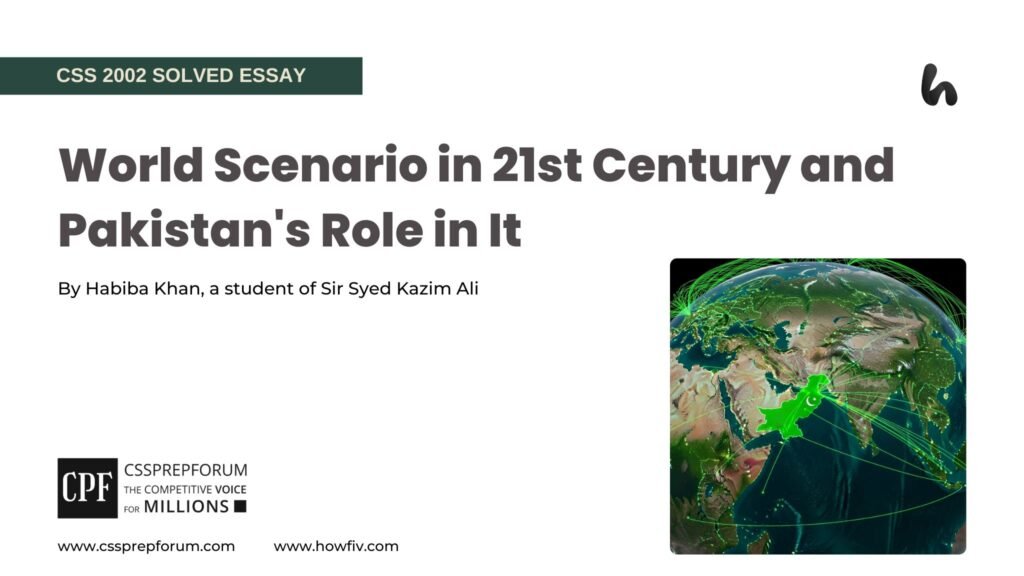
Habiba Khan, a student of Sir Syed Kazim Ali, has attempted the CSS 2002 essay “World Scenario in 21st Century and Pakistan’s Role in It” using Sir Kazim’s proven essay writing pattern and strategy. As Pakistan’s leading CSS and PMS English Essay and Precis coach, Sir Syed Kazim Ali has been the only English mentor with the highest success rate of his students in Essays and Precis for over a decade. The essay is uploaded to help other competitive aspirants learn and practice essay writing techniques and patterns to qualify for the essay paper.

Outline
1-Introduction
Although critics argue that the dominance of global powers, such as the United States, China, and the European Union, limits Pakistan’s ability to influence regional and international affairs, the evolving multipolar world order has in reality expanded Pakistan’s strategic relevance, enabling it to play a significant role in global connectivity, regional stability, counterterrorism, climate diplomacy, and emerging economic and technological domains.
2-Transformation of Global Power Dynamics in the 21st Century
3-Emergence of Multipolarity and Shifting Strategic Alliances
4-Geopolitical and Economic Importance of South Asia in Global Affairs
5-Pakistan’s Strategic Relevance in Regional Stability, Trade, and Counterterrorism
6-How Pakistan Plays a Decisive Role in Shaping the 21st Century World Scenario?
6.1-Geopolitical Role
- ✓Harnessing Pakistan’s Geographical Location
- Case in Point: The World Bank highlighting that Gwadar Port situated on Pakistan’s southwestern coast near the Strait of Hormuz
- ✓Balancing Global Powers
- Case in Point: Al Jazeera reported thatPakistan simultaneously pursues BRICS+ membership (a bloc favored by China and Russia) while continuing to engage with the US-supported IMF.
6.2-Economic Role
- ✓Advancing Trade and Prosperity through CPEC
- Case in Point: According to the National Highway Authority (NHA), the upgraded Karakoram Highway deepening Pakistan-China connectivity, supporting trans-regional movements of goods and people
- ✓Strengthening Regional Economic Cooperation
- Case in Point: Pakistan, a founding member of ECO and a full member of the SCO since 2017
6.3-Socio-Technological Role
- ✓Promoting Digital Integration and Innovation
- Case in Point: The World Bank reported thatPakistan’s IT and IT-enabled Services (ITeS) exports have exceeded $3.5 billion in FY2024, reflecting strong global engagement in fields, such as software development, fintech, and artificial intelligence.
- ✓Enhancing Global Influence through Soft Power and Diaspora
- Case in Point: According to the State Bank of Pakistan, the overseas Pakistani community and figures like London’s Mayor Sadiq Khan enhance Pakistan’s global image, strengthening its soft power in the 21st-century world.
6.4-Environmental Role
- ✓Leading Global Climate Diplomacy and Environmental Advocacy
- Case in Point: According to the United Nations Framework Convention on Climate Change (UNFCCC) in 2024, Pakistan secured a governance seat on the Loss and Damage Fund Board, ensuring its continued leadership in shaping climate finance policies for vulnerable nations.
- ✓Fostering Green Initiatives and Sustainable Development
- Case in Point: According to the Ministry of Climate Change (2024), Pakistan signed a framework with the Global Green Growth Institute (GGGI) at COP29 to mobilize green finance and implement its climate goals in the waste and water sectors.
7-On what basis do critics claim that Pakistan has a limited influence in the 21st-century world scenario?
- ✓Counterargument: Major global powers, such as the USA, China, and the EU, dominate the world scenario in the 21st century, limiting Pakistan’s influence in regional and global affairs.
- Refutation: Although major global powers largely influence global affairs, Pakistan continues to play an active role through its active participation in the OIC, SCO, and UN, as well as its mediation in the Afghan peace process, demonstrating an independent voice in global governance.
- Evidence: According to the OIC, Pakistan leads key Contact Groups on Jammu & Kashmir, Palestine, and Islamophobia and has tabled related resolutions at the UN.
- Refutation: Although major global powers largely influence global affairs, Pakistan continues to play an active role through its active participation in the OIC, SCO, and UN, as well as its mediation in the Afghan peace process, demonstrating an independent voice in global governance.
- ✓Counterargument: Persistent political instability limits Pakistan’s role in the 21st-century world scenario.
- Refutation: Despite internal instability, Pakistan is gradually shifting toward sustainable economic revival and structural reforms.
- Evidence: The Asian Development Bank (2024) notes that Pakistan’s industrial expansion and renewable energy projects under CPEC are enhancing productivity and trade capacity while digital economy initiatives are integrating Pakistan into the broader 21st-century global market.
- Refutation: Despite internal instability, Pakistan is gradually shifting toward sustainable economic revival and structural reforms.
8-Future outlook for Pakistan in the 21st-century world
- ✓To ensure political stability and a consistent foreign policy
- ✓To strengthen economic foundations through regional integration
- ✓To invest in digital transformation and innovation
- ✓To project soft power through culture and diaspora
9-Conclusion
The twenty-first century marks a transformative period in global politics, defined by shifting power centers, evolving alliances, and emerging economic and technological realities. As the world transitions from a unipolar to an increasingly multipolar order, states now operate within a system shaped not by a single hegemon but by a constellation of influential actors whose interests intersect across regions. In particular, South Asia has assumed remarkable strategic importance due to its nuclear states, rapidly expanding markets, and critical trade corridors connecting the Middle East, Central Asia, and East Asia. Within this complex geopolitical landscape, Pakistan stands as a pivotal actor whose relevance extends far beyond its borders. Despite assertions that global superpowers overshadow Pakistan’s influence, the country continues to shape regional and international affairs through its unique geographic position, expanding economic partnerships, active diplomatic engagement, and contributions to global security and climate advocacy. From facilitating trade and connectivity through the China-Pakistan Economic Corridor to playing a central role in counterterrorism, peace negotiations, climate resilience, and digital innovation, Pakistan remains an important stakeholder in the evolving 21st-century world scenario. This essay examines how Pakistan’s geopolitical, economic, socio-technological, and environmental roles contribute to shaping global dynamics and assesses its potential to strengthen its influence in the years ahead.
Before exploring the topic, it is necessary first to examine how power dynamics have transformed worldwide. After the Cold War, the United States emerged as a major global power, shaping the rules of the international political and economic order. However, countries like China, Russia, and the European Union (EU) have now emerged as key players. China’s swift economic growth and technological innovations undermine the US’s supremacy. Similarly, Russia has regained prominence through active military and diplomatic influence. Meanwhile, the EU strengthens its presence through trade and institutional power. This spread of power has increased competition, nurtured cooperation, and intensified negotiation among states in areas, such as defense, trade, and digital advancement.
After examining the transformation of global power dynamics in the 21st century, it is equally important to analyze the emergence of multipolarity and shifting alliances. Over time, the globe has evolved through technological advances and humanity’s ongoing struggle for power, peace, and progress. From ancient empires and colonial expansion to industrial and technological revolutions, each era has redefined the distribution of power and shaped the nature of global relations. Before the 21st century, the world was divided into two superpowers, the United States of America (USA) and the Union of Soviet Socialist Republics (USSR). Moreover, the collapse of the Soviet Union led to the rise of a unipolar world under US dominance. However, the 21st century has moved toward multipolarity as emerging powers, such as China, Russia, and the European Union, increasingly challenge Western hegemony. This shift is reinforced by economic interdependence, rapid technological progress, and shared global issues, such as climate change, pandemics, and digital insecurity, which collectively influence how states align and cooperate.
Similarly, exploring South Asia’s significant geopolitical and economic importance in the contemporary world is widely essential. In fact, the region links major strategic zones, including the Middle East, Central Asia, and East Asia, making it vital for global trade and energy routes. It consists of two nuclear powers, India and Pakistan, placing it at the center of global security concerns. Furthermore, the China-Pakistan Economic Corridor (CPEC) enhances regional connectivity by linking China to the Arabian Sea, boosting trade, infrastructure development, and economic integration. Additionally, the Indian Ocean provides crucial sea lanes for global energy transportation. Therefore, South Asian developments directly influence international political dynamics, security stability, and economic interests.
Moving ahead, to understand Pakistan’s role in the 21st-century world, it is essential to explore its geography, which connects South Asia, the Middle East, and Central Asia, giving it a vital role in regional geopolitics. Pakistan supports global trade, energy movement, and infrastructure development through Gwadar Port and CPEC, which link China to the Arabian Sea. Furthermore, Pakistan has contributed to counterterrorism efforts, especially through its participation in fighting extremist networks. Additionally, it has contributed diplomatically to significant negotiations, such as the Afghan peace talks and limited back-channel engagements related to Israel-Palestine dialogues. And Pakistan’s participation in regional platforms such as the SCO and OIC further strengthens its diplomatic presence. Thus, its young population and emerging markets add economic potential to the region.
Taking an overview of Pakistan’s role in shaping the 21st-century world, its geographical location is a key factor, given its unique position at the geopolitical nexus of South Asia, Central Asia, the Middle East, and China. Moreover, Pakistan connects the energy-rich Middle East with the rapidly growing economies of Asia. For instance, the World Bank notes that Gwadar Port, located on Pakistan’s southwestern coast near the Strait of Hormuz, is strategically important for regional connectivity and maritime trade, linking the Persian Gulf with Central Asia. This shows that Pakistan’s geographical position enables it to serve as a trade and energy corridor, fostering economic interdependence and enhancing its relevance in the modern world. Thus, Pakistan’s unique location makes it an essential bridge between energy-rich countries and fast-growing economies, helping to promote trade, regional connectivity, and global cooperation in the 21st-century world.
In addition, Pakistan plays a vital role in balancing global powers due to its strategic location and pragmatic foreign policies. It maintains close economic ties with China through the China-Pakistan Economic Corridor (CPEC) while cooperating with the United States in defense and counterterrorism. For example, according to Al Jazeera, Pakistan has simultaneously sought BRICS+ membership, an alliance favored by China and Russia, while continuing to engage with the US-supported IMF. This dual engagement shows Pakistan’s diplomatic ability to maintain relations with both the Eastern and Western blocs, avoiding dependence on any single power and maintaining security and economic cooperation with the West and the US-supported IMF. Thus, Pakistan acts as a bridge between rival global players, contributing to a more balanced and multipolar world order.
Further, Pakistan’s economic role in the 21st century is strongly defined by the China-Pakistan Economic Corridor, a gateway to regional trade and connectivity. CPEC is a major part of China’s Belt and Road Initiative (BRI) and includes projects, such as railways, the Karakoram Highway, energy plants, and special economic zones. This is evident from the 2024 report by the National Highway Authority, which highlights that the upgraded Karakoram Highway has deepened the Pakistan-China connectivity, supporting trans-regional movements of goods and people. Undoubtedly, this highway is a vital link between China and Pakistan. By improving this route, Pakistan not only strengthens bilateral trade with China but also positions itself as a central hub for regional connectivity, linking South Asia with Central Asia and beyond. Hence, through CPEC and the upgraded Karakoram Highway, Pakistan boosts its economic significance in the 21st century.
Moreover, regional economic cooperation has become an essential pillar of Pakistan’s foreign and economic policy, enabling it to enhance trade, connectivity, and development within South Asia, Central Asia, and beyond. Furthermore, Pakistan’s participation in SAARC, though limited due to India-Pak tensions, reflects its intent to support South Asian cooperation. To illustrate, Pakistan is a founding member of the Economic Cooperation Organization (ECO) and a full member of the Shanghai Cooperation Organisation (SCO) since 2017. This aims to foster trade and economic collaboration with regional partners. Therefore, Pakistan’s regional economic cooperation initiatives not only strengthen its economic profile but also position it as a connector state in 21st-century regional integration.
Additionally, in the 21st-century global landscape, where technological innovation and digital connectivity define progress, Pakistan is emerging as a socio-technological actor. By integrating technology into governance, education, and communication sectors, Pakistan seeks not only economic advancement but also social empowerment through digital inclusion. This is evident in the World Bank report, which notes that Pakistan’s IT and IT-enabled Services (ITeS) exports have crossed $3.5 billion in FY2024, reflecting strong global engagement in fields, such as software development, fintech, and artificial intelligence. This transformation has enabled Pakistan to participate more actively in the global digital economy, a major driver of modern globalization, hence proving that Pakistan also plays a role in shaping the world’s digital future.
Another important factor behind Pakistan’s growing influence in the 21st century is its ability to project soft power and leverage its global diaspora, enhancing its image through culture, values, and diplomacy. These elements of cultural diplomacy are essential not only for projecting a positive identity but also for improving Pakistan’s soft image through Coke Studio’s fusion of traditional and modern music, the global popularity of Pakistani dramas, and the successful hosting of international cricket through the Pakistan Super League (PSL). In addition, Pakistan’s vast diaspora of over nine million people living across the globe plays a key role in strengthening this image. According to the State Bank of Pakistan, the overseas Pakistani community and figures like London’s Mayor Sadiq Khan enhance Pakistan’s global image, strengthening its soft power in the 21st-century world. Collectively, these culture and diaspora-driven contributions promote peace, understanding, and cooperation in the international community. Therefore, enabling Pakistan to play a decisive role in shaping the moral and cultural dimensions of the 21st-century world order.
Furthermore, in the 21st century, where climate change has emerged as a defining global crisis, Pakistan has assumed an increasingly decisive role in shaping the international environmental agenda through climate diplomacy and global advocacy. Undeniably, Pakistan’s leadership in climate diplomacy stems from its exposure to the devastating impacts of climate change. It is ranked among the 10th most climate-vulnerable countries by the Global Climate Risk Index. Pakistan faces severe flooding, glacier melting, droughts, and rising temperatures. According to the United Nations Framework Convention on Climate Change (UNFCCC) (2024), Pakistan secured a governance seat on the Loss and Damage Fund Board, ensuring its continued leadership in shaping climate finance policies for vulnerable nations. This highlights that Pakistan has been active in framing global environmental narratives that emphasize equity, responsibility, and resilience. Therefore, Pakistan’s leadership in global climate diplomacy reflects its transition into a moral and strategic power in environmental advocacy.
Last but not least, Pakistan demonstrates a strong domestic commitment to sustainable development through green initiatives that balance environmental preservation with economic growth. Pakistan has launched several large-scale projects that promote renewable energy, forest restoration, and eco-friendly infrastructure. These efforts show benefits to people without degrading natural resources. According to the Ministry of Climate Change (2024), Pakistan signed a framework with GGGI at COP29 to mobilize green finance and implement its climate goals in the waste and water sectors. This evidently clarifies Pakistan’s commitment to sustainable development, growing its economy without harming the environment, thus contributing to shaping a greener, more sustainable world in the 21st century.
Going down the ladder, as every coin has two sides, some opponents claim that the 21st-century world is dominated by superpowers, such as the USA, China, and the EU, leaving the third-world countries like Pakistan with limited influence over major decisions. Although superpowers largely influence global affairs, Pakistan continues to play an active role through its active participation in the OIC, SCO, and UN, as well as its mediation in the Afghan peace process, indicating an independent voice in global governance. According to the OIC, Pakistan leads key Contact Groups on Jammu and Kashmir, Palestine, and Islamophobia, and has tabled related resolutions at the UN. This highlights Pakistan’s active diplomatic role in addressing global and Islamic issues through multilateral cooperation. Thus, it shows Pakistan’s active role in global affairs beyond superpower dominance.
Furthermore, contenders also argued that persistent political instability has limited Pakistan’s role in the 21st-century world scenario. They claim that the country’s frequent changes in government, weak democratic institutions, and power struggles have prevented it from creating stable policies and long-term plans. Therefore, inconsistent governance has often weakened Pakistan’s ability to maintain sustained regional and global strategies. However, despite internal instability, Pakistan is gradually shifting toward sustainable economic revival and structural reforms. For instance, the Asian Development Bank (2024) notes that Pakistan’s industrial expansion and renewable energy projects under CPEC are enhancing productivity and trade capacity while digital economy initiatives are integrating Pakistan into the broader 21st-century global market. These developments show that in the face of political challenges, Pakistan continues to strengthen its economic foundation and global connectivity through consistent progress in industrial and digital sectors. Thus, political instability remains a hurdle, but Pakistan’s reform and diversification demonstrate its resilience and growing global relevance.
Stepping forward to the suggestions, Pakistan should prioritize political stability and a consistent foreign policy as both are essential to the country’s long-term progress and global credibility. Moreover, a stable political environment attracts the country’s investment, strengthens its institutions, and ensures the continuity of its national policies. Furthermore, Pakistan should promote transparent governance and effective decision-making, which collectively enhance the country’s international standing. Additionally, Pakistan should reduce internal polarization to enable the government to implement reforms smoothly. Hence, by sustaining stability and maintaining a clear diplomatic direction, Pakistan should position itself as a reliable global partner and secure steady development in the 21st century.
Second, Pakistan should reinforce its economic foundations through deeper regional integration. Specifically, the country should expand trade and connectivity under frameworks, such as ECO and CPEC, which promote mutual growth and cooperation. Moreover, strengthened regional linkages should open new markets, diversify Pakistan’s economic opportunities, and reduce external vulnerabilities. Likewise, Pakistan should improve its infrastructure and regulatory mechanisms to attract investment and solidify regional partnerships. Thus, by advancing interdependence and shared development with neighboring states, Pakistan should achieve sustainable economic stability and emerge as a pivotal economic bridge in the 21st-century world.
Finally, Pakistan should elevate its global profile by projecting soft power through culture, values, and the strength of the country’s diaspora. To do so, Pakistan should invest in cultural diplomacy, creative industries, and international outreach to present a positive national image. Moreover, engaging the overseas Pakistani community should strengthen its people-to-people connections and expand global goodwill. Likewise, highlighting the country’s cultural heritage, tourism potential, and artistic achievements should attract partnerships and extend its influence. Thus, by prioritizing soft-power strategies and diaspora-led initiatives, Pakistan should enhance its international standing and secure broader opportunities for progress in the 21st century.
In conclusion, Pakistan plays a pivotal role in regional and global affairs by promoting trade, ensuring stability, and advancing economic connectivity through initiatives, such as CPEC and the Karakoram Highway. Owing to its unique geostrategic location, the country is a vital bridge between energy-rich regions and fast-growing markets. Moreover, Pakistan strengthens global balance by encouraging dialogue among major powers, supporting counterterrorism efforts, and projecting soft power through socio-technological engagement. Overall, Pakistan’s regional cooperation initiatives enhance its economic profile, expand its strategic relevance, and position the country as a key connector in an increasingly interdependent and multipolar world.
CSS 2002 Solved Essays!
Interested in learning all the CSS 2002 Solved Essays? Click on any to continue reading. Each essay is meticulously attempted by Sir Syed Kazim Ali’s students, who have either qualified for CSS or PMS or secured the highest marks in the essay paper.
| 1- World Scenario in 21st Century and Pakistan’s Role in It |
| 2- International Crisis in Terrorism |
| 3-“Every Art is an Imitation of Nature”. |
| 4- Higher Science Education in the Developing Countries |
| 5- Austerity as a Solution of all Our Economic Problems |
| 6-“Politics is Perhaps the Only Profession for which no Preparation is Thought Necessary”. |
| 7- Higher Economic Problems in Pakistan and How to Meet them |
| 8-“A Little Philosophy Inclincth Man’s Mind to Atheism; but Depth in Philosophy bringeth Man’s Minds about to Religion”. |
| 9- Art and Morality |
| 10-“Of all the Needs a Book has, the Chief Need is that it be Readable”. |
| 11-“Education has for its Object the Formation of Character”. |
| 12- Need for Serious Planning in Technical Education in Pakistan |
CSS Solved Past Papers’ Essays
Looking for the last ten years of CSS and PMS Solved Essays and want to know how Sir Kazim’s students write and score the highest marks in the essays’ papers? Then, click on the CSS Solved Essays to start reading them.
CSS Solved Essays
CSS Solved General Science & Ability Past Papers
Want to read the last ten years’ General Science & Ability Solved Past Papers to learn how to attempt them and to score high? Let’s click on the link below to read them all freely. All past papers have been solved by Miss Iqra Ali & Sir Ammar Hashmi, Pakistan’s top CSS GSA coach having the highest score of their students.