CSS Pakistan Affairs | The Denial of Provincial Autonomy and East Pakistan’s Secession
The following question of CSS Pakistan Affairs is solved by Eman Ashraf under the supervision ofHowfiv’s Pakistan Affairs and Current Affairs Coaches: Miss Iqra Ali and Sir Ammar Hashmi. She learnt how to attempt 20 marks question and essay writing from Sir Syed Kazim Ali, Pakistan’s best CSS and PMS English essay and precis teacher with the highest success rate of his students. This solved question is attempted on the pattern taught by Sir to his students, scoring the highest marks in compulsory and optional subjects for years.

Outline
1-Introduction
2-Pakistan’s Geographical Realities and Roots of Autonomy Demands
3-How the Denial of Provincial Autonomy Contributed to East Pakistan’s Secession
- The Language Controversy and Cultural Suppression
- Centralization of Power and Constitutional Imbalance
- Political Exclusion and Marginalization
- Economic Disparities and Exploitation
- The Six Points of Sheikh Mujibur Rahman
- The 1970 Elections and the Crisis of Power Transfer
- Military Crackdown and Secession
4-Critical Analysis
5-Conclusion

Answer to the Question
Introduction
The secession of East Pakistan in December 1971 was not an abrupt or accidental occurrence, but the result of a long-drawn process of alienation, grievances, and constitutional distortions that accumulated over two decades. At the heart of this tragic separation lay the persistent denial of provincial autonomy to East Pakistan. Despite being the majority province, East Pakistan was denied its due share in political power, economic resources, cultural recognition, and decision-making processes. Furthermore, the ruling elite, dominated by West Pakistani politicians, military, and bureaucracy, opted for a centralized model of governance that alienated the Bengali population. Therefore, all these factors ultimately pushed East Pakistan toward separatism.
Pakistan’s Geographical Realities and Roots of Autonomy Demands
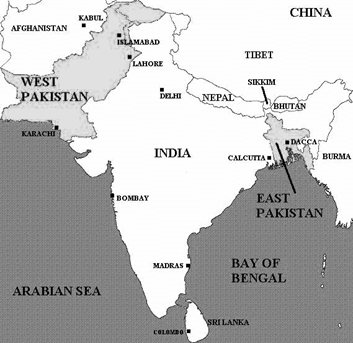
At the time of independence, Pakistan emerged as a state divided into two wings, East and West Pakistan, separated by over one thousand miles of Indian territory. East Pakistan, with its Bengali-speaking majority, comprised nearly fifty-six percent of the population, yet real political authority remained concentrated in West Pakistan, dominated by Punjabi and Urdu-speaking elites in the civil and military bureaucracy. The linguistic and cultural identity of Bengalis was often sidelined, particularly through the imposition of Urdu as the sole national language. This geographical separation and cultural diversity made centralized governance unworkable, laying the foundation for East Pakistan’s demand for genuine provincial autonomy.
How the Denial of Provincial Autonomy Contributed to East Pakistan’s Secession
- The Language Controversy and Cultural Suppression
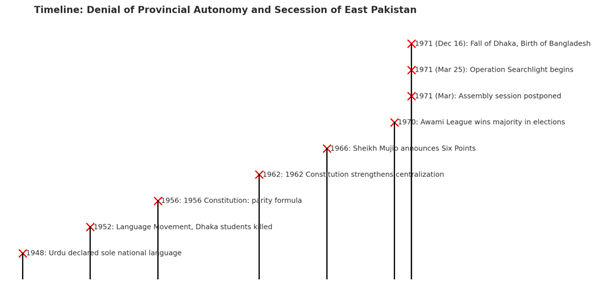
Language became the earliest flashpoint in the East–West divide. In 1948, the central government declared Urdu as the sole national language of Pakistan. For Bengalis, whose mother tongue was Bangla and who formed the majority of Pakistan’s population, this decision amounted to cultural suppression. Resistance culminated in the Language Movement of 1952, when several students were killed while protesting in Dhaka. This tragic episode turned language into a powerful symbol of Bengali identity and autonomy. The demand for recognition of Bangla as one of the state languages was essentially a call for respect of provincial and cultural rights. Hence, by imposing Urdu and denying linguistic autonomy, the central government deepened Bengali mistrust toward the state, planting one of the earliest seeds of alienation.
- Centralization of Power and Constitutional Imbalance
Moving further, The foundation of Pakistan’s constitutional development was laid in an atmosphere of centralization. The ruling elite in West Pakistan consistently avoided devolving authority to the provinces. The 1956 Constitution adopted the parity formula, which granted East and West Pakistan equal representation in the National Assembly despite East Pakistan’s numerical majority. This was seen in East Pakistan as a deliberate attempt to deny their democratic right to rule through majority. Instead of functioning as a federal system with genuine autonomy, the constitution created a centralized state under a powerful center. The situation worsened under Ayub Khan’s 1962 Constitution, which concentrated authority in the presidency and reduced the provinces to subordinate units. The Basic Democracies system further curtailed autonomy by centralizing electoral and administrative control in the hands of the federal government. Thus, constitutional experiments that were supposed to unify the state instead entrenched a system of domination, convincing Bengalis that the central government had no intention of granting them their rightful share in power.
- Political Exclusion and Marginalization
Moreover, the denial of autonomy was also reflected in the repeated political exclusion of East Pakistan. Bengali leaders were rarely entrusted with central authority despite the province’s majority status. The dismissal of Khawaja Nazimuddin in 1953, despite his position as Prime Minister, was seen as a humiliation of East Pakistani leadership. Similarly, Suhrawardy’s government was undermined and dismissed in 1957, revealing the unwillingness of the West Pakistani establishment to accept Bengali leadership. Through measures such as the Elective Bodies Disqualification Order (EBDO), many Bengali politicians were barred from political participation. Moreover, the civil and military bureaucracy was overwhelmingly dominated by West Pakistanis, leaving Bengalis with little role in national decision-making. Thus, this imbalance in political representation served as a constant reminder of their marginalized status in the federation.
- Economic Disparities and Exploitation
Furthermore, economic grievances added another dimension to East Pakistan’s alienation. The province generated the largest share of Pakistan’s foreign exchange through its jute exports, yet the benefits of development were disproportionately directed toward West Pakistan. Between 1947 and 1971. Likewise, East Pakistan contributed a significant percentage of national revenues, but industrial development and infrastructure investment were concentrated in the western wing. The majority of industrial licenses were awarded to West Pakistani businessmen, leaving East Pakistan dependent on raw jute exports. This widening economic disparity created the perception of East Pakistan as a colony of West Pakistan. Consequently, the lack of autonomy in economic planning, foreign trade, and resource allocation further deepened resentment, eventually forming one of the central demands in Sheikh Mujibur Rahman’s Six-Point Program.
- The Six Points of Sheikh Mujibur Rahman
By the mid-1960s, the accumulated political exclusion, economic exploitation, and cultural suppression of Bengalis crystallized into Sheikh Mujibur Rahman’s Six-Point Program of 1966, which emerged as the definitive manifesto of Bengali nationalism.
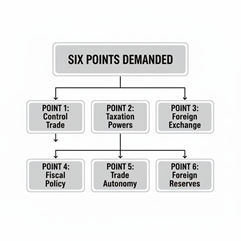
For West Pakistani leaders, they represented a blueprint for secession; for Bengalis, they were the minimum conditions for remaining within the federation. Unfortunately, the rejection of these demands by the central government signaled the final breakdown in the political compact between the two wings.
- The 1970 Elections and the Crisis of Power Transfer
Additionally, the watershed 1970 general elections, the first direct polls in Pakistan’s history, decisively demonstrated the democratic will of East Pakistan.
| Party | East Pakistan Seats | West Pakistan Seats | Total Seats |
| Awami League | 160 | 0 | 160 |
| Pakistan People’s Party (PPP) | 0 | 81 | 81 |
| Others (various) | 2 | 57 | 59 |
| Total | 162 | 138 | 300 |
However, despite securing an absolute majority in the National Assembly, the Awami League was denied the rightful transfer of power, confirming to Bengalis that majority rule and provincial autonomy would never be honored within Pakistan’s centralized framework.
- Military Crackdown and Secession
Eventually, the failure of political negotiations led the central government to rely on military force to deal with the crisis. On the night of 25 March 1971, the military launched Operation Searchlight in Dhaka and other cities of East Pakistan. The crackdown was brutal, involving widespread killings, arrests, and destruction. Instead of restoring order, the operation triggered a civil war. Millions of refugees fled to India, which soon intervened militarily in December 1971. Within two weeks, the Pakistani army surrendered in Dhaka, and Bangladesh emerged as an independent state. The use of military force, instead of granting autonomy, showed that the central leadership was unwilling to accommodate East Pakistan within the federation. In the end, the persistent denial of provincial autonomy reached its ultimate consequence, the disintegration of Pakistan and the creation of Bangladesh.
Critical Analysis
Critically, the core lesson from the 1971 crisis is that the central government’s failure to address economic and political disparity can be fatal to national unity. The center’s rigid control and disproportionate allocation of resources sowed the seeds of secession. Today, this historical pattern continues to manifest in regional insurgencies, particularly in Balochistan, where local populations feel marginalized despite their province being rich in natural resources. The ongoing demand for provincial rights and equitable resource distribution demonstrates that the fundamental issues of power-sharing and economic justice remain unresolved, threatening Pakistan’s internal stability.
Conclusion
In conclusion, the secession of Bangladesh was a direct consequence of the central government’s failure to address fundamental issues of provincial autonomy. The combination of economic exploitation and the cultural suppression of East Pakistan’s Bengali population created widespread discontent. This refusal to share power and resources led to a critical breakdown in governance, ultimately resulting in the tragic and irreversible breakup of the country.

CSS Solved Past Papers’ Essays
Looking for the last ten years of CSS and PMS Solved Essays and want to know how Sir Kazim’s students write and score the highest marks in the essays’ papers? Then, click on the CSS Solved Essays to start reading them.
CSS Solved Essays
CSS Solved Islamiyat Past Papers
Want to read the last ten years’ Islamiyat Solved Past Papers to learn how to attempt them and to score high? Let’s click on the link below to read them all freely. All past papers have been solved by Pakistan’s top CSS Islamiyat coaches having the highest score of their students.
CSS Solved Islamiyat
CSS Solved General Science & Ability Past Papers
Want to read the last ten years’ General Science & Ability Solved Past Papers to learn how to attempt them and to score high? Let’s click on the link below to read them all freely. All past papers have been solved by Pakistan’s top CSS GSA coachez having the highest score of their students.
CSS Solved General Science & Ability
CSS Solved Pakistan Affairs Past Papers
Want to read the last fifteen years’ Pakistan Affairs Solved Past Papers to learn how to attempt them and to score high? Let’s click on the link below to read them all freely. All past papers have been solved by Pakistan’s top CSS Pakistan Affairs coaches having the highest score of their students.
CSS Solved Pakistan Affairs
CSS Solved Current Affairs Past Papers
Want to read the last fifteen years’ Current Affairs Solved Past Papers to learn how to attempt them and to score high? Let’s click on the link below to read them all freely. All past papers have been solved by Pakistan’s top CSS Current Affairs coaches having the highest score of their students.
CSS Solved Current Affairs