CSS Pakistan Affairs | Brain Drain and the Crisis in Pakistan’s Higher Education System
The following question of CSS Pakistan Affairs is solved by Eman Ashraf under the supervision ofHowfiv’s Pakistan Affairs and Current Affairs Coaches: Miss Iqra Ali and Sir Ammar Hashmi. She learnt how to attempt 20 marks question and essay writing from Sir Syed Kazim Ali, Pakistan’s best CSS and PMS English essay and precis teacher with the highest success rate of his students. This solved question is attempted on the pattern taught by Sir to his students, scoring the highest marks in compulsory and optional subjects for years.

Outline
1- Introduction
2- Historical Roots of Brain Drain in Pakistan
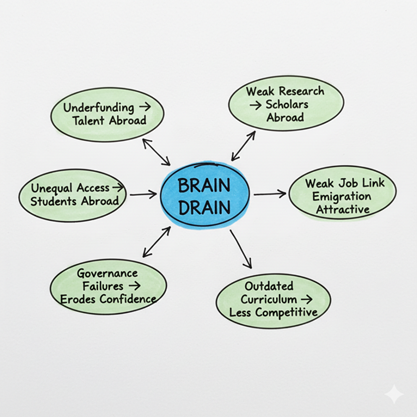
3-Brain Drain as a Reflection of Crises in Pakistan’s Higher Education System
- ✓Underfunding drives talent abroad
- ✓Weak research culture pushes scholars abroad
- ✓Inequitable access to higher education forces students to look abroad
- ✓Weak job linkage makes emigration more attractive
- ✓Governance failures erode confidence in universities
- ✓Outdated curriculum weakens global competitiveness
4-Suggestions
5-Critical Analysis
6-Conclusion
Answer to question
Introduction
Brain drain, defined as the migration of highly educated and skilled individuals to other countries, has emerged as one of Pakistan’s most pressing socio-economic challenges. Regrettably, each year, thousands of professionals, including doctors, engineers, IT experts, and academics, leave the country in search of better opportunities. This massive outflow reflects structural weaknesses in the higher education system. Some noteworthy issues include underfunding, weak research culture, poor governance, job-market disconnection, and outdated curriculum. These crises in higher education system of Pakistan has encouraged migration and fueled brain drain on a large scale. However, by increasing funding, strengthening governance, and aligning curriculum with job market needs can help mitigate the challenges of higher education and ultimately reduce brain drain.
Historical Roots of Brain Drain in Pakistan
The phenomenon of ‘brain drain’ from Pakistan represents a chronic historical challenge rooted in systemic political and economic factors. This trend first intensified during the 1960s to 1990s, driven by heightened political instability and pervasive economic uncertainty, which resulted in a significant outflow of skilled professionals and intellectuals. Moreover, from 2000 to 2020, this outflow persisted as limited employment opportunities and professional growth continued to push skilled workers abroad in search of better pay, stability, and living conditions. Crucially, this strong wave of migration continues among all groups, mainly driven by the desire for better economic opportunities and career growth.
Brain Drain as a Reflection of Crises in Pakistan’s Higher Education System
- Underfunding drives talent abroad
First and foremost, one of the clearest indicators of crisis is Pakistan’s chronic underfunding of higher education. Pakistan’s spending on research and development is strikingly lower than international norms, reflecting the neglect of knowledge creation in policymaking. The World Bank (2023) reported that Pakistan spends less than 0.3% of GDP on research and development, far below the global average of 2.2%.This underinvestment leaves universities with outdated laboratories, poorly equipped libraries, and minimal opportunities for research. Hence, talented students and faculty seeking advanced facilities and research grants often migrate to countries that prioritize higher education funding, making underfunding a direct driver of brain drain.
- Weak research culture pushes scholars abroad
Moreover, a second crisis is the shortage of qualified faculty and a fragile research culture. The problem is not only limited to weak facilities but also to the inability of institutions to retain the very scholars they sponsor. A study on educational migration found that 51 out of 81 Pakistani faculty members funded by the Higher Education Commission (HEC) for PhDs abroad never returned to their universities, despite contractual bonds.This loss deprives universities of much-needed expertise, while reinforcing the perception that academic careers at home lack incentives and institutional support. Thus, brain drain reflects the failure to develop and retain a strong research culture within Pakistan’s higher education sector.
- Inequitable access to higher education forces students to look abroad
Furthermore, higher education in Pakistan is also marked by inequitable access and regional disparities. Limited access to universities not only reduces opportunities but also compels students from marginalized areas to consider leaving the country. According to UNESCO (2021), Pakistan’s gross tertiary enrollment ratio is only around 12%, one of the lowest in South Asia.Universities are concentrated in major cities, while rural areas and smaller provinces remain underserved. As a result, this lack of equitable access pushes ambitious students from marginalized regions to seek foreign opportunities, either through scholarships or private means, reinforcing the cycle of brain drain.
- Weak job linkage makes emigration more attractive
Simultaneously, another major factor driving migration is the weak linkage between higher education and the job market. Evidence shows that Pakistan’s universities are not equipping students with the skills that industries demand, widening the gap between education and employment. The World Economic Forum’s Global Competitiveness Report (2020) ranked Pakistan poorly in skills development and innovation capacity, noting that its universities fail to equip graduates with the competencies demanded by modern industries.As a result, many graduates face underemployment or unemployment, while skilled professionals such as doctors and IT experts find higher wages and better working conditions abroad. Therefore, this disconnect makes foreign migration a rational choice for educated youth.
- Governance failures erode confidence in universities
In addition, governance failures and political instability further erode confidence in local universities. Governance weaknesses in universities are reflected in their inability to enforce accountability or manage talent effectively. A study in the Journal of Research in Social Sciences (2020) revealed that the non-return of HEC-sponsored scholars has severely disrupted the functioning of universities, as institutions lack mechanisms to enforce accountability. This reflects broader governance weaknesses, including nepotism, bureaucratic red tape, and politicization of academic appointments. Hence, in such an environment, faculty and students perceive greater professional stability and meritocracy abroad, making migration a more attractive option.
- Outdated curriculum weakens global competitiveness
Lastly, Pakistan’s outdated curricula and weak international standing also drive brain drain. International rankings highlight the country’s poor performance in innovation and higher education, underscoring the declining value of its degrees. The Global Innovation Index (2022) ranked Pakistan 87th out of 132 countries, highlighting weak investment in education, research, and innovation. Outdated programs and limited global recognition reduce the competitiveness of Pakistani degrees, prompting students to seek qualifications from foreign institutions that are more widely respected. Thus, this lack of modernization directly translates into the loss of talent to foreign universities and job markets.
Suggestions to curb brain drain
The following suggestions can help alleviate the accelerating brain drain in the country.
- Increasing funding and research investment in universities can help mitigate and ultimately reduce brain drain.
- Strengthening governance and ensuring merit-based policies in higher education institutions can help mitigate and ultimately reduce brain drain.
- Aligning curricula and skills development with job market needs can help mitigate and ultimately reduce brain drain.
Critical Analysis
Critically, brain drain, often seen as a setback, can also be a boon for developing countries, as it can bring remittances, global networks, and skill transfer. For example, India benefits from billions in remittances and international research ties, especially in technology and medicine, which have strengthened its capacity. However, in Pakistan, the persistent ills of the higher education system are reversing these potential benefits. Instead of becoming a source of international collaboration and knowledge exchange, brain drain is accelerating the depletion of domestic talent, making migration more as a weakness than an opportunity. Nevertheless, to reverse this trend, Pakistan must reform its higher education system and create incentives to retain and reintegrate talent.
Conclusion
In sum, brain drain in Pakistan is not an isolated demographic phenomenon but a mirror of the crises within higher education. Underfunding, weak faculty development, inequitable access, poor job-market alignment, governance failures, and outdated curricula all push the country’s brightest individuals abroad. Unless Pakistan invests in higher education, ensures equitable access, updates curricula, and creates stronger research cultures, the brain drain will continue to erode national development. Reforming higher education is therefore essential not only to retain talent but also to secure Pakistan’s long-term socio-economic future.

CSS Solved Past Papers’ Essays
Looking for the last ten years of CSS and PMS Solved Essays and want to know how Sir Kazim’s students write and score the highest marks in the essays’ papers? Then, click on the CSS Solved Essays to start reading them.
CSS Solved Essays
CSS Solved Islamiyat Past Papers
Want to read the last ten years’ Islamiyat Solved Past Papers to learn how to attempt them and to score high? Let’s click on the link below to read them all freely. All past papers have been solved by Pakistan’s top CSS Islamiyat coaches having the highest score of their students.
CSS Solved Islamiyat
CSS Solved General Science & Ability Past Papers
Want to read the last ten years’ General Science & Ability Solved Past Papers to learn how to attempt them and to score high? Let’s click on the link below to read them all freely. All past papers have been solved by Pakistan’s top CSS GSA coachez having the highest score of their students.
CSS Solved General Science & Ability
CSS Solved Pakistan Affairs Past Papers
Want to read the last fifteen years’ Pakistan Affairs Solved Past Papers to learn how to attempt them and to score high? Let’s click on the link below to read them all freely. All past papers have been solved by Pakistan’s top CSS Pakistan Affairs coaches having the highest score of their students.
CSS Solved Pakistan Affairs
CSS Solved Current Affairs Past Papers
Want to read the last fifteen years’ Current Affairs Solved Past Papers to learn how to attempt them and to score high? Let’s click on the link below to read them all freely. All past papers have been solved by Pakistan’s top CSS Current Affairs coaches having the highest score of their students.
CSS Solved Current Affairs