Choosing the right time and strategy for CSS and PMS preparation can determine your success or failure. This article reveals the most effective stages to start preparation and explains why beginning with English transforms your entire journey. If you want to avoid common mistakes and follow a proven path to qualification, this guide will change your approach completely.
In a country where thousands of aspirants step into the competitive arena of CSS and PMS every year, one question continues to trouble beginners: what is the right time to start preparation? Is it after graduation, during university, or after completing a master’s degree? While many academies and self-proclaimed mentors complicate this question with vague answers, the reality is far more practical and grounded in understanding the nature of the examination itself. CSS and PMS are not exams of age; they are exams of intellectual maturity, language command, and analytical thinking. Therefore, the best time to begin preparation is not determined by a number, but by readiness to learn systematically and consistently.
From my practical experience of teaching thousands of CSS and PMS aspirants over the years, I have clearly observed that there are two stages where students can begin their preparation with maximum advantage and clarity. This is not something I say theoretically; it is based on what I have seen repeatedly: students who start at the right stage with the right approach perform far better than those who begin late or without direction.
In fact, I believe in this approach so strongly that I apply it not only to my students but also to my own close circle. Whenever it comes to my family members, or the family members of the Howfiv and Cssprepforum team, I guide them to follow the same path. As a teacher, I always recommend what is tested, practical, and result-oriented, because in competitive exams like CSS and PMS, the right start often determines the final outcome.
The first stage, which I strongly recommend, is after graduation and before starting a master’s degree, particularly for students coming from a science background. Such students generally have limited exposure to analytical writing and social sciences, which are essential for CSS and PMS. Therefore, this period becomes highly valuable, as it allows them to build their intellectual foundation, writing ability, and analytical thinking from the ground up before attempting the examination.
The second ideal stage is during graduation, after completing four to five semesters, especially for students from social science backgrounds. At this stage, these students already have a basic understanding of subjects like political science, sociology, and international relations. If they begin preparation here, they can gradually align their academic studies with CSS and PMS requirements, making their preparation more natural, connected, and effective.
In both situations, the key advantage lies in starting early with a structured approach. Students who follow this path develop clarity, confidence, and command over their subjects, while those who delay preparation or rely on shortcuts often struggle, repeat attempts, and fail to make meaningful progress.

Why You Should Attempt CSS or PMS Before Doing a Master’s Degree
My dear aspirants, let me guide you with complete clarity on a decision that can shape your entire career: whether you should attempt CSS or PMS before or after pursuing a master’s degree. In the context of Pakistan, the answer is not emotional: it is practical and strategic. It is far better to attempt CSS or PMS after graduation and before starting a master’s degree.
First, you must understand a ground reality. In Pakistan, a master’s degree, in most cases, does not guarantee career growth, job security, or social status. Every year, thousands of students complete their master’s, yet many struggle to secure stable and respectable careers. In contrast, CSS and PMS offer something entirely different: prestige, authority, structured career progression, long-term job security, and social recognition. A single successful attempt can transform your professional and social standing in a way that a degree alone often cannot.
Now think logically. If you have already decided to pursue CSS or PMS, then delaying your attempt for two additional years of a master’s degree is not a wise decision. Those two years are extremely valuable. Instead of investing them in a degree that may or may not significantly impact your future, you can invest them in building the skills required to qualify one of the most competitive and rewarding examinations in Pakistan. If you succeed, you achieve your goal early. And if, for any reason, you do not succeed, you still have the option to pursue your master’s afterward, without losing anything.
Another critical advantage lies in mental focus and flexibility. Right after graduation, you are still in a learning phase. Your mind is more adaptable, your energy is higher, and your responsibilities are fewer. This is the ideal time to build your analytical thinking and writing skills from scratch. Once you enter a master’s program, your focus becomes divided. Academic pressure increases, and many students start thinking about jobs alongside their studies. This divided attention weakens the consistency and depth required for CSS and PMS preparation.
Moreover, CSS and PMS demand a dedicated, uninterrupted, and concept-based approach, especially when you are building your English foundation. As I always emphasize, if your approach is wrong, you will waste attempts. But if your approach is correct, even a single well-prepared attempt can change your life. That is why I strongly recommend starting at the right stage. For science students, particularly, the period after graduation is crucial because it allows them to focus entirely on developing writing skills and analytical thinking, areas that are usually not part of their academic training.
In simple words, attempting CSS or PMS before your master’s is not just an option; it is a well-thought-out strategy. It allows you to invest your time where it matters most, gives you the best opportunity to succeed early, and keeps all other options open. If you succeed, you gain everything. And even if you don’t, you move forward with experience, clarity, and a stronger academic direction.

Why Social Science Students Should Start CSS/PMS Preparation During Graduation
However, if you belong to a social science background, you must understand that your path is different, and in many ways, more advantageous, than that of science students. Whether you come from political science, sociology, international relations, law, or any related field, you already have a basic exposure to analytical thinking, social issues, and conceptual understanding. This gives you a natural head start. Therefore, waiting until graduation is complete before beginning your preparation is not a wise decision: it is a delay that can cost you valuable time.
Let me explain this in practical terms. Serious CSS and PMS preparation is not a three- or six-month journey; it requires at least one to one and a half years of focused, structured effort. This is not just my opinion: it is the consistent pattern followed by qualifiers and officers. Now, if you postpone your preparation until after graduation, you unnecessarily compress this time and place yourself under pressure. However, if you begin after your 4th or 5th semester, you unlock a golden opportunity. During your remaining semesters, you can cover subjects gradually, one by one, while continuing your academic studies. By the time your graduation ends, a substantial portion of your preparation is already complete.
This approach gives you a decisive advantage. On one side, your degree is completed; on the other, your CSS or PMS preparation is nearly ready, provided you are studying under a proper, guided mentorship. After graduation, you can dedicate the next four to six months to revision, mock exams, and detailed evaluation. You can consult subject specialists, refine your weaknesses, and polish your writing. I have personally seen many students follow this exact path and qualify CSS and PMS in their very first attempt.
Nevertheless, let me advise you about a mistake that destroys many careers. Do not rely blindly on CSP officers, qualifiers, or general academies. Passing an exam and teaching it are entirely different abilities. If you truly want to succeed, you must seek specialized and expert teachers for each subject. Every subject in CSS and PMS requires depth, clarity, and proper understanding. If your goal is to qualify, you must give each subject at least three to four months of focused and thorough preparation.
So, for social science students, the strategy is simple yet powerful: start early during graduation, prepare systematically, revise after graduation, and attempt with confidence. If you follow this disciplined path, you will not only save time; you will significantly increase your chances of success in your very first attempt.
How and from Which Subject Should You Start CSS and PMS Preparation?
Now that you understand when to begin your journey, let me guide you toward the most decisive question: how to begin and from where to start. This is the stage where most aspirants make a mistake that costs them not months, but years. They start with energy but without direction. They pick up newspapers, join academies, start optional subjects, or collect notes, yet after months of effort, they remain unable to write a single convincing answer. The reason is very simple: they start from the wrong place.
Let me make this absolutely clear: never begin your preparation with Current Affairs. This is one of the biggest mistakes aspirants commit. Current Affairs is not an independent subject; it is an extension of Pakistan Affairs. If you start reading newspapers without understanding Pakistan’s historical, political, and structural context, you will only collect scattered information, not develop understanding. You will read daily, but when it comes to writing, you will find yourself unable to produce a meaningful, structured answer.
So where should you begin?
You must begin with English, and you must give it the importance it truly deserves. English is not just one paper in CSS and PMS; it is the language through which your entire preparation is judged. Every answer you write, whether in Pakistan Affairs, Current Affairs, Islamiat, Political Science, or optional subjects, is evaluated through your ability to communicate clearly, logically, and persuasively in English. If you cannot express your ideas effectively, your knowledge will remain invisible to the examiner.
In the beginning, dedicate two to three months exclusively to English, under a proper and expert CSS/PMS English teacher. During this phase, you are not merely learning grammar; you are learning how to think and how to express. You work on sentence structure, vocabulary, cohesion, and coherence. More importantly, you learn how ideas are formed, connected, and communicated. You begin writing: first sentences, then paragraphs, then short essays, gradually building clarity and confidence.
Once you develop this ability, you should add Pakistan Affairs alongside English. This is the most powerful and practical combination for any serious aspirant. For the next two to three months, prepare both subjects together. English strengthens your expression, while Pakistan Affairs provides you with content and context. Now, when you read about Pakistan’s history, politics, economy, or governance, you are not just reading, you are understanding and learning to write about it effectively.
Within these five months, you will experience a transformation. Your thinking will become clearer. Your writing will gain structure. You will start understanding questions instead of guessing them. You will develop the ability to present arguments instead of memorizing them. And most importantly, you will build a strong grip over Essay and Precis, the very papers that eliminate the majority of candidates.
Now let me expose a harsh reality that many aspirants realize too late. There are officers, qualifiers, and academies who claim that they can prepare you for all CSS and PMS subjects within three to six months. This is not guidance; this is one of the biggest reasons behind mass failure. Such programs are designed to cover content, not to build competence. They provide notes, lectures, and so-called “important topics,” but they do not teach you how to think, how to analyze, or how to communicate.
This is exactly what the FPSC reports highlight year after year. Candidates fail not because they lack knowledge, but because they do not know how to express it. They misinterpret questions, fail to develop arguments, and cannot present their ideas coherently. In simple words, they lack thought process and analytical ability. And this weakness is not created in the exam hall; it is the result of starting preparation incorrectly.
Once you complete your English and Pakistan Affairs phase, you will notice something remarkable. Subjects that once seemed difficult will become manageable. Over the next five to six months, you can cover all compulsory subjects with clarity and confidence. You will read better, understand faster, and write more effectively. After that, your optional subjects can be covered within three to four months with surprising ease, because your foundation is now strong.
Always remember this principle: CSS is not a test of how much you have studied; it is a test of how well you can think and communicate. If you build this ability first, the rest of your journey becomes smooth and predictable. But if you ignore it, no amount of study will save you from failure.
So do not rush. Do not follow shortcuts. Do not be misled by quick plans and attractive promises. Start the right way:
Begin with English → Add Pakistan Affairs → Move to compulsory subjects → Then optional subjects.
If you follow this path with discipline and sincerity, you will not just prepare for CSS and PMS: you will prepare to qualify them with confidence, clarity, and complete command over your expression.
Why English Matters the Most in CSS and PMS Examinations
English is not just a subject in CSS and PMS: it is the foundation of the entire examination. Every paper you attempt, whether compulsory or optional, is written in English. This means your success is not determined only by what you know, but by how well you understand and communicate that knowledge.
If your English is weak, you will not even understand the question properly. You will misinterpret the demand, and instead of answering what is asked, you will write something irrelevant. At this stage, most students fall into another trap: they start memorizing vocabulary, attractive phrases, and ready-made sentences. They follow social media teachers who themselves do not understand how to teach writing. As a result, instead of learning how to think and express, students become dependent on memorization; and this is where failure begins.
You must accept a harsh reality: English Essay and Precis papers alone account for nearly 90% of failures. Not because students lack knowledge, but because they lack command over English. The stronger your English, the easier your entire preparation becomes. And the weaker your English, the more certain your failure becomes. It is a direct and undeniable relationship.
Another major mistake students make is that their basic English, at the intermediate or functional level, is weak, yet they rush toward essay writing. Either due to pressure, impatience, or false promises made by teachers, they jump into advanced writing without building their foundation. As a result, they spend years writing essays without improvement, wasting both time and attempts. This is why I always say: first assess your level honestly.
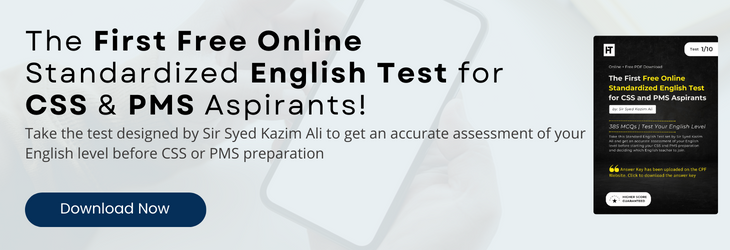
For this purpose, I have designed a test that every aspirant must attempt
👉 https://cssprepforum.com/the-first-free-online-standardized-english-test-for-css-and-pms-aspirants/
If your score is 50% or above, it means your basics are reasonably strong, and you can move toward advanced preparation with a competent teacher who specializes in CSS and PMS English. However, if your score is below 50%, it clearly shows that your foundation is weak. In that case, you must first join a functional English teacher or a professor and spend 2 to 3 months strengthening your basics, sentence structure, grammar in use, comprehension, and communication. Only after this should you move toward advanced writing skills.
Let me also address a common misconception. Many students are told to study books like Wren and Martin, believing that this will improve their English. But understand this clearly: grammar books do not teach you how to communicate or write effectively. They only explain rules. CSS requires you to express ideas, build arguments, and communicate logically, which cannot be learned from rules alone. That is why choosing a competent and experienced teacher is essential.
From years of teaching successful candidates, it is evident that developing command over English, especially essay writing and precis, requires four to five months of structured learning, followed by one to two months of intensive practice and evaluation. During this process, you do not just learn writing; you learn how to think, how to connect ideas, and how to present arguments with clarity and logic.
Once this foundation is built, you will notice a major shift. Your entire preparation becomes easier. You start understanding subjects deeply, interpreting questions correctly, and writing answers with confidence. In fact, one of the most important truths of CSS preparation is this: communication is the key to success. Knowledge alone is never enough. If you cannot present it convincingly, it has no value in the examination.
So before you begin your preparation blindly, pause for a moment. Assess your English level. Build your foundation properly. Learn under the right guidance. Because if your English is strong, CSS becomes manageable. But if your English is weak, no amount of study will be enough to save you from failure.
Therefore, my dear aspirants, the real question is not about age, qualification, or timing: it is about approach, direction, and discipline. CSS and PMS are not cleared by those who simply start early; they are cleared by those who start correctly. If you commit yourself to a systematic, concept-based approach, beginning with English, developing your thinking process, and then progressing step by step toward complete preparation, you naturally place yourself among those who succeed. But if you choose shortcuts, quick plans, and superficial learning, you may spend years attempting the exam without achieving meaningful progress.
Always keep this in mind: those who succeed are not necessarily the most intelligent; they are the most consistent, guided, and disciplined. They invest their time in learning how to think, how to analyze, and how to communicate. They do not run after tips; they focus on building skills. In contrast, those who delay preparation, ignore their weaknesses, or rely on ready-made material often find themselves repeating attempts with the same mistakes. In fact, many of my students, who are now officers, qualifiers, and professionals, have already shared the don’ts of CSS and PMS preparation in their reviews. I strongly encourage you to read them carefully; they will show you the reality that most aspirants fail to see.
So, whether you begin after graduation or during your later semesters, ensure that you begin the right way. Start with English, give it the time it truly requires, learn under proper mentorship, and build your foundation with patience and consistency. Once you learn and master the art of thinking and writing, the rest of CSS and PMS preparation becomes far more manageable. At that stage, success is no longer a matter of chance; it becomes a predictable result of your effort, direction, and discipline.
CSS Solved Past Papers’ Essays
Looking for the last ten years of CSS and PMS Solved Essays and want to know how Sir Kazim’s students write and score the highest marks in the essays’ papers? Then, click on the CSS Solved Essays to start reading them.
CSS Solved Essays
CSS Solved General Science & Ability Past Papers
Want to read the last ten years’ General Science & Ability Solved Past Papers to learn how to attempt them and to score high? Let’s click on the link below to read them all freely. All past papers have been solved by Miss Iqra Ali & Sir Ammar Hashmi, Pakistan’s top CSS GSA coach having the highest score of their students.