
CSS Current Affairs | Rationale Behind the US Involvement in the South China Sea
The following question of CSS Pakistan Affairs is solved by Waleeja Taj under the supervision of Howfiv’s Pakistan Affairs and Current Affairs Coaches: Miss Iqra Ali and Sir Ammar Hashmir. She learnt how to attempt 20 marks question and essay writing from Sir Syed Kazim Ali, Pakistan’s best CSS and PMS English essay and precis teacher with the highest success rate of his students. This solved question is attempted on the pattern taught by Sir to his students, scoring the highest marks in compulsory and optional subjects for years.

Outline
1- Introduction
2- Historical overview of South China Sea Dispute
3- The rationale behind the US involvement in South China Sea conflict
- Maintaining a geopolitical balance of power with China through the policy of Free and Open Indo-Pacific
- Advocating for the UN Convention on the Law of the Sea (UNCLOS)
- Protecting freedom of navigation and global trade routes
- Reassuring regional allies and maintaining alliance credibility
4- Critical Analysis: A strategic containment strategy of the US
5- Conclusion

Answer to the Question
Introduction
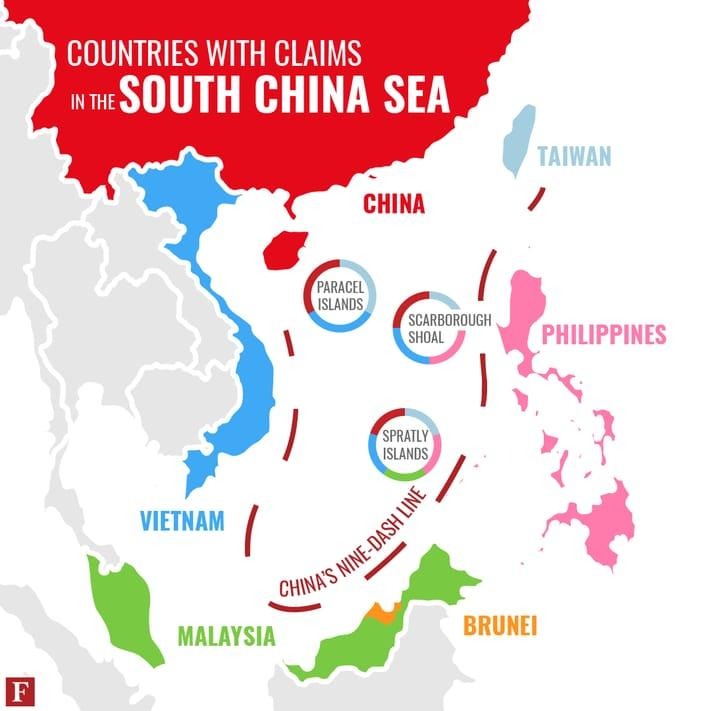
The South China Sea, located to the south of China, is a heavily contested territorial and maritime region among China, the Philippines, Malaysia, Brunei, Vietnam, and Taiwan. The dispute is primarily driven by the region’s abundant natural resources and its vitality as a global shipping lane. The aforementioned coastal nations have overlapping claims to the territory and exclusive economic zones; however, the US, an officially non-claimant state, holds significant interest in the region, as suggested by its military activities. The emergence of China in the changing world dynamics is seen as a potential threat to the hegemonic ambitions of the US; consequently, the US has shaped policies, such as the Free and Open Indo-Pacific, mainly to counter China. Apart from this, the US has served as an important advocate for the United Nations Convention on the Law of the Sea (UNCLOS), which protects freedom of navigation and global trade routes, and reassures regional allies to maintain alliance credibility. Therefore, although a non-claimant state, the US remains a key factor in the dispute for the reasons mentioned above.
Strategic and Historical Importance of the South China Sea
Strategically, the South China Sea is bounded by major export-driven economies. Its strategic importance is highlighted by the fact that an estimated $5.3 trillion in global trade, approximately one-fifth of all maritime trade, passes through it. Moreover, the Paracel and Spratly Islands in the South China Sea are at the center of the dispute. Additionally, the area is believed to hold significant untapped oil and gas reserves, along with supporting 10% of global fisheries. Due to the aforementioned strategic importance, the region is highly contested among coastal nations. Specifically, China’s Nine-Dash Line, used as a demarcation of its claimed territory and exclusive economic zones, has fueled the dispute due to its rejection by other claimants, as it covers almost 85% of the South China Sea, including the Paracel and Spratly Islands. Under the Nine-Dash Line, China claims 80% of the Philippines’ and Malaysia’s exclusive economic zones, 50% of Vietnam’s, 90% of Brunei’s, and 30% of Indonesia’s.
The Rationale Behind US Involvement in the South China Sea Conflict
- Maintaining a Geopolitical Balance of Power with China through the Policy of Free and Open Indo-Pacific
US involvement in the South China Sea dispute stems from its intent to maintain a geopolitical balance of power with China despite being a non-claimant state. As a global hegemon, the US’s intention to counterbalance the rising influence of China in South Asia culminated in a shift in foreign policy toward the Free and Open Indo-Pacific. This is manifested by the Quadrilateral Security Dialogue (QUAD), a diplomatic and security framework comprising Japan, India, the US, and Australia, with the objective of ensuring a Free and Open Indo-Pacific and promoting a rules-based international order. However, the underlying motive behind QUAD is to strategically constrain China’s aggressive maritime assertions in the South China Sea. Besides, from an economic perspective, the US strives to dissuade nations from developing economic dependence on China by strengthening supply chains in the South China Sea with its allies. Thus, although a non-claimant state in the SCS dispute, the US maintains its presence in the Indo-Pacific, given its role as a global power seeking to contain China both politically and economically.
- Advocating for the UN Convention on the Law of the Sea (UNCLOS)
Second, the backdrop to US interest in the SCS dispute is its role as an advocate for UNCLOS. At the heart of the conflict lies China’s so-called Nine-Dash Line, which encompasses most of the South China Sea. In 2015, the Philippines filed a case against China’s illegal territorial claims in the UN tribunal, and the Permanent Court of Arbitration ruled against China’s Nine-Dash Line claim. Although China rejected and ignored the ruling, the US has since stressed that China must follow UNCLOS. For instance, the Biden Administration emphasized that China must abide by the same international rules as everyone else. This underscores how the US advocates for a rules-based international order in the South China Sea, given that the UN has no enforcement mechanism. Therefore, US presence in the dispute reflects its advocacy for a rules-based order while framing China’s actions as unlawful.
- Protecting Freedom of Navigation and Global Trade Routes
Third, US involvement in the SCS supports its claim to global hegemony, as it intends to protect global trade routes. In response to China’s expansion, the US seeks to ensure the safety of smaller claimant states, which leads it to maintain a constant military presence in the Indo-Pacific. For instance, according to the United States, claimant countries, under UNCLOS, should have freedom of navigation through exclusive economic zones and are not required to notify other claimants of military activities. Moreover, about $5.3 trillion in global trade passes through the SCS. This explains why the US is actively engaged in the dispute: to safeguard global trade and ensure freedom of navigation, which China refuses to accept. Ultimately, despite being a non-claimant state, the US remains committed to participating in the dispute.
- Reassuring Regional Allies and Maintaining Alliance Credibility
Furthermore, to reassure allies in Southeast Asia and portray itself as a credible partner, the US remains closely associated with claimant states including the Philippines, Japan, and Taiwan. For this purpose, the US has established bilateral and multilateral military and trade agreements to secure its diplomatic interests. For instance, Washington is bound by a Mutual Defense Treaty with the Philippines, which obligates the US to assist in the defense of Philippine forces, vessels, and aircraft in the disputed region. Moreover, AUKUS and QUAD also serve the same objective of strengthening regional allies by supplying them with sophisticated weaponry to deter China and sustain the US’s position as a global power. Therefore, US association with the SCS dispute serves to reassure regional allies and maintain alliance credibility.
Critical Analysis: A Strategic Containment Strategy of the US Against China
Critically analyzed, the US’s championing of the Free and Open Indo-Pacific and its advocacy for UNCLOS signal a strategic containment strategy against China. Moreover, the US’s effort to maintain hegemony in the South China Sea and Asia-Pacific is based on policies aimed at controlling economic opportunities in the region. For instance, the QUAD and AUKUS agreements were formed to militarize the Indo-Pacific and strengthen its allies in Southeast Asia, primarily to sustain global primacy and counter the emerging economic and military might of China. Finally, the US’s promotion of freedom of navigation and its consistent joint military operations make its strategic containment of China evident. Although the dispute remains entangled, peace may be maintained through increasing interdependence between China and the US, alongside ASEAN cooperation; otherwise, a global catastrophe is conceivable given the complexity of the dispute.
Conclusion
To conclude, owing to its strategic significance and status as a vital trade route, the South China Sea has remained a heavily contested region for decades. Apart from China and other claimant states, the US has demonstrated political, economic, and normative interests in the region despite its non-claimant status. Its advocacy for upholding UNCLOS regarding EEZs, its promotion of freedom of navigation, its military and diplomatic support for regional allies, and its Free and Open Indo-Pacific stance all incline the US toward active engagement in the SCS conflict. Ultimately, from a broader perspective, US involvement reflects an effort to constrain China’s emergence as a global economic power that challenges US hegemonic primacy.

CSS Solved Past Papers’ Essays
Looking for the last ten years of CSS and PMS Solved Essays and want to know how Sir Kazim’s students write and score the highest marks in the essays’ papers? Then, click on the CSS Solved Essays to start reading them.
CSS Solved Essays
CSS Solved Islamiyat Past Papers
Want to read the last ten years’ Islamiyat Solved Past Papers to learn how to attempt them and to score high? Let’s click on the link below to read them all freely. All past papers have been solved by Pakistan’s top CSS Islamiyat coaches having the highest score of their students.
CSS Solved Islamiyat
CSS Solved General Science & Ability Past Papers
Want to read the last ten years’ General Science & Ability Solved Past Papers to learn how to attempt them and to score high? Let’s click on the link below to read them all freely. All past papers have been solved by Pakistan’s top CSS GSA coachez having the highest score of their students.
CSS Solved General Science & Ability
CSS Solved Pakistan Affairs Past Papers
Want to read the last fifteen years’ Pakistan Affairs Solved Past Papers to learn how to attempt them and to score high? Let’s click on the link below to read them all freely. All past papers have been solved by Pakistan’s top CSS Pakistan Affairs coaches having the highest score of their students.
CSS Solved Pakistan Affairs
CSS Solved Current Affairs Past Papers
Want to read the last fifteen years’ Current Affairs Solved Past Papers to learn how to attempt them and to score high? Let’s click on the link below to read them all freely. All past papers have been solved by Pakistan’s top CSS Current Affairs coaches having the highest score of their students.
CSS Solved Current Affairs