CSS Current Affairs | The South China Sea and The Twenty-First Century World Order
The following question of CSS Current Affairs is solved by Malaika Tabasum under the supervision of Howfiv’s Pakistan Affairs and Current Affairs Coaches: Miss Iqra Ali and Sir Ammar Hashmir. She learnt how to attempt 20 marks question and essay writing from Sir Syed Kazim Ali, Pakistan’s best CSS and PMS English essay and precis teacher with the highest success rate of his students. This solved question is attempted on the pattern taught by Sir to his students, scoring the highest marks in compulsory and optional subjects for years.

Outline
1. Introduction
2. Geographic Orientation: The Geopolitical Heart of the Indo-Pacific
3. Why The South China Sea Is Considered A “Crucible” For The Twenty-First Century World Order
- 3.1- The Economic Vitality: A crucible for global trade and commerce
- The jugular vein of global shipping
- Supply chain dependencies
- 3.2- Resource wealth: A crucible of ecological and energy competition
- The hydrocarbon goldmine
- The blue economy and food security
- 3.3- Geostrategic significance: A crucible for a power shift in the world order
- US-China hegemonic rivalry
- Militarization and power projection
- The test of International law
5. Critical Analysis
6. Conclusion
Answer to the Question
Introduction
The South China Sea has emerged as the definitive crucible of the twenty-first-century world order, serving as the primary arena where the structural transition from a unipolar, American-led system to a multipolar reality is actively being forged and tested. This semi-enclosed maritime space has transcended local territorial disputes to become a global flashpoint due to its unrivaled tripartite significance. Economically, it acts as the jugular vein of global commerce, hosting crucial trade superhighways like the Malacca and Taiwan Straits that collectively facilitate over $6 trillion in annual maritime trade. Resource-wise, it is a contested subterranean and ecological goldmine, containing billions of barrels of untapped hydrocarbons and rich marine ecosystems critical to regional food security. Geostrategically, the sea functions as a foundry of modern power politics, where China’s assertive island-building and “Nine-Dash Line” claims directly collide with the United States’ “Free and Open Indo-Pacific” strategy and the rules-based architecture of international maritime law (UNCLOS). Ultimately, the South China Sea represents a deep structural paradox: it is an ecosystem where intense economic interdependence coexists with profound military distrust, making its future stability the ultimate bellwether for war or peace in the contemporary international system.
Geographic Orientation: The Geopolitical Heart of the Indo-Pacific
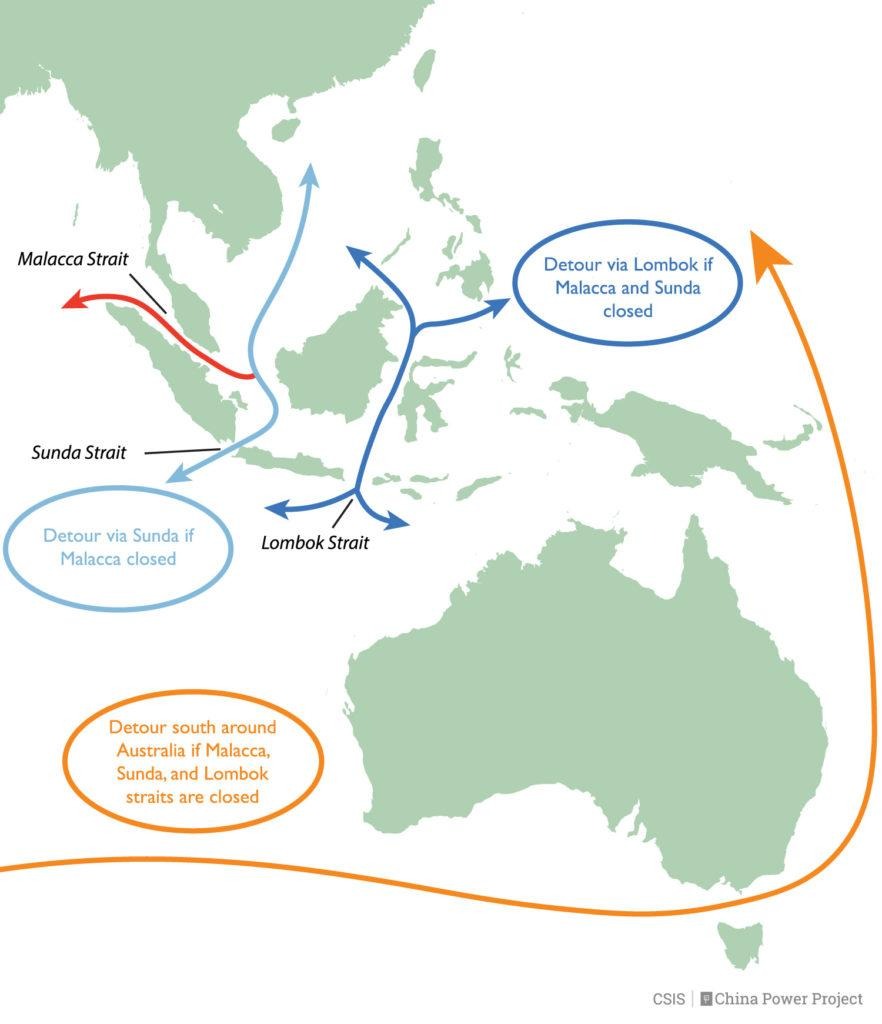
Geographically situated at the maritime crossroads of Southeast Asia, the South China Sea serves as the indispensable geopolitical heart of the Indo-Pacific region, functioning as a critical physical link connecting the Indian and Pacific Oceans. Enclosed by a dense rim of littoral nations, including China, Vietnam, the Philippines, Malaysia, Brunei, and Taiwan, this strategic body of water anchors the world’s most dynamic economic zone. Its unique geography is defined by a network of vital maritime choke points, most notably the Strait of Malacca to the southwest, which acts as a narrow funnel for global energy flows, alongside the Sunda, Lombok, and Taiwan Straits. By commanding these narrow bottlenecks, the South China Sea transforms from a mere geographic basin into a high-stakes arena of proximity, where the immediate security interests of major regional powers directly intersect, ensuring that any localized disruption ripples instantly into a global geostrategic crisis.
Why The South China Sea Is Considered A “Crucible” For The Twenty-First Century World Order
A- The Economic Vitality: A crucible for global trade and commerce
- The jugular vein of global shipping
The South China Sea operates as the indispensable jugular vein of the global maritime economy, serving as a transit corridor for approximately one-third of all global seaborne trade, valued at over $3.4 trillion annually according to data from the United Nations Conference on Trade and Development (UNCTAD) and the Center for Strategic and International Studies (CSIS). The region’s commercial density means that global economic stability is profoundly contingent upon maintaining uninterrupted freedom of navigation through its waters. Any geopolitical friction or localized kinetic conflict that shuts down these lanes would force global shipping fleets to reroute around Indonesia’s Lesser Sunda Islands or the African continent. Such detours would instantly trigger exponential spikes in war-risk insurance premiums, double freight transit costs, and cause catastrophic backlogs at major international ports, altogether injecting immediate inflationary shocks into the global economy.
- Supply chain dependencies
Beyond its role as a high-volume transit highway, this maritime basin is the foundational link for contemporary, just-in-time global supply chains, binding the economic engines of East Asia, Europe, and the Middle East together. It functions as a critical multi-directional pipeline: it channels raw industrial materials, agricultural commodities, and nearly 40% of the world’s traded petroleum products from the West and Middle East into the manufacturing hubs of China, Japan, and South Korea, while simultaneously carrying finished consumer electronics, automotive parts, and machinery back to Western markets. Because regional economic powerhouses are heavily dependent on this corridor, with over 64% of China’s maritime trade, 42% of Japan’s foreign commerce, and nearly a third of India’s trade transiting these waters, any systemic disruption would instantly break global manufacturing loops, paralyze cross-border industrial production, and expose the deep structural vulnerability of modern globalization.
B- Resource wealth: A crucible of ecological and energy competition
- The hydrocarbon goldmine
Beneath its contested waters, the South China Sea conceals vast, untapped energy reserves, transforming it into a high-stakes hydrocarbon goldmine that intensifies regional competition. The U.S. Energy Information Administration (EIA) estimates that the seabed holds approximately 11 billion barrels of oil and 190 trillion cubic feet of natural gas in proved and probable reserves, with unproven estimates ranging significantly higher. These resources are highly concentrated around disputed maritime features, particularly the Reed Bank, the Spratly Islands, and the Parcels Islands. For rapidly growing East and Southeast Asian economies facing steep domestic energy deficits, securing sovereign access to these underwater fields is a matter of critical national security. Consequently, unilateral oil exploration projects, seismic surveys, and drilling initiatives by nations like Vietnam, the Philippines, and Malaysia frequently trigger tense maritime standoffs with China, turning energy exploration into a volatile trigger for regional conflict.
- The blue economy and food security
Beyond fossil fuels, the South China Sea is a vital cornerstone of the regional blue economy and a cornerstone of food security for hundreds of millions of people in the littoral states. It contains some of the world’s most productive marine ecosystems, accounting for approximately 10% of the total global fish catch while employing millions of regional fishers. However, as near-shore fish stocks deplete due to overfishing and climate pressures, commercial fishing fleets are pushing further into contested deep-sea zones, turning fishing rights into a primary flashpoint for maritime law enforcement. The frequent arrest of foreign fishermen, the destruction of vessels, and the deployment of China’s armed maritime militia, often disguised as commercial fishing fleets, have weaponized the fishing industry. This fierce competition over marine life degrades critical coral reef ecosystems and elevates routine fisheries disputes into national security crises that threaten the political stability of the entire Indo-Pacific rim.
C- Geostrategic significance: A crucible for a power shift in the world order
- US-China hegemonic rivalry
The South China Sea is the primary geographic theater for the systemic transition from a unipolar, American-dominated international system into a highly volatile bipolar or multipolar friction zone. This rivalry is characterized by a fundamental clash of strategic visions: Beijing views the sea as its historical maritime backyard, formalizing its sweeping territorial ambitions through the controversial “Nine-Dash Line” (and its expanded ten-dash variant) which claims sovereignty over nearly 90% of the waters. Conversely, Washington treats the region as an open, global commons vital to its alliance architecture and global primacy, operationalized through its “Free and Open Indo-Pacific” strategy. This clash turns the sea into a structural crucible; it is where China’s ambition to establish regional hegemony directly collides with the United States’ determination to preserve its post-World War II security umbrella, turning localized maritime disputes into a macro-level struggle for global leadership.
- Militarization and power projection
This systemic rivalry manifests physically through aggressive militarization and competing power-projection strategies. Over the past decade, Beijing has executed a massive island-building campaign, transforming low-tide elevations and coral reefs, such as Fiery Cross, Subi, and Mischief Reefs, into heavily fortified artificial islands. Outfitted with long-range radar systems, runways, anti-ship cruise missiles, and surface-to-air defense networks, these outposts form the backbone of China’s Anti-Access/Area Denial (A2/AD) strategy, designed to push American carrier strike groups out of the First Island Chain during a conflict. In response, the United States and its Western allies regularly conduct Freedom of Navigation Operations (FONOPs), sailing warships within the 12-nautical-mile territorial limits of these militarized features to contest unlawful maritime claims. This constant tactical proximity between the U.S. Navy and the People’s Liberation Army Navy (PLAN) creates a hyper-militarized environment where a single tactical miscalculation could trigger a major escalatory spiral.
- The test of International law
Beyond military hardware, the South China Sea is the ultimate battleground for the survival of the rule-based international order, presenting a direct clash between unilateral historical claims and multilateral legal frameworks. The bedrock of global maritime governance, the United Nations Convention on the Law of the Sea (UNCLOS), establishes clear definitions for Exclusive Economic Zones (EEZs) and maritime sovereignty based on geography. However, China’s reliance on “historical rights” directly defies this consensus, a defiance underscored when Beijing completely rejected the landmark 2016 Permanent Court of Arbitration (PCA) ruling, which unanimously concluded that China’s historical claims had no legal basis under UNCLOS. By continuing to enforce its claims through maritime coercion, China openly challenges the enforcement power of international law. The South China Sea has thus become a critical test case: if international frameworks like UNCLOS fail to constrain great power revisionism here, the global order will slide away from institutional diplomacy and back toward a “might-makes-right“ realist paradigm.
Critical Analysis
The South China Sea embodies a classic “security paradox” where deep economic interdependence through frameworks like RCEP coexists with acute, zero-sum military distrust. In this volatile theater, any defensive measure taken by a state to secure its maritime lifelines is automatically perceived by its rivals as an offensive, existential threat. The catastrophic stakes of this systemic fragility are grounded in data from the Center for Strategic and International Studies (CSIS), which reveals that the region’s shipping lanes facilitate over $6.4 trillion in annual commerce, making it the indispensable core of global supply chains. CSIS warns that while the global economy can absorb localized maritime blockades elsewhere, a conflict here would be uniquely devastating, instantly severing international trade arteries. Ultimately, this high-pressure friction zone between globalization and great-power revisionism ensures that a single localized tactical miscalculation will not remain a regional skirmish; it will trigger a global economic depression and risk a direct, systemic confrontation between nuclear-armed superpowers.
Conclusion
In conclusion, the South China Sea stands as the definitive crucible of the twenty-first-century world order, uniquely binding global economic vitality, immense resource wealth, and the tectonic US-China geostrategic rivalry within a single maritime basin. As the primary arena where the transition of global power is being tested, the future of this maritime corridor will ultimately dictate the character of international governance. To prevent this high-pressure system from boiling over into a catastrophic global conflict, the revitalization of regional diplomacy is absolutely imperative. Specifically, the rapid finalization of a legally binding and enforceable ASEAN-China Code of Conduct (CoC), anchored firmly in international legal frameworks like UNCLOS, is critical to defuse zero-sum hostility. Ultimately, replacing volatile great-power friction with rules-based regional cooperation is the only viable path to ensure this crucible fosters managed geopolitical stability rather than a systemic global collapse.

CSS Solved Past Papers’ Essays
Looking for the last ten years of CSS and PMS Solved Essays and want to know how Sir Kazim’s students write and score the highest marks in the essays’ papers? Then, click on the CSS Solved Essays to start reading them.
CSS Solved Essays
CSS Solved Islamiyat Past Papers
Want to read the last ten years’ Islamiyat Solved Past Papers to learn how to attempt them and to score high? Let’s click on the link below to read them all freely. All past papers have been solved by Pakistan’s top CSS Islamiyat coaches having the highest score of their students.
CSS Solved Islamiyat
CSS Solved General Science & Ability Past Papers
Want to read the last ten years’ General Science & Ability Solved Past Papers to learn how to attempt them and to score high? Let’s click on the link below to read them all freely. All past papers have been solved by Pakistan’s top CSS GSA coachez having the highest score of their students.
CSS Solved General Science & Ability
CSS Solved Pakistan Affairs Past Papers
Want to read the last fifteen years’ Pakistan Affairs Solved Past Papers to learn how to attempt them and to score high? Let’s click on the link below to read them all freely. All past papers have been solved by Pakistan’s top CSS Pakistan Affairs coaches having the highest score of their students.
CSS Solved Pakistan Affairs
CSS Solved Current Affairs Past Papers
Want to read the last fifteen years’ Current Affairs Solved Past Papers to learn how to attempt them and to score high? Let’s click on the link below to read them all freely. All past papers have been solved by Pakistan’s top CSS Current Affairs coaches having the highest score of their students.
CSS Solved Current Affairs