
CSS Current Affairs | Historical Evolution of the China-Taiwan Dispute
The following question of CSS Pakistan Affairs is solved by Luqman Naeem under the supervision of Howfiv’s Pakistan Affairs and Current Affairs Coaches: Miss Iqra Ali and Sir Ammar Hashmir. She learnt how to attempt 20 marks question and essay writing from Sir Syed Kazim Ali, Pakistan’s best CSS and PMS English essay and precis teacher with the highest success rate of his students. This solved question is attempted on the pattern taught by Sir to his students, scoring the highest marks in compulsory and optional subjects for years.

Outline
1- Introduction
2- Pre-civil War dynamics of China and Taiwan
3- Historical evolution of China-Taiwan dispute from civil war to contemporary era
- 1927-1949 Civil War to Great Retreat
- Ideological faction led to the Chinese Civil War
- 1949 Establishing PRC and the Great Retreat of Chinese Nationalists
- 1950-1960s Taiwan -US Nexus against PRC and Strait Crisis
- US involvement of 1950
- First Strait Crisis 1954-1955
- Second Strait Crisis 1958
- 1970s-1980s Diplomatic Shifts and narrative of legitimacy
- UN resolution 2758 to recognise PRC as sole legitimate Govt of China Oct, 1971
- 1979 Truman’s shift from Taipei to Beijing, countering the Soviet Union
- 1979 The Taiwan Relations Act: Americans’ diplomatic ambiguity counter to One China policy
- Late 1980s and 1990s Taiwan’s democratic transition and rapprochement with PRC One-China Narrative
- 1987 Democratic transition: end of ‘White Terror’ – authoritarian rule – in Taiwan
- 1992 Consensus: one China with separate definition
- 1990s-2000s Rise of Taiwanese Identity and third Strait Crisis
- 1995-1996 Third Strait crisis
- 1996 Rise of DPP in Taiwan: a shift from 1992 consensus
- 2010s Xi Jinping’s ambitions of legacy as Chinese unifier
- Present Modern Era: Taiwan’s economic independence by silicon shield
- Reunification is inevitable for PRC
- Taiwan’s Silicon Shield: 90% microchip manufacturing tool for bargaining
- Nancy Pelosi’s Taiwan visit August, 2022
4- Conclusion

Answer to the Question
Introduction
The China-Taiwan dispute dates back to 1927, when the two main political stakeholders, Chiang Kai-shek’s KMT and Mao Zedong’s Chinese Communist Party (CCP), fractured their united front due to ideological differences. Following the Shanghai Massacre, both groups initiated a civil war that ended in 1949 with nearly 7.5 million casualties, bifurcating a unified China into two governments: the CCP established the People’s Republic of China (PRC) on the mainland, while the KMT formed the Republic of China (ROC) in Taiwan, which was initially recognized by the UN. Afterward, the scope of the dispute expanded into the Taiwan Strait with the PLA’s bombardments of the island during the 1954 and 1958 Taiwan Strait Crises. These grey-zone strategies prompted the US to side with the ROC to stabilize the situation. In 1971, the PRC gained UN legitimacy under Resolution 2758, replacing the ROC. Furthermore, the US strategy to counter the Soviet Union shifted Washington’s priority from Taipei to Beijing in 1979; however, America formulated the Taiwan Relations Act to maintain a balance between the two. Meanwhile, Taiwan democratized in 1987, moving away from martial law under the KMT, which eventually culminated in the 1992 Consensus: “One China” but with two different interpretations. Moving forward, the rise of the Democratic Progressive Party (DPP) in Taiwan turned this ideology upside down, shifting focus from “One China” to Taiwanese nationalism. This infuriated the PRC, resulting in the Third Taiwan Strait Crisis in 1996. Moreover, the rise of Xi Jinping has brought the conflict to the verge of direct threats of war. Concurrently, Taiwan has pioneered microchip technology, monopolizing around 90% of the advanced global market—a position known as its “silicon shield,” which serves as both an economic independence milestone and a security tool. In 2022, Nancy Pelosi’s visit further fueled the crisis, prompting China to stage an excessive show of power in and around the strait.
Pre-civil War dynamics of China and Taiwan
Following the collapse of the 2,000-year-old Qing Dynasty in 1912, a period of chaos emerged that initially unified two distinct forces; however, their broken alliance ultimately culminated in a civil war and the domination of the Chinese Communist Party (CCP) on mainland China, temporarily ending the active conflict in 1949 yet leaving it to persist in the form of the China-Taiwan crisis. Prior to this, after the end of imperial rule, China became home to numerous warlords who heavily weaponized the countryside from 1916 to 1928. In addition, foreign exploitation brought devastating consequences for the Chinese people through heavy taxation, Japanese colonialism, and the degradation of the Chinese as second-class citizens in their own homeland, while the Chinese Agrarian Crisis further fueled resentment against these foreign oppressors. Consequently, two major forces emerged Chiang Kai-shek’s Chinese Nationalist Party, famously known as the Kuomintang (KMT), and the CCP forming a united front in 1923. The two groups joined hands to achieve two main objectives: first, to defeat the warlords and unify China under one government; and second, to stand firm against foreign aggressors. While this alliance successfully eliminated the threat of the warlords and resisted foreign exploitation, deep ideological differences became undeniable when the KMT and its allied forces killed thousands of communists during the Shanghai Massacre in 1927. As a result, the communist party dispersed into the countryside and launched a campaign against the KMT government, marking the true beginning of the Chinese Civil War.
Historical evolution of China-Taiwan dispute from civil war to contemporary era
- 1927-1949 Civil War to Great Retreat
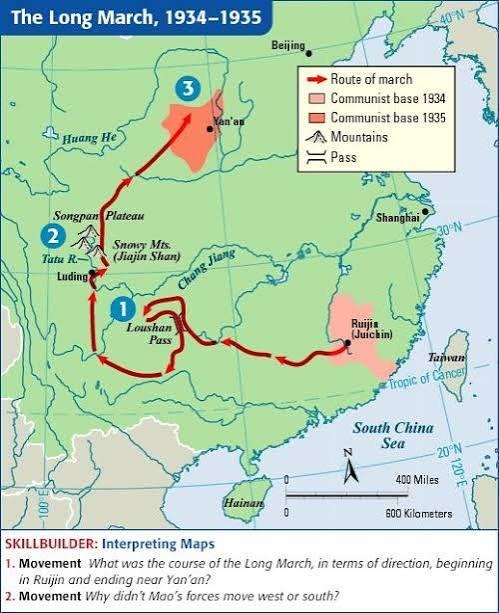
The Chinese Civil War is divided into two distinct eras: the initial phase from 1927 to 1937, and the later phase from 1946 to 1949, following a pause during World War II. After the Shanghai Massacre of 1927, the communists launched an armed struggle against the KMT government, resulting in the deaths of thousands on both sides through ambushes, direct combat, and guerrilla warfare between the People’s Liberation Army (PLA) and the Nationalist army. Following the fall of their base, Mao Zedong initiated the Long March on October 16, 1934, breakout out from Jiangxi with around 86,000 to 100,000 communist troops to escape encirclement by Nationalist forces. However, after losing more than 90% of their forces during the arduous 6,000-mile journey, only 4,000 to 8,000 survivors successfully reached a secure base in Shaanxi province between October 22 and 24, 1935. During World War II, both sides agreed to a truce, which immediately collapsed once the war ended and the Japanese empire fell, prompting the KMT and the PLA to rush to claim vacated territories in a wave of massive bloodshed. In 1946, the American Marshall Mission failed to broker a lasting peace, sparking the eruption of a full-scale, brutal war between the former allies. The PLA, relying on a mix of asymmetric and conventional warfare, inflicted heavy losses on the KMT army during the decisive Liaoshen and Huaihai campaigns, effectively expelling the Nationalist elite forces from central China. In April 1949, the PLA captured Chiang’s capital of Nanjing, marking the end of Nationalist rule on the mainland. Consequently, in October 1949, the CCP declared its new government in Beijing, establishing the People’s Republic of China (PRC) with Mao as its leader. Meanwhile, Chiang Kai-shek retreated alongside his Nationalist followers to Taiwan, establishing an authoritarian regime that was initially recognized by the United Nations and the international community as the legitimate government of China under the name of the Republic of China (ROC). It is estimated that nearly 7.6 million people lost their lives throughout the entirety of the conflict, which also caused catastrophic economic devastation.
- 1950-1960s Taiwan -US Nexus against PRC and Strait Crisis
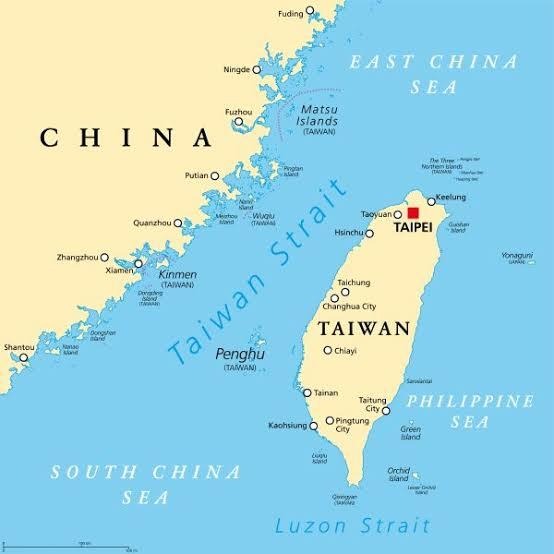
During the 1950s and 1960s, the Taiwan Strait transformed into a volatile Cold War arena, deeply entangling the United States in the China-Taiwan dispute. After the Korean War started in 1950, US President Truman deployed the Seventh Fleet to the strait. This decisive move effectively blocked a looming invasion by the PRC, positioning the US as Taiwan’s Ally. This deeply angered Beijing, sparking the First and Second Taiwan Strait Crises. In 1954 and 1958, the PRC heavily bombarded Taiwan military outposts on islands. For ordinary citizens living on these islands, life became a terrifying cycle of dodging artillery fire and seeking shelter in underground bunkers. Fearing a communist takeover, the US deepened its commitment by signing a Mutual Defense Treaty with Taipei in 1954, even threatening the use of nuclear weapons to deter mainland forces. For two decades, this US-Taiwan nexus effectively froze the conflict, providing the island with a vital security shield. However, it also locked both sides into a dangerous standoff. This period solidified a painful national fracture, dividing families across the narrow waters and setting the stage for decades of geopolitical tension.
- 1970s-1980s Diplomatic Shifts and narrative of legitimacy
The 1970s and 1980s marked a dramatic shift in global geopolitics, fundamentally altering the battle for legal legitimacy between Beijing and Taipei. For over two decades, Taiwan’s Republic of China was recognized as the sole government of China. However, this narrative shattered in October 1971 when the United Nations passed Resolution 2758, officially recognizing the People’s Republic of China (PRC) as the only legitimate representative to the UN and expelling Taipei. This diplomatic isolation deepened, as the US prioritized Cold War realpolitik. Seeking a strategic counterweight to the Soviet Union, DC pivoted toward Beijing. This culminated on January 1, 1979, when the US officially switched its formal diplomatic recognition from Taipei to Beijing, acknowledging the PRC as the sole legal government of China. To prevent Taiwan’s total abandonment and to offset China in the South China Sea, the US Congress swiftly passed the Taiwan Relations Act of 1979. This crucial legislation pushed back against Beijing’s strict ‘One China’ policy by establishing a framework for unofficial ties. Most importantly, it legally obligated Washington to provide Taiwan with defensive weapons. This masterclass in diplomatic ambiguity created a delicate deterrent that has effectively frozen the cross-strait conflict, stopping short of official statehood while ensuring the island’s survival.
- Late 1980s and 1990s Taiwan’s democratic transition and rapprochement with PRC One-China Narrative
Later on, the late 1980s and 1990s brought a profound transformation to the Taiwan Strait as Taiwan transitioned from a rigid military dictatorship into a democracy. A pivotal moment occurred in 1987 when Taiwan lifted martial law, effectively ending the brutal ‘White Terror’ era of authoritarian rule. This newfound political freedom allowed the island’s citizens to openly debate their political future and explore a distinct identity, shifting away from the KMT’s old dream of retaking the mainland. As Taiwan democratized, both sides recognized the need to manage their fragile relationship, leading to an era of cautious rapprochement. Therefore, in 1992, mid-level representatives from Beijing and Taipei met in Hong Kong and established what later became known as the 1992 Consensus. Under this framework, both sides agreed to the core narrative that there is only ‘One China.’ However, they crucially agreed to disagree on its meaning, with each side maintaining its own separate definition of what ‘China’ actually represents. This clever piece of diplomatic wordplay allowed cross-strait trade, tourism, and semi-official talks to flourish throughout the decade, providing a peaceful, stabilizing formula that successfully postponed the unresolved question of sovereignty
- 1990s-2000s Rise of Taiwanese Identity and Third Strait Crisis
The mid-1990s and 2000s marked a volatile era in the cross-strait dispute, characterized by a surging local Taiwanese identity and dangerous military posturing. Tensions reached a boiling point during the Third Taiwan Strait Crisis from 1995 to 1996. Angered by Taiwanese President Lee Teng-hui’s high-profile visit to the United States, Beijing launched provocative missile tests into the shipping lanes surrounding the island. This aggressive move was meant to intimidate voters ahead of their first-ever direct democratic presidential election in 1996, but it backfired. It prompted the United States to deploy its largest naval armada to the region since the Vietnam War, drawing a firm line against mainland aggression. Instead of backing down, Taiwan’s electorate responded by embracing their distinct democratic identity, paving the way for a historic political shift. Later on, in 2000, Chen Shui-bian was elected president, marking the rise of the pro-independence Democratic Progressive Party DPP. The DPP’s ascension signalled deviation from the 1992 Consensus, as the new leadership openly rejected the narrative of a single China concept. This era solidified a permanent psychological shift, where citizens increasingly viewed themselves as uniquely Taiwanese rather than Chinese, permanently altering the cross-strait dynamic.
- 2010s Xi Jinping’s ambitions of legacy as Chinese unifier
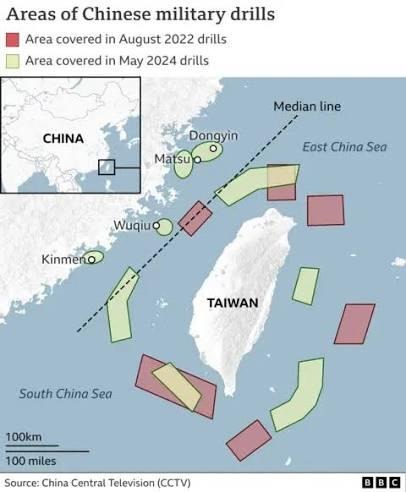
As Xi Jinping rose to power in Beijing, placing Taiwan at the very center of his political legacy, marking a highly assertive turn in the cross-strait dispute. Departing from the cautious diplomacy of his predecessors, the president explicitly linked the reunification of Taiwan with his grand vision for the Great Rejuvenation of the Chinese Nation. He framed the unresolved dispute not as a lingering historical problem to be indefinitely postponed, but as an urgent task that cannot be passed down from generation to generation. Under his leadership, Beijing adopted a maximum-pressure strategy, systematically peeling away Taiwan’s remaining diplomatic allies and isolating it on the world stage. To enforce this vision of unification, Mr. Xi oversaw a massive modernization of the PLA, shifting the balance of power in the region. The Chinese military drastically escalated its grey-zone warfare tactics, turning near-daily air and naval incursions across the Taiwan Strait median line into a tense new normal. This aggressive posture was paired with explicit warnings that Beijing would never rule out the use of military force to achieve its goals. By shifting the narrative from peaceful co-existence to mandatory absorption, the president’s ambitions injected unprecedented volatility into the dispute, turning the Taiwan Strait into one of the world’s most critical geopolitical flashpoints.
- Present Modern Era: Taiwan’s economic independence by silicon shield and American angle
In the present era, the China-Taiwan dispute has evolved into a high-stakes arena where technological dominance and global economic stability serve as the primary deterrents against war. While Beijing maintains its unyielding, long-term political stance that the reunification of Taiwan is entirely inevitable, the actual cost of enforcing that vision by military force has skyrocketed. This is heavily due to Taiwan’s Silicon Shield: its global monopoly on advanced semiconductor manufacturing. Crucially anchored by companies like TSMC, the island produces over 90% of the world’s most advanced microchips. Because these microchips are the lifeblood of everything from global smartphones to advanced artificial intelligence infrastructure, they function as a powerful tool for bargaining, ensuring that any mainland invasion would trigger an immediate, catastrophic global economic collapse. Furthermore, the technology-backed status quo faces constant geopolitical tests, most notably highlighted by US House Speaker Nancy Pelosi’s high-profile visit to Taiwan in August 2022. Pelosi’s visit infuriated Beijing, prompting the PLA to launch unprecedented, live-fire military exercises that effectively encircled the island for days. While the crisis underscored Beijing’s willingness to use aggressive military posturing, it also proved that the Silicon Shield remains a highly effective deterrent. Today, the narrow Taiwan Strait is no longer just a local territorial fracture, but a critical global choke point where a single disruption could bring the digital economy to a sudden halt.
Conclusion
The historical evolution of the China-Taiwan dispute demonstrates how a domestic, ideological conflict between the KMT and CCP transformed into one of the world’s most critical geopolitical flashpoints. Over nearly a century, the struggle has shifted from the bloody battlefields of the Chinese Civil War to the high-tech economic landscape of the modern era. While the 1949 split created two competing claims of sovereignty, subsequent decades added deep layers of complexity. This includes the military standoffs of the Cold War, a dramatic shift in international diplomatic recognition toward Beijing, and Taiwan’s profound transition into a distinct, self-governing democracy. Today, the cross-strait dynamic exists in a state of fragile equilibrium. Beijing’s unyielding political assertion that reunification is inevitable faces the modern reality of Taiwan’s silicon shield. This technological dominance ensures that any attempt to alter the status quo by force would trigger immediate global economic ruin. Backed by Washington’s enduring policy of strategic ambiguity, this shield acts as a vital deterrent. The narrow Taiwan Strait remains a critical chokepoint, where an unresolved 20th-century political fracture now holds the balance of the 21st-century digital world.

CSS Solved Past Papers’ Essays
Looking for the last ten years of CSS and PMS Solved Essays and want to know how Sir Kazim’s students write and score the highest marks in the essays’ papers? Then, click on the CSS Solved Essays to start reading them.
CSS Solved Essays
CSS Solved Islamiyat Past Papers
Want to read the last ten years’ Islamiyat Solved Past Papers to learn how to attempt them and to score high? Let’s click on the link below to read them all freely. All past papers have been solved by Pakistan’s top CSS Islamiyat coaches having the highest score of their students.
CSS Solved Islamiyat
CSS Solved General Science & Ability Past Papers
Want to read the last ten years’ General Science & Ability Solved Past Papers to learn how to attempt them and to score high? Let’s click on the link below to read them all freely. All past papers have been solved by Pakistan’s top CSS GSA coachez having the highest score of their students.
CSS Solved General Science & Ability
CSS Solved Pakistan Affairs Past Papers
Want to read the last fifteen years’ Pakistan Affairs Solved Past Papers to learn how to attempt them and to score high? Let’s click on the link below to read them all freely. All past papers have been solved by Pakistan’s top CSS Pakistan Affairs coaches having the highest score of their students.
CSS Solved Pakistan Affairs
CSS Solved Current Affairs Past Papers
Want to read the last fifteen years’ Current Affairs Solved Past Papers to learn how to attempt them and to score high? Let’s click on the link below to read them all freely. All past papers have been solved by Pakistan’s top CSS Current Affairs coaches having the highest score of their students.
CSS Solved Current Affairs