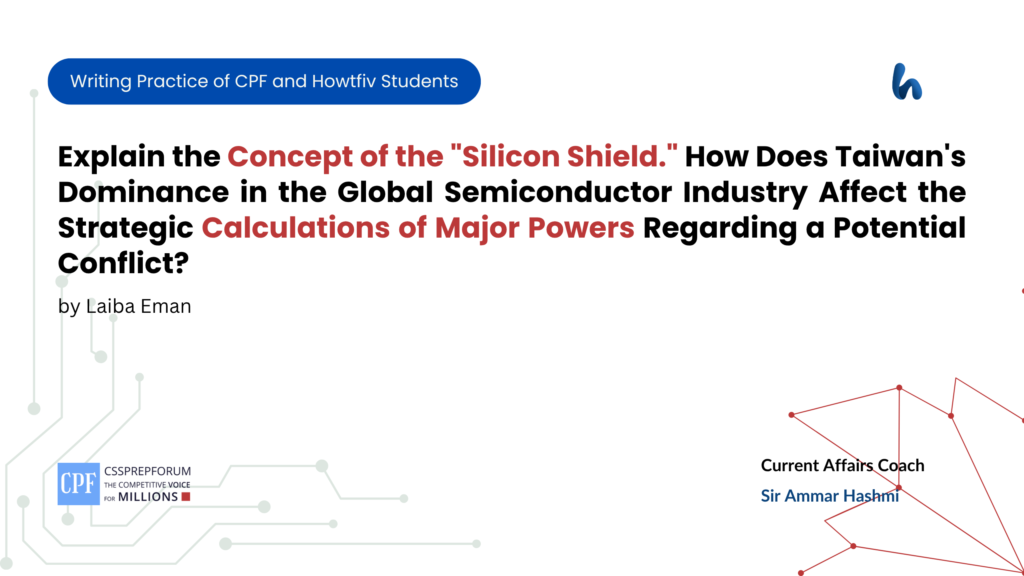
CSS Current Affairs | Silicon Shield and Taiwan in the Global Semiconductor Industry
The following question of CSS Pakistan Affairs is solved by Laiba Eman under the supervision of Howfiv’s Pakistan Affairs and Current Affairs Coaches: Miss Iqra Ali and Sir Ammar Hashmir. She learnt how to attempt 20 marks question and essay writing from Sir Syed Kazim Ali, Pakistan’s best CSS and PMS English essay and precis teacher with the highest success rate of his students. This solved question is attempted on the pattern taught by Sir to his students, scoring the highest marks in compulsory and optional subjects for years.

Outline
1- Introduction
2- Understanding The Term “Silicon Shield”
3- How does Taiwan’s dominance in the global semiconductor industry affect the strategic calculations of major powers regarding a potential conflict?
3.1 Strategic Calculations of China Regarding a Potential Conflict
- China Depends on Taiwan Chips
- Taiwan Would Apply The “Broken Nest Strategy” in Case of Conflict
- US and Other Powers Would Be Involved in The Conflict
3.2 Strategic Calculations of The US Regarding a Potential Conflict
- The U.S. Tech Industry Would Collapse
- US Would No Longer Remain the Superpower
- The History’s Biggest Global Economic Recession will Emerge
3.3. Policy Actions of China and the US
- China Initiates “Made in China Policy”
- The US Adopts Small-Yard, High-Fence Strategy and Passed “The CHIPS Act”
4- Critical Analysis
5- Conclusion
Answer to the Question
Introduction
Semiconductors have become the backbone of the modern global economy because every advanced technology, from artificial intelligence and smartphones to military weapons and communication systems, depends on them. Taiwan has emerged as the world’s leading producer of advanced semiconductors through the Taiwan Semiconductor Manufacturing Company (TSMC), giving rise to the concept of the Silicon Shield. The Silicon Shield refers to the idea that Taiwan’s dominance in semiconductor manufacturing discourages China from attacking the island because such a conflict would disrupt the global supply of advanced chips and cause severe economic and strategic losses for all major powers. Therefore, Taiwan’s semiconductor industry has become an important factor in shaping the strategic calculations of China, the United States, and other powers regarding a potential conflict. However, although the Silicon Shield currently acts as a strategic deterrent, the efforts of both the United States and China to achieve semiconductor self-sufficiency are gradually weakening its long-term effectiveness.
Understanding The Term “Silicon Shield”
The ‘Silicon Shield’ is a claim that Taiwan’s role in advanced semiconductor manufacturing makes many world powers more attentive to stability across Taiwan’s strait, forming a strategic deterrence. The term ‘Silicon Shield’ is introduced by a writer, Craig Edison, in his book, Silicon Shield: Taiwan’s Protection Against China’s Attack. Taiwan’s Semiconductor Manufacturing Company (TSMC) produces almost 90% of the world’s most advanced logic chips, creating a strategic choke point for both East and West. It is an irreversible supplier to China’s tech industry and, at the same time, a linchpin for the U.S. defense and high-tech leadership. However, this silicon shield of Taiwan may delay the China attack but not provide complete protection for a long time, as the policy actions of the US and China to make them independent in chip manufacturing are already threatening the silicon shield. In short, the silicon shield is one lens for understanding the geopolitical significance of Taiwan, but it is a hypothesis, not a settled conclusion. Therefore, the current strategic calculations of major powers prevent China from attacking Taiwan, but their future policy goals make Taiwan vulnerable to attack.
How does Taiwan’s dominance in the global semiconductor industry affect the strategic calculations of major powers regarding a potential conflict?
3.1 Strategic Calculations of China Regarding a Potential Conflict
Despite being the proponent of the One-China policy, the following strategic calculations deter China from using force against Taiwan.
- China Depends on Taiwan Chips
First, China depends on Taiwan due to its advanced high-tech military and AI ambitions, as Taiwan’s TSMC is the leader in fabricating high-end logic chips. TSMC produces nearly 90% of the most advanced semiconductors in the world. Meanwhile, China’s semiconductor capabilities lag behind the cutting edge. Despite pouring billions of dollars into it, the industry requires decades to match TSMC’s manufacturing level. Therefore, if China starts a conflict with Taiwan, its technological infrastructure would also suffer.
- Taiwan Would Apply The “Broken Nest Strategy” in Case of Conflict
Second, China cannot use coercive methods to detain Taiwan due to the possible threat of the Broken Nest Strategy. International experts propose that if China attacks Taiwan, it would destroy its chip manufacturing capabilities so that China could not leverage them. Since China is heavily dependent on Taiwan chips, it cannot afford the destruction of chip manufacturing capabilities. Therefore, it has rightly calculated the cost of conflict, which deters attacking Taiwan.
- US and Other Powers Would Be Involved in The Conflict
Moreover, as the world’s economy depends on TSMC’s nanochips, major powers like the U.S. are definitely concerned about Taiwan’s stability. For instance, tech giants like Apple and Nvidia are completely dependent on TSMC chips for chip manufacturing. Therefore, in case of conflict, the US, its allies, and other powers whose economies are dependent on TSMC’s semiconductors would certainly be involved; another world war could emerge, which would harm China’s other hegemonic ambitions, like the String of Pearls policy and the BRI.
3.2 Strategic Calculations of The US Regarding a Potential Conflict
Similarly, the United States is also threatened by a conflict. US intelligence and economists have calculated the cost of a potential conflict for the country. Chris Miller’s book, Chip War: The Fight for the World’s Most Critical Technology, highlighted threats for the U.S.
- The U.S. Tech Industry Would Collapse
Chris Miller argued that the United States tech industry cannot be run without TSMC. TSMC manufactures the US-designed advanced chips; the whole tech industry relies on these chips. Therefore, if conflict emerges, the supply chain of semiconductors would be interrupted, and the US tech industry would collapse. Consequently, the US would protect Taiwan from China at every cost.
- US Would No Longer Remain the Superpower
The TSMC client list spans top US tech companies and defense contractors. Even chips used in the F-35 fighter jet and other “military-grade” DOD systems are fabricated by TSMC fabs. Therefore, not only mobile phones but also the defense system rely on TSMC; an attack on Taiwan would destroy TSMC, weakening the US defense system. Moreover, the economic and political systems would also suffer severely. With a weak defense system and paralyzed digital and economic systems, the US would not remain in a superpower position. Consequently, Washington has indicated it would go to extremes to prevent Taiwan from possible Beijing attacks.
- History’s Biggest Global Economic Recession will Emerge
As TSMC’s advanced logic chips are the backbone of the global economy, the conflict would lead to a worldwide economic recession. From digital devices to automobiles, from small businesses to high-tech giants, from defense to government, nanochips are in high demand. In other words, the world’s economy stands on semiconductors. In case of war, when the supply chain would be interrupted, the world would suffer trillion-dollar losses, as the US State Department estimated that a war over Taiwan would lead to a 10 trillion dollar loss in a single year. Therefore, currently, due to the Silicon Shield, the Taiwan conflict is a lose-lose situation. Nevertheless, Washington, as well as Beijing, are trying to overcome their dependence on TSMC following the strategic calculation.
3.3. Policy Actions of China and the US
- China Initiates “Made in China Policy”
China has initiated a ‘Made in China’ policy to become technologically independent. China has invested tens of billions in the tech industry. Although China’s technology has not matched TSMC’s advanced nanotechnology, it has made a small, successful experiment of manufacturing a 7-nanometer logic chip. Despite the export bans from the Netherlands and the US allies, even slow progress in semiconductor manufacturing, the silicon shield is threatened. Once China achieves independence in the manufacturing of high-tech semiconductors, no one could stop it from attacking Taiwan.
- The US Adopts Small-Yard, High-Fence Strategy and Passed “The CHIPS Act”
The United States has launched an aggressive campaign to contain China’s advanced chip development. Washington uses a “small-yard, high-fence strategy,” keeping the core advanced technology strictly protected while restricting China’s access. The US and its allies ban the export of extreme ultraviolet (EUV) lithography tools required for most advanced chip fabrication. The US Chips and Science Act has directed billions of dollars to incentivize TSMC and other tech manufacturing giants to build their manufacturing units in the US. Today, TSMC fabs are present in Arizona and Texas. Additionally, the US has also invested in domestic semiconductor manufacturing and research. Therefore, through these steps, the US is reducing its dependence on TSMC so that the loss to the economy of the US will be lower in case of conflict.
Critical Analysis
Although Taiwan is enjoying a monopoly over advanced semiconductor manufacturing, it is declining as the US, China, and Europe have announced their own microprocessor plants to produce high-technology chips. Moreover, the US and China are tirelessly working to achieve independence in advanced semiconductor manufacturing, breaching the silicon shield. Analysts rightly assume that the Silicon Shield cannot protect Taiwan from China for long. Therefore, Taiwan should not rely on semiconductors; it should establish more nuanced foreign relations with other countries to counter China’s threat.
Conclusion
In conclusion, the world, including China, relies on Taiwan’s chips, making Silicon Shield that deters China from attacking Taiwan. The Silicon Shield currently protects Taiwan, as China itself depends on TSMC for its advanced technological ambitions, and the US is concerned for the protection of Taiwan in a possible conflict for its survival. However, the Shield would not remain for long because both powers’ strategic calculations resulted in efforts to produce their own independent chip-manufacturing units. The world would not be solely dependent on Taiwan for semiconductors in the coming decades. Therefore, Taiwan should explore other diplomatic options for protection.

CSS Solved Past Papers’ Essays
Looking for the last ten years of CSS and PMS Solved Essays and want to know how Sir Kazim’s students write and score the highest marks in the essays’ papers? Then, click on the CSS Solved Essays to start reading them.
CSS Solved Essays
CSS Solved Islamiyat Past Papers
Want to read the last ten years’ Islamiyat Solved Past Papers to learn how to attempt them and to score high? Let’s click on the link below to read them all freely. All past papers have been solved by Pakistan’s top CSS Islamiyat coaches having the highest score of their students.
CSS Solved Islamiyat
CSS Solved General Science & Ability Past Papers
Want to read the last ten years’ General Science & Ability Solved Past Papers to learn how to attempt them and to score high? Let’s click on the link below to read them all freely. All past papers have been solved by Pakistan’s top CSS GSA coachez having the highest score of their students.
CSS Solved General Science & Ability
CSS Solved Pakistan Affairs Past Papers
Want to read the last fifteen years’ Pakistan Affairs Solved Past Papers to learn how to attempt them and to score high? Let’s click on the link below to read them all freely. All past papers have been solved by Pakistan’s top CSS Pakistan Affairs coaches having the highest score of their students.
CSS Solved Pakistan Affairs
CSS Solved Current Affairs Past Papers
Want to read the last fifteen years’ Current Affairs Solved Past Papers to learn how to attempt them and to score high? Let’s click on the link below to read them all freely. All past papers have been solved by Pakistan’s top CSS Current Affairs coaches having the highest score of their students.
CSS Solved Current Affairs