CSS Pakistan Affairs | Evolution, Growth, and Downfall of Muslim Society in the Subcontinent
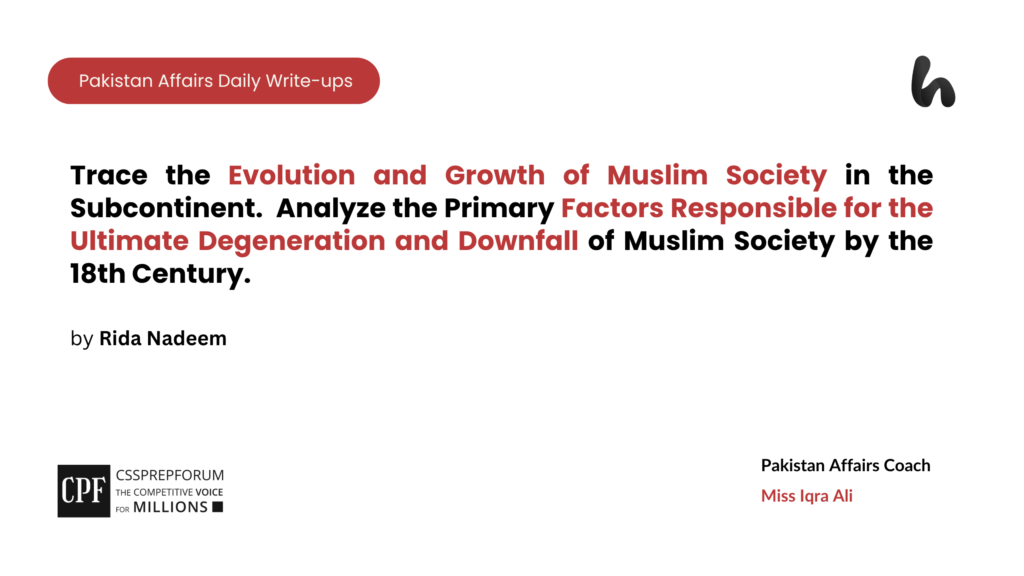
This analysis traces the trajectory of Muslim society in the subcontinent, contrasting its robust socio-political consolidation and Sufi-led cultural synthesis (1206–1526) with its systemic collapse in the eighteenth century. It argues that the ultimate downfall was a self-inflicted civilizational decay driven by the crippling Jagirdari economic crisis, profound intellectual stagnation, and severe administrative fragmentation, rather than mere external conquests.

Introduction
The Muslim society of the Indian subcontinent has experienced a huge transformation from consolidation to self-destruction. From 1206 to 1526, society laid strong foundations through administrative prudence and social and religious assimilation offered by the Sufi movement. After 1605, however, a paradox set in as the empire became culturally grander than ever; it suffered from structural decay. This thriving civilization collapsed in the eighteenth century. This decline resulted not only from external invasions but also from a range of profound internal challenges, including economic misgovernance, intellectual stagnation, and the absence of capable leadership.
Foundation and Growth of Indo-Muslim Civilization (1206–1526)
In this developmental stage, the Muslim ruling class realized that it needed to maintain a minority government and that it had to be both stable and culturally assimilated into the Hindu majority.
- Administrative Consolidation
First, the state replaced tribal rule with the Iqta system (land-granting system in which land was given to military and administrative servants in return). This served to create a loyal agrarian aristocracy that connected distant provinces to the central government in Delhi.
- Socio-Religious Synthesis
Moreover, the real builders of the integration of society were the Sufi mystics of the Chishti and Suhrawardi orders. They spread a doctrine of equality among human beings, which was quite different from the caste system prevalent in the region. For instance, Hazrat Nizamuddin Auliya introduced the langar system of a community kitchen where people of all castes sit together to eat, having a tremendous impact on the social fabric of society.
- Linguistic and Architectural Evolution
Furthermore, the Urdu language is the outcome of a long relationship between the elite of the Muslim people, who were of Turkish-Afghan origin, and the natives of this area. Likewise, the blend of Islamic domes and arches with local stone construction created a common Indo-Islamic style.
Post-1605 Climax and Creeping Decay of Muslims in the Sub-Continent
The periods of Jahangir, Shah Jahan, and Aurangzeb are indeed a historical paradox. The empire had become the wealthiest and most culturally productive, but at the same time, its very structure was undermined.
- Cultural Zenith vs. State Burden
The Mughal Empire reached its architectural peak during Shah Jahan’s reign, but this grandeur came at a high financial cost. The construction of the Taj Mahal placed immense pressure on the imperial treasury, prompting the government to impose heavier taxes on the peasantry.
- Ideological Polarization
Early emperors employed syncretist policies to foster political unity. In contrast, later rulers adopted a dogmatic orthodox stance. However, Aurangzeb became a cause of resentment for the Rajput nobility when he reintroduced the Jizya (poll tax) in 1679, turning important allies into constant rebels.
- The “Deccan Ulcer”
In Aurangzeb’s twenty-five-year military campaign, there is the concept of the ‘Deccan Ulcer.’ In the end, this prolonged fighting stretched imperial forces thin and caused long-term exhaustion of the military.

Primary Factors of Degeneration in the 18th Century
By the dawn of the eighteenth century, the empire’s internal structure had begun to unravel.
- The Economic Implosion: The Jagirdari and Agrarian Crisis (The economic implosion, the crisis of jagirdari and agrarian society)
First, the Mansabdari system was the backbone of the empire’s economy; it involved paying nobles Jagirs (revenue-collecting land grants). By the early eighteenth century, however, due to prolonged warfare and overexpansion, there was a shortage of well-farmed land (Paibaqi). As a result, the central treasury went bankrupt, and the nobles started to plunder the peasantry and squeezed out as much immediate cash as possible, thus wiping out the agricultural backbone of the kingdom. The Indian case study explores the Jat and Satnami rebellions in detail.
Case Study: Indian Rebellion; Jat and Satnami
The ruthless exploitation of peasants by desperate Jagirdars triggered a widespread agrarian revolt. In the late seventeenth and early eighteenth centuries, Mathura’s Jats and peasant-artisans, known as Satnamis, waged large-scale armed revolts. These were not wars of religion but fights for economic reform and a reduction in confiscatory taxes. In the long run, these rebellions ended the belief in the invincible Mughals and left the Mughal Empire economically incapable of generating revenue.
- Intellectual Paralysis and Epistemological Stagnation
Moreover, in European societies, the Scientific Revolution and Enlightenment took place, while in the Muslim society in the subcontinent, intellectual conservatism was becoming extreme. Independent empirical thinking (ijtihad) was actively discouraged in the educational paradigm, and blind imitation (taqlid) and memorization of theology were encouraged. In addition, the elite deliberately resisted technologies that would have made knowledge widely available.
Case Study: The Dars-e-Nizami and the Printing Press Blunder
Intellectual stagnation has most clearly shown in the institution of the Dars-i-Nizami syllabus during the 18th century. It began organizing Islamic education but actively excluded modern empirical sciences (Ma’qulat). At the same time, the Europeans introduced the modern printing press and printed works to the Mughals, who viewed them as less beautiful than Persian calligraphy, and thus of low aesthetic value. Thus, knowledge was retained by a dwindling elite, disenfranchising the wider society from encounters with European colonizers.
- Political Fragmentation and the emergence of factionalism
Moreover, because there was no codified system of primogeniture (succession by the firstborn), each emperor’s rule ended in a devastating civil war across the entire empire. The Mughal Empire came to a crumbling end by the eighteenth century as the later Mughal emperors were weak, hedonistic, and unable to govern. Consequently, power moved into the hands of ambitious nobles who carved out rival, sinister factions and devoted themselves chiefly to their own enrichment rather than the preservation of the state.
The Syed Brothers: A Case Study
However, the ultimate failure of the central political order occurred during the 1710s when the Syed Brothers (Abdullah Khan and Hussain Ali Khan) were in power. The central authority was gone, and these two nobles were the sole “kingmakers. They installed, deposed, and even killed four Mughal emperors without any opposition between 1713 and 1720. This total collapse of the throne was a sign to the governors of the region that the central government was virtually lifeless and that independent states, including Awadh, Bengal, and Hyderabad, had split from it.
- Military Obsolescence and Strategic Myopia
Furthermore, the military was becoming obsolete, and the strategic vision was short-sighted. Although it had begun as a very dynamic “Gunpowder Empire,” by the 1700s, the military machine was suffering from a severe technological lag. The army was still relentlessly interested in large, slow-moving war camps and elephant cavalry.Moreover, despite possessing an extensive coastline, the empire remained largely “sea-blind” and failed to develop a strong navy, allowing European powers to dominate maritime trade and coastal defence in the region.
Case Study: The Battle of Karnal (1739).
During the Persian ruler Nadir Shah’s invasion, the lethal imbalance of power was brutally revealed. Emperor Muhammad Shah fought the Battle of Karnal with a huge army comprising traditional Mughals and heavy elephant cavalry. In contrast, Nadir Shah used well-trained light infantry and zamburaks (swivel guns mounted on camels). The Mughal elephants were destroyed in just a few hours, thanks to the swift Persian artillery. This disastrous defeat led to the looting of Delhi, the loss of the Peacock Throne, and ultimately exposed the obsolescence of the Mughal military.
- Ideological Alienation and the Loss of the Military Vanguard
Lastly, the consolidation of the empire at an early stage, especially under Akbar, was based on liberal policies, which involved the co-opting of non-Muslim elites into the administration and the army. However, the latter’s move to dogma and exclusionary policies broke this essential partnership. In relinquishing secular rule, the state lost the warrior classes indigenous to the empire, which had served as its defense units at that time.
Case Study: The re-imposition of the Jizya and the Rajput rebellion (1679).
The Rajput nobles had been the most loyal military sentinels of the Mughal government for many centuries. But in 1679, during Aurangzeb’s ideological decision-making to reimpose the Jizya (A poll Tax) on non-Muslims and interfere in the succession to the Marwar state, they completely turned against Aurangzeb. This sparked a guerrilla war that lasted for decades in the empire against the chief generals, the Rathore Rebellion. As a result, in the eighteenth century, when foreign invaders, such as Ahmad Shah Abdali and the British, arrived, they were unable to find indigenous loyal military allies to defend the kingdom.
Critical Analysis
Muslim society in the subcontinent was not only losing its political space but also its civilizational fatigue and tiredness. The eighteenth-century elite was not an innovator, but instead extracted wealth that they did not produce, and strongly opposed the modernization of thought and technology. The society thus became very vulnerable to the intellectual and technologically superior powers of the Europeans. The British East India Company did not invade an existing state, but rather slowly broke down an already failing social system.
Conclusion
To sum up, the history of the Muslim community in the subcontinent is a good illustration of phases of civilizational uplift and self-destruction. There was a resilient socio-political environment between 1206 and 1526, which was provided by pragmatic governance and egalitarianism of the Sufis. However, the post-1605 period was more concerned with monumentalism and less with structural longevity, thereby setting the stage for a slow decline within. The Jagirdari crisis, in the end, along with an oppressive intellectual lethargy and administrative breakdown, eroded the society by the eighteenth century. The society had already lost the battle before formal European colonization began.
References
The following are the references that can be useful for further study:
- The Economic Implosion: The Jagirdari & Mansabdari Crisis
https://www.britannica.com/topic/jagirdar-system - Political Fragmentation: The Syed Brothers and Weak Successors
https://www.britannica.com/biography/Sayyid-Ahmad-Khan - Overview of the Iqta System in India
https://www.scribd.com/document/423866571/Iqta-System - The Fall of the Mughal Empire: Analyzing the Decline of the Mansabdari System
https://pakistanstudies.pk/the-fall-of-the-mughal-empire-analyzing-the-decline-of-the-mansabdari-system/ - Alam, Muzaffar — The Crisis of Empire in Mughal North India: Awadh and the Punjab, 1707–1748
Oxford Academic – The Crisis of Empire

Important Note for CSS and PMS Aspirants
For aspirants preparing for competitive examinations, exploring solved past papers is essential to understand examiner expectations, analytical answer writing, and paper trends. Therefore, candidates are strongly encouraged to read the following comprehensive solved papers available on CSSPREPFORUM.
- CSS Solved Pakistan Affairs Past Papers
- CSS Solved Current Affairs Past Papers
- CSS Solved Islamiat Past Papers
- CSS Solved General Science and Ability Past Papers
Moreover, aspirants searching for the most credible and result-oriented teachers for CSS and PMS preparation can benefit from the following detailed guidance articles
- Who is the Best CSS PMS Islamiat Teacher in Pakistan?
- Who is the Best CSS PMS Pakistan Affairs Teacher in Pakistan?
- Who is the Best CSS Current Affairs Teacher in Pakistan?
- Who is the Best CSS GSA Teacher in Pakistan?
- Who is the Best CSS PMS English Essay and Precis Teacher in Pakistan?
- Who is the Best English Grammar Teacher in Pakistan?