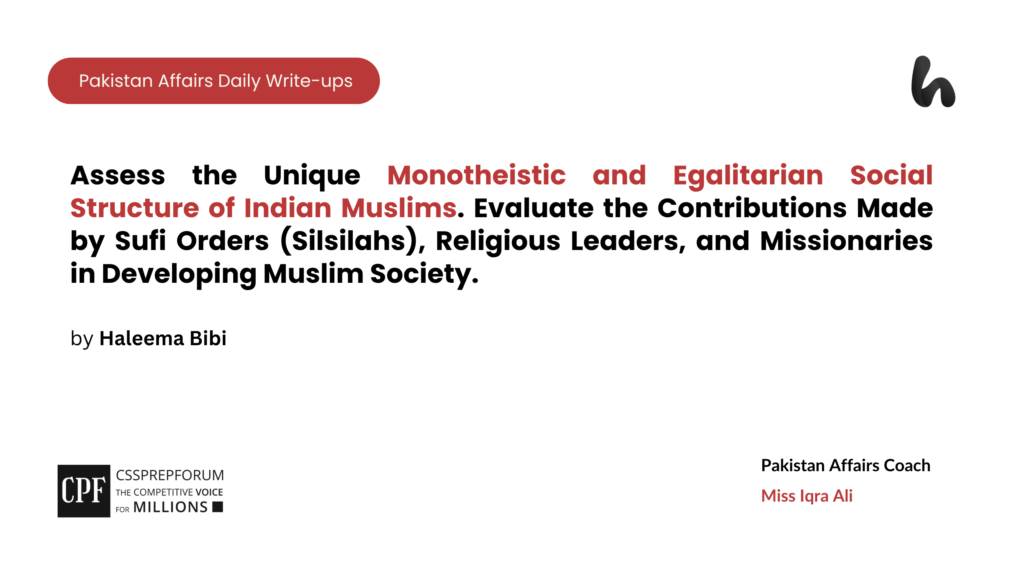
CSS Pakistan Affairs | Contributions of Sufi Orders, Religious Leaders, and Missionaries in Developing Muslim Society
Following early medieval conquests, the evolution of Muslim society and culture in the Indian subcontinent was driven by administrative stability, vibrant commercial trade, and institutionalized educational frameworks. Central to this profound transformation was the spiritual and social missionary work of major Sufi orders, namely the Chishti, Suhrawardi, Qadiri, and Naqshbandi Silsilahs, which fostered a unique Indo-Islamic synthesis, birthed the Urdu language, and fundamentally reshaped regional social structures.

Introduction
The Muslim presence in the Indian subcontinent began with the conquest of Sindh by Muhammad bin Qasim in 711 CE, but the real evolution of Muslim society and culture was a gradual process that took shape over several centuries. While early conquests provided a political foundation, the growth of Muslim society was mainly influenced by peaceful interaction, trade, education, and the spiritual efforts of Sufi saints. During the Delhi Sultanate and Mughal periods, these factors helped develop a distinct Indo-Islamic culture characterized by religious tolerance, Persian influence, new administrative systems, and the rise of the Urdu language. Among all influences, the role of Sufi orders was the most important in socially integrating Islam into the local population.
Factors Responsible for the Evolution, Growth and Transformation of Muslim Society
- Early Conquests and Political Stability
The early conquest of Sindh by Muhammad bin Qasim in 711 CE introduced Islam into the region, but long-term development of Muslim society occurred under later dynasties such as the Delhi Sultanate and Mughals. These rulers established strong political institutions, Islamic courts, and administrative systems that created stability for cultural and religious development. According to historian Satish Chandra, the Delhi Sultanate played a key role in institutionalizing Islamic governance in India, which allowed Muslim culture to expand and integrate with local society over time.
- Trade and Commercial Interaction
Trade was another major factor in spreading Islam and shaping Muslim society. Long before military conquests, Arab traders had already established commercial links with the Malabar and Sindh coastal regions in the 7th century. Through peaceful trade relations, many local communities were introduced to Islamic values such as honesty, fairness, and equality. Historian K. M. Ashraf explains that Islam spread significantly in coastal India through trade and mercantile activities rather than force, leading to voluntary conversions and cultural exchange between Arabs and Indians.
- Sufi Missionary Activities
Sufi saints played the most influential role in the transformation of Muslim society in South Asia. They spread Islam through love, tolerance, and service to humanity rather than force. Their Khanqahs became centers of social welfare where food, shelter, and spiritual guidance were provided to people regardless of caste or religion. According to historian Richard Eaton, the spread of Islam in many parts of South Asia was largely due to Sufi networks that attracted lower-caste Hindus who were socially marginalized. This inclusive approach made Islam deeply rooted in Indian society.
- Educational and Cultural Institutions
The establishment of madrasas, mosques, and Khanqahs under Muslim rulers helped in spreading education and Islamic knowledge. These institutions taught religious studies along with philosophy, science, mathematics, and literature. For example, Madrasa-i-Muizzi in Delhi became a major center of learning during the Sultanate period. Historian Irfan Habib notes that these educational institutions were crucial in developing an intellectual Muslim class and preserving Islamic identity while also interacting with local knowledge systems.
- Persian Language and Cultural Influence
The introduction of Persian as the official language of administration under the Delhi Sultanate and Mughal Empire had a deep cultural impact. It influenced literature, administration, poetry, and architecture, and also contributed to the development of Urdu as a mixed language of Persian, Arabic, and local dialects. The poet Amir Khusrau is considered a pioneer of Indo-Persian culture and early Urdu literature. Historian Satish Chandra describes Persian as the cultural bridge that connected Central Asian Islamic traditions with Indian society.
Major Sufi Orders (Silsilahs) and Their Role
- Chishti Order
The Chishti Silsilah was the most influential Sufi order in India, introduced by Khwaja Moinuddin Chishti in Ajmer. It emphasized love for humanity, equality, humility, and service to the poor. The Chishti saints avoided political involvement and focused on spiritual teachings through their Khanqahs, which became centers of social integration and interfaith harmony. According to historian K. A. Nizami, the Chishti order played a central role in spreading Islam peacefully in the Indian subcontinent by attracting people from lower social classes who were impressed by its message of equality and compassion.
- Suhrawardi Order
The Suhrawardi Silsilah, introduced by Bahauddin Zakariya in Multan, followed a more organized and politically engaged approach compared to the Chishtis. They accepted state patronage and worked closely with rulers to promote Islamic education and administration. Multan became an important center of Islamic learning under this order. Historian Peter Hardy notes that the Suhrawardi saints helped integrate religious authority with political structure, strengthening Islamic institutions in northern India.
- Qadiri Order
The Qadiri Silsilah, founded by Abdul Qadir Jilani in Baghdad, gained influence in India during the Mughal period. It emphasized strict adherence to Shariah, moral discipline, and spiritual purification. Prominent figures such as Dara Shikoh, a Mughal prince, were influenced by this order. According to scholar Annemarie Schimmel, the Qadiri order played a significant role in shaping the religious thought of the Mughal elite and strengthening Islamic ethics in society.
- Naqshbandi Order
The Naqshbandi Silsilah was introduced in India by Khwaja Baqi Billah and later strengthened by Shaykh Ahmad Sirhindi, who is known as the Mujaddid Alf-e-Sani (Renewer of the Second Millennium). This order emphasized strict adherence to Islamic law and opposed religious syncretism promoted during Emperor Akbar’s reign. Sirhindi played a major role in reviving orthodox Islam and influencing Mughal policies. Historian Aziz Ahmad highlights that the Naqshbandi order significantly strengthened Islamic identity during the later Mughal period.
Transformation of Muslim Society and Culture in the Subcontinent
- Formation of Indo-Islamic Culture (Cultural Synthesis)
Muslim rule in the subcontinent led to a gradual blending of Islamic and local Indian traditions, resulting in a unique Indo-Islamic culture. This transformation can be seen in art, architecture, customs, and social practices where Persian, Central Asian, and Indian elements merged. The Mughal period especially reflects this synthesis in buildings like the Taj Mahal and Red Fort, which combine Islamic geometric designs with Indian artistic motifs. According to historian Satish Chandra, this cultural fusion was one of the most distinctive outcomes of Muslim rule in India.
- Development of Urdu Language
One of the most significant transformations was the emergence of Urdu, which developed as a result of interaction between Persian, Arabic, Turkish, and local Indian languages. Urdu became a symbol of Muslim identity in South Asia and was widely used in poetry, literature, and communication. Poet Amir Khusrau is often credited as one of the earliest contributors to this linguistic development, as he blended Persian and local dialects in his poetry. Historian Irfan Habib notes that Urdu evolved as a cultural bridge between different communities in medieval India.
- Growth of Sufi-Based Social Harmony
Sufi teachings transformed society by promoting equality, tolerance, and brotherhood, which reduced rigid social divisions. The Khanqah system played a central role in bringing people of different castes and religions together through food distribution, spiritual gatherings, and moral teachings. According to historian Richard Eaton, Sufi saints were key agents in social transformation because they attracted marginalized groups, especially lower-caste Hindus, through their message of equality and compassion.
- Expansion of Educational and Intellectual Life
Muslim rule led to the establishment of madrasas and centers of learning that transformed intellectual life in the subcontinent. These institutions not only taught religious studies but also philosophy, mathematics, astronomy, and medicine. Cities like Delhi, Lahore, and Multan became major centers of education. Historian Irfan Habib highlights that these institutions created a new educated Muslim class that played an important role in administration and cultural development.
- Changes in Social Structure and Reduction of Caste Barriers
Islamic teachings emphasized equality among all believers, which challenged the rigid caste system of Indian society. While caste did not disappear completely, the influence of Islam and Sufism provided an alternative social structure based on merit rather than birth. Many lower-caste groups converted to Islam due to its message of social justice. According to K. A. Nizami, this aspect of Islam was particularly attractive to socially oppressed groups in medieval India.
- Development of Art, Architecture and Music
Muslim rule transformed the artistic landscape of the subcontinent. New architectural styles such as domes, minarets, arches, and calligraphy were introduced and merged with local designs, creating a distinct Indo-Islamic architecture. Music also developed under Sufi influence, especially through Qawwali, which became a popular form of devotional expression. Historian Annemarie Schimmel explains that Sufi culture deeply influenced South Asian music and artistic traditions.
- Political and Administrative Transformation
Muslim rulers introduced new systems of governance based on Islamic principles and Persian administrative traditions. The introduction of centralized bureaucracy, revenue systems, and legal structures transformed governance in the subcontinent. This administrative system remained influential even after the decline of the Mughal Empire. According to Satish Chandra, the Mughal administrative system was one of the most organized systems of its time in the world.
Conclusion
In conclusion, the evolution and transformation of Muslim society in the Indian subcontinent was not the result of conquest alone but a long historical process shaped by multiple factors. Political stability, trade networks, education, and Persian cultural influence provided a structural foundation, while Sufi orders such as Chishti, Suhrawardi, Qadiri, and Naqshbandi played a central role in spreading Islam and integrating it into local society. Together, these elements created a rich Indo-Islamic civilization that continues to influence the cultural, social, and religious life of South Asia today.

Important Note for CSS and PMS Aspirants
For aspirants preparing for competitive examinations, exploring solved past papers is essential to understand examiner expectations, analytical answer writing, and paper trends. Therefore, candidates are strongly encouraged to read the following comprehensive solved papers available on CSSPREPFORUM.
- CSS Solved Pakistan Affairs Past Papers
- CSS Solved Current Affairs Past Papers
- CSS Solved Islamiat Past Papers
- CSS Solved General Science and Ability Past Papers
Moreover, aspirants searching for the most credible and result-oriented teachers for CSS and PMS preparation can benefit from the following detailed guidance articles
- Who is the Best CSS PMS Islamiat Teacher in Pakistan?
- Who is the Best CSS PMS Pakistan Affairs Teacher in Pakistan?
- Who is the Best CSS Current Affairs Teacher in Pakistan?
- Who is the Best CSS GSA Teacher in Pakistan?
- Who is the Best CSS PMS English Essay and Precis Teacher in Pakistan?
- Who is the Best English Grammar Teacher in Pakistan?