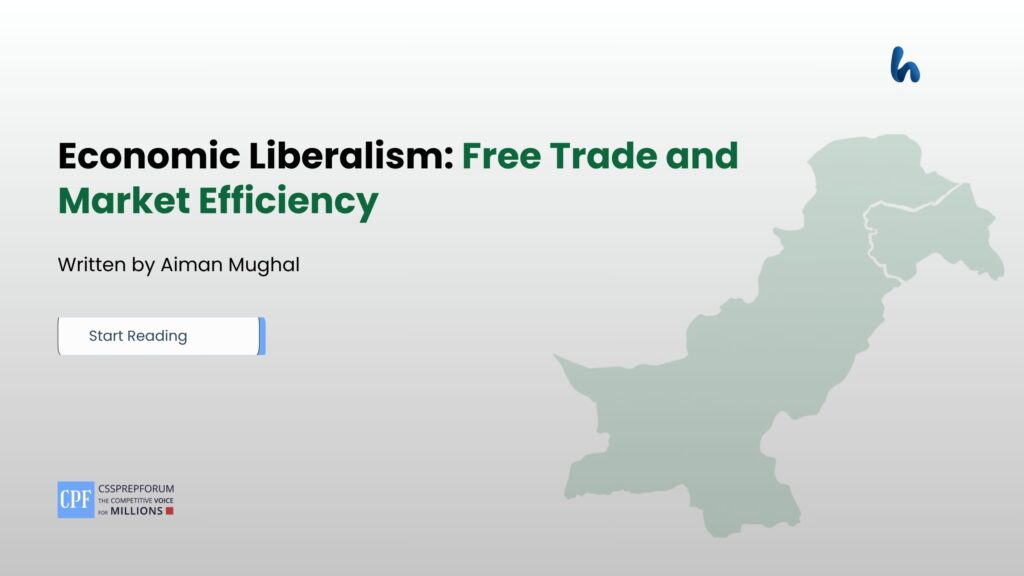
CSS Current Affairs | Economic Liberalism: Free Trade and Market Efficiency
Economic Liberalism advocates free trade, competitive markets, and limited government intervention to promote economic growth, efficient resource allocation, innovation, and consumer welfare. It is a key concept in CSS Current Affairs.

Introduction
Economic Liberalism is a key approach within Development Economics and broader economic theory that emphasizes free markets, minimal government intervention, and unrestricted trade as the most efficient path to economic growth. It argues that when individuals and firms are allowed to operate freely in competitive markets, resources are allocated more efficiently, productivity increases, and overall welfare improves. In the context of international trade, Economic Liberalism strongly supports free trade, suggesting that open markets benefit all participating countries through specialization, comparative advantage, and increased global efficiency. The theory gained prominence through classical economists such as Adam Smith and David Ricardo, and it continues to shape modern globalization policies.
Definition
According to Adam Smith:
“Little else is required to carry a state to the highest degree of opulence from the lowest barbarism but peace, easy taxes, and a tolerable administration of justice.”
This definition reflects the core liberal belief that limited government intervention and free markets are essential for economic prosperity and development.
Core Idea and Functional Understanding
Economic Liberalism is based on the idea that markets function best when they are free from excessive government control. It assumes that individuals act in their self-interest, and through the “invisible hand” mechanism, their actions contribute to overall economic efficiency and social welfare. In international trade, countries benefit by specializing in goods where they have comparative advantage and trading for others, leading to mutual gains.For example, if one country produces textiles efficiently and another produces machinery efficiently, both countries benefit by trading rather than producing everything domestically. This increases efficiency, reduces costs, and enhances global welfare.
Key Principles of Economic Liberalism
| Principle | Explanation | Economic Impact |
| Free Markets | Prices determined by supply and demand | Efficient resource allocation |
| Free Trade | Unrestricted international trade | Increased global welfare |
| Minimal State Intervention | Limited government role in economy | Greater private sector growth |
| Competition | Firms compete in open markets | Innovation and efficiency |
| Private Property Rights | Legal protection of ownership | Investment and economic stability |
Role of Free Trade in Economic Development
Free trade is central to Economic Liberalism because it allows countries to specialize based on comparative advantage. This leads to higher productivity, lower prices, and greater consumer choice. Trade openness also encourages innovation, technology transfer, and foreign investment.For instance, countries like Germany and Japan have benefited significantly from open trade systems by exporting high-value manufactured goods, while importing cheaper raw materials and intermediate goods.
Benefits of Economic Liberalism
Economic Liberalism offers several advantages for both developed and developing countries. It promotes efficient allocation of resources, increases global trade, and encourages competition. Consumers benefit from lower prices and greater variety of goods. Additionally, firms are forced to innovate and improve productivity to remain competitive.For example, globalization has allowed countries like Vietnam and Bangladesh to expand their export sectors significantly, creating millions of jobs in manufacturing industries.
Challenges and Criticism of Economic Liberalism
Despite its advantages, Economic Liberalism faces several criticisms. Critics argue that free markets can lead to inequality, as not all countries or individuals benefit equally from globalization. Developing countries may struggle to compete with advanced economies due to technological and financial disadvantages. Additionally, excessive reliance on markets can lead to economic instability and financial crises.For example, global financial crises have shown that unregulated markets can sometimes create severe economic disruptions affecting both developed and developing economies.

Contemporary Relevance in the Global Economy
Economic Liberalism remains highly influential in today’s globalized world. Institutions such as the World Trade Organization (WTO), International Monetary Fund (IMF), and World Bank promote trade liberalization, deregulation, and open markets. Many countries have reduced tariffs to integrate into the global economy.However, recent trends show a partial shift toward protectionism in some regions due to concerns about national security, supply chain resilience, and domestic industry protection.This shift shows that while globalization continues, states are increasingly balancing openness with strategic economic interests. Therefore, modern economic policy reflects a hybrid approach combining liberalization with selective protectionism.
Comparative Analysis of Economic Liberalism with Related Economic Systems
| Basis | Economic Liberalism | Protectionism | Structuralism |
| Core Idea | Free markets and free trade | Protect domestic industries | Structural transformation through state intervention |
| Role of State | Minimal intervention | High intervention | Strong developmental role |
| Trade Policy | Open international trade | Restricted trade | Selective protection |
| Market Mechanism | Efficient and self-regulating | Controlled by government | Mixed approach |
| Economic Outcome | Growth through competition | Domestic industry protection | Industrial development |
| Key Thinkers | Adam Smith, David Ricardo | Friedrich List | Raúl Prebisch |
Real-World Case Studies and Economic Outcomes
Economic Liberalism has influenced many successful economies. The United Kingdom and United States historically benefited from free market systems and industrial competition. In Asia, countries like Singapore and Hong Kong adopted open trade policies, becoming global financial and trade hubs. Similarly, Vietnam and Bangladesh have integrated into global markets through export-oriented liberalization policies, resulting in rapid industrial growth and poverty reduction. However, some countries that liberalized too quickly without strong institutions have faced inequality and market instability, highlighting the importance of balanced reforms.
Theoretical Evaluation: Strengths and Limitations
Economic Liberalism provides a strong theoretical foundation for understanding how free markets and trade can drive efficiency, innovation, and economic growth. Its main strength lies in promoting competition, specialization, and consumer welfare. However, it assumes perfect market conditions, which rarely exist in developing economies. Critics argue that it can increase inequality, weaken domestic industries, and expose economies to external shocks. Despite these limitations, Economic Liberalism remains a dominant framework in global economic policy due to its strong empirical support in many successful economies.
Conclusion
Economic Liberalism explains how free markets and unrestricted trade can contribute to global economic growth and efficiency. By promoting competition, specialization, and minimal government intervention, it provides a framework for understanding modern globalization. Although it faces criticism for increasing inequality and market volatility, its central idea—that free trade benefits participating economies—continues to influence international economic policies and development strategies.
Key Takeaways
- Economic Liberalism supports free markets and free trade.
- It emphasizes minimal government intervention in the economy.
- Comparative advantage increases global efficiency and welfare.
- Institutions like WTO and IMF promote liberal economic policies.
- Benefits include innovation, growth, and consumer welfare.
- Risks include inequality and market instability.
- It is a core foundation of modern globalization.
- Many developing countries benefit through export-led integration.
References
- International YouTube Lecture (Economic Liberalism / Free Trade)
- World Bank – Trade and Development (Free Trade Benefits)
- OECD – Trade Liberalisation and Economic Growth
- UNCTAD – Global Trade and Development Report
- CSSPrepForum – Economic Liberalism / Free Market Approach
Important Note for CSS and PMS Aspirants
For aspirants preparing for competitive examinations, exploring solved past papers is essential to understand examiner expectations, analytical answer writing, and paper trends. Therefore, candidates are strongly encouraged to read the following comprehensive solved papers available on CSSPREPFORUM.
- CSS Solved Pakistan Affairs Past Papers
- CSS Solved Current Affairs Past Papers
- CSS Solved Islamiat Past Papers
- CSS Solved General Science and Ability Past Papers
Moreover, aspirants searching for the most credible and result-oriented teachers for CSS and PMS preparation can benefit from the following detailed guidance articles
- Who is the Best CSS PMS Islamiat Teacher in Pakistan?
- Who is the Best CSS PMS Pakistan Affairs Teacher in Pakistan?
- Who is the Best CSS Current Affairs Teacher in Pakistan?
- Who is the Best CSS GSA Teacher in Pakistan?
- Who is the Best CSS PMS English Essay and Precis Teacher in Pakistan?
- Who is the Best English Grammar Teacher in Pakistan?