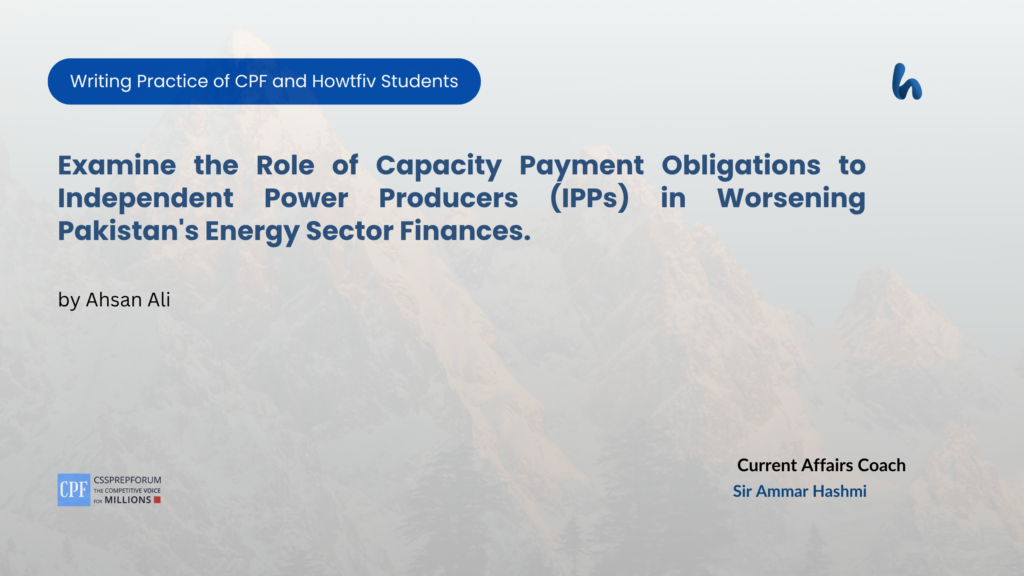
CSS Current Affairs | Role of Capacity Payment of IPPs in Worsening Pakistan’s Energy Sector
The following question of CSS Pakistan Affairs is solved by Ahsan Ali under the supervision of Howfiv’s Pakistan Affairs and Current Affairs Coaches: Miss Iqra Ali and Sir Ammar Hashmir. She learnt how to attempt 20 marks question and essay writing from Sir Syed Kazim Ali, Pakistan’s best CSS and PMS English essay and precis teacher with the highest success rate of his students. This solved question is attempted on the pattern taught by Sir to his students, scoring the highest marks in compulsory and optional subjects for years.

Outline
1-Introduction
2-Overview of Independent Power Producers (IPPs)
3-Role of Capacity Payment Obligations in Worsening Pakistan’s Energy Sector Finances
- Fixed Payments Regardless of Electricity Generation
- Increase in Circular Debt
- Higher Electricity Tariffs
- Excess Generation Capacity and Underutilization
- Fiscal Burden on Government
- Dependence on Expensive Thermal Power Projects
- Impact on Industrial Competitiveness and Economic Growth
4-Critical Analysis
5-Conclusion
Answer to the Question
Introduction
Pakistan’s energy sector faces serious financial challenges that threaten economic growth and electricity affordability. A financially stable power sector is essential for sustaining industrial development and meeting growing energy demands. According to the Economic Survey of Pakistan 2024-25, thirty-three IPPs received Rs. 979 billion in capacity payments during FY24. These payments are guaranteed under contractual agreements and remain payable regardless of actual electricity generation levels. Consequently, capacity payment obligations have significantly worsened Pakistan’s energy sector finances.
Overview of Independent Power Producers (IPPs)
Independent Power Producers have become a vital source of electricity generation in Pakistan. They were introduced to attract private investment and address persistent power shortages across the country. According to Pakistan’s 1994 Power Policy, private investors were encouraged through guaranteed returns and long-term purchase agreements. These incentives successfully attracted domestic and foreign investment into electricity generation projects. As a result, IPPs became an important pillar of Pakistan’s power sector development. Consequently, their growing role has made their financial arrangements increasingly significant for the energy sector.
Role of Capacity Payment Obligations in Worsening Pakistan’s Energy Sector Finances
- Fixed Payments Regardless of Electricity Generation
Capacity payments create financial obligations even when electricity is not generated or consumed. Under most power purchase agreements, IPPs receive payments for maintaining available generation capacity. According to the Ministry of Energy (Power Division), capacity payments are contractually guaranteed regardless of actual electricity dispatch. Consequently, the government must continue making payments despite fluctuations in electricity demand. Therefore, fixed payment obligations significantly increase the financial burden on Pakistan’s energy sector.
- Increase in Circular Debt
Capacity payments have become a major contributor to Pakistan’s growing circular debt problem. When distribution companies fail to recover sufficient revenue, payment obligations accumulate throughout the power sector. According to the IMF’s Pakistan Country Report, rising capacity charges have contributed to persistent growth in power sector liabilities. This situation creates cash flow shortages for generation, transmission, and distribution entities. Therefore, capacity payments have played a significant role in worsening circular debt.
- Higher Electricity Tariffs
Capacity payments directly increase the cost of electricity supplied to consumers. These fixed charges are incorporated into tariff calculations regardless of actual power consumption levels. According to NEPRA tariff determinations, capacity charges constitute a substantial portion of consumer electricity bills. As capacity payments increase, electricity prices rise for households, businesses, and industries. Therefore, capacity payment obligations contribute significantly to higher electricity tariffs.
- Excess Generation Capacity and Underutilization
Excess generation capacity has amplified the financial burden associated with capacity payment obligations. Pakistan’s installed capacity often exceeds actual electricity demand and system utilization levels. According to the Economic Survey of Pakistan 2024–25, installed generation capacity reached 46,605 MW during FY25. However, a significant portion of this capacity remains underutilized because of lower demand and transmission constraints. Therefore, payments for unused capacity continue to strain Pakistan’s energy sector finances.
- Fiscal Burden on Government
Capacity payment obligations place considerable pressure on the government’s fiscal resources and budgetary planning. The government often provides financial support when power sector revenues fall short of obligations. According to the IMF’s Pakistan Country Report, power sector liabilities remain a major risk to fiscal sustainability. These obligations increase public expenditures and limit resources available for other development priorities. Therefore, capacity payments have become a significant fiscal burden on the government.
- Dependence on Expensive Thermal Power Projects
Many IPPs operate thermal power plants that rely on imported fuels and costly generation technologies. Dependence on imported coal, LNG, and furnace oil increases overall electricity generation costs. According to the World Bank, Pakistan’s energy sector remains vulnerable to fluctuations in international fuel prices. Rising fuel costs increase the financial obligations associated with many power purchase agreements. Therefore, expensive thermal power projects intensify the financial impact of capacity payments.
- Impact on Industrial Competitiveness and Economic Growth
High electricity costs reduce industrial competitiveness and discourage investment across key economic sectors. Capacity payments contribute to elevated tariffs that increase production expenses for businesses. According to the State Bank of Pakistan, rising energy costs adversely affect industrial performance and economic activity. Higher production costs reduce export competitiveness and weaken overall economic productivity. Therefore, capacity payment obligations indirectly hinder industrial growth and broader economic development.
Critical Analysis
Capacity payment obligations were originally introduced to attract private investment into Pakistan’s electricity sector. These agreements successfully expanded generation capacity and reduced the government’s direct investment burden. However, guaranteed payments became increasingly problematic as electricity demand grew more slowly than expected. Financial pressures intensified because payments remained mandatory despite underutilized generation capacity and revenue shortfalls. Therefore, capacity payments have evolved from an investment incentive into a significant financial challenge for the energy sector.
Conclusion
In conclusion, capacity payment obligations have become a major challenge for Pakistan’s energy sector. These payments increase fixed costs regardless of actual electricity generation levels. They contribute significantly to circular debt, higher tariffs, and growing fiscal pressures. Excessive reliance on costly thermal projects further aggravates these financial burdens. Therefore, comprehensive reforms are essential to ensure long-term financial sustainability.

CSS Solved Past Papers’ Essays
Looking for the last ten years of CSS and PMS Solved Essays and want to know how Sir Kazim’s students write and score the highest marks in the essays’ papers? Then, click on the CSS Solved Essays to start reading them.
CSS Solved Essays
CSS Solved Islamiyat Past Papers
Want to read the last ten years’ Islamiyat Solved Past Papers to learn how to attempt them and to score high? Let’s click on the link below to read them all freely. All past papers have been solved by Pakistan’s top CSS Islamiyat coaches having the highest score of their students.
CSS Solved Islamiyat
CSS Solved General Science & Ability Past Papers
Want to read the last ten years’ General Science & Ability Solved Past Papers to learn how to attempt them and to score high? Let’s click on the link below to read them all freely. All past papers have been solved by Pakistan’s top CSS GSA coachez having the highest score of their students.
CSS Solved General Science & Ability
CSS Solved Pakistan Affairs Past Papers
Want to read the last fifteen years’ Pakistan Affairs Solved Past Papers to learn how to attempt them and to score high? Let’s click on the link below to read them all freely. All past papers have been solved by Pakistan’s top CSS Pakistan Affairs coaches having the highest score of their students.
CSS Solved Pakistan Affairs
CSS Solved Current Affairs Past Papers
Want to read the last fifteen years’ Current Affairs Solved Past Papers to learn how to attempt them and to score high? Let’s click on the link below to read them all freely. All past papers have been solved by Pakistan’s top CSS Current Affairs coaches having the highest score of their students.
CSS Solved Current Affairs