CSS Solved Political Science 2026 Past Paper | Pakistan’s National Capacity and Economic Development
The following question of CSS Political Science 2026 is solved by Miss Ayesha Irfan, a renowned CSS coach for Islamiat and Political Science. Moreover, the question is attempted using the same pattern taught by Sir Syed Kazim Ali to his students, who have scored the highest marks in compulsory and optional subjects for years. This solved past paper question is uploaded to help aspirants understand how to crack a topic or question, write relevantly, what coherence is, and how to include and connect ideas, opinions, and suggestions to score the maximum.

Question Breakdown
The question asks for an analysis of Pakistan’s national capacity, which is the country’s ability to pursue its strategic, economic, and social objectives effectively. The focus is on three key dimensions: economic capacity, which includes GDP, industrial and agricultural output, trade, and fiscal resources; military capacity, encompassing armed forces strength, strategic capabilities, defense spending, and technological advancement; and human development capacity, which refers to education, health, skills, and social welfare. The question requires a critical assessment of both strengths and weaknesses in each dimension, along with trends over time and comparisons with regional peers. Contemporary examples, statistical data, and realistic evaluations of limitations are expected to support the analysis
Outline
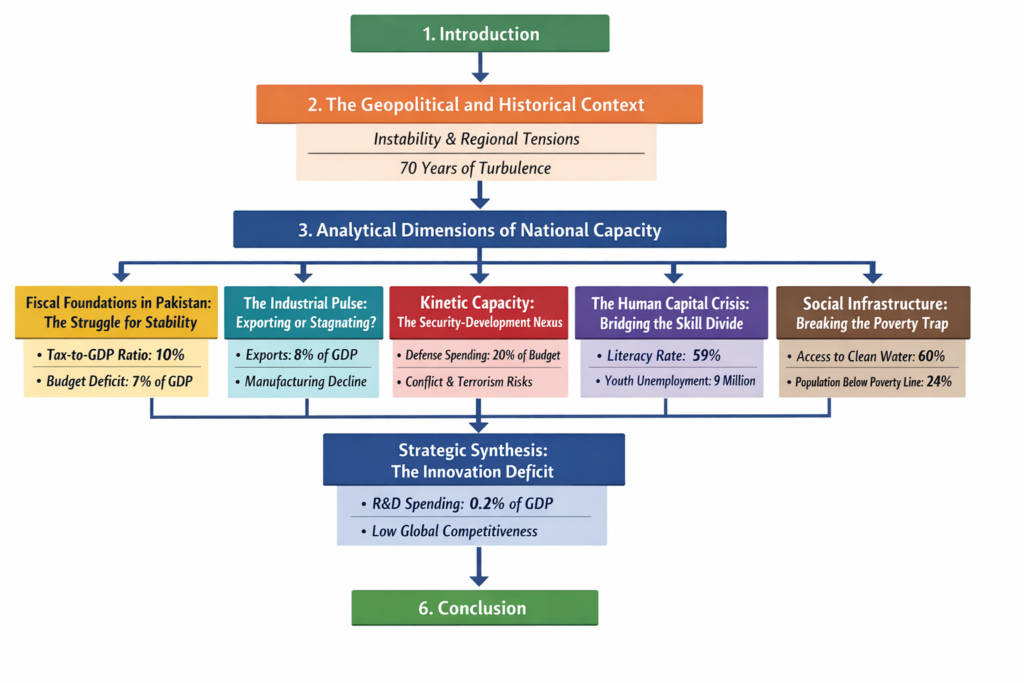
1- Introduction
2- The Geopolitical and Historical Context
3- Analytical Dimensions of National Capacity
- Fiscal Foundations: The Struggle for Stability
- The Industrial Pulse: Exporting or Stagnating?
- Kinetic Capacity: The Security-Development Nexus
- The Human Capital Crisis: Bridging the Skill Divide
- Social Infrastructure: Breaking the Poverty Trap
- Strategic Synthesis: The Innovation Deficit
6- Conclusion

Answer to the Question
Introduction
True national power in the 21st century is not merely the sum of armaments, but the synergy between fiscal health, human ingenuity, and strategic defense. In a volatile global landscape, Pakistan operates under the weight of deep-seated economic imbalances while simultaneously addressing high-stakes security imperatives. To assess the nation’s standing, one must examine the friction between its formidable military posture and its pressing socio-economic vulnerabilities. While Pakistan’s military and strategic geography provide an essential foundation for national power, its long-term viability is constrained by persistent economic fragility and underinvestment in human capital.
The Geopolitical and Historical Context
Pakistan’s post-colonial journey has evolved into the management of a demographic giant of over 255 million people. Historically, the state has prioritized a “security-first” policy, often at the expense of social sector development. Geopolitical positioning has necessitated a robust defense posture, which, while providing regional stability, has inadvertently fostered a cycle of “boom-bust” economics. This systemic institutional stagnation has hindered the development of a modern, competitive, and diversified national economy, leaving the state reliant on external financial support and remittances to bridge persistent developmental gaps.
Analytical Dimensions of National Capacity
The analytical dimensions of national capacity provide a multidimensional lens through which to assess a state’s true power, moving beyond simple gross indicators to reveal how resources are mobilized and sustained. These dimensions are generally categorized into three interdependent levels, individual, organizational, and systemic, that collectively determine a nation’s ability to achieve strategic objectives. At the individual level, capacity is measured by the aggregate skills, knowledge, and health of the population, which serves as the fundamental engine of productivity and innovation. Organizationally, capacity relates to the efficiency of public and private institutions, the quality of bureaucratic governance, and the ability to effectively allocate resources. Systemically, capacity is defined by the enabling environment, including legal frameworks, political stability, and the economic infrastructure, that dictates how individual skills and organizational efforts are translated into tangible national results. A comprehensive analysis must account for these layers not in isolation, but as a complex network where, for example, a robust military capacity is inherently dependent on the strength of the underlying economic and human capital systems.
- Fiscal Foundations: The Struggle for Stability
Economic capacity is the bedrock of state power, yet Pakistan currently faces severe fiscal volatility. The 2025-26 fiscal focus on stabilization and modest GDP growth, projected between 3.75% and 4.75% by the State Bank of Pakistan, shows clear intent, yet the high cost of debt servicing continues to consume a staggering portion of federal revenue. When such a large share of the budget is directed toward interest payments rather than infrastructure or technology, the state’s capacity to innovate is paralyzed. Without a broadened tax base and reduced reliance on external credit, the government remains trapped in a defensive fiscal cycle that inhibits long-term capital formation.
- The Industrial Pulse: Exporting or Stagnating?
The resilience of a nation is often measured by the complexity and scale of its industrial output. The Large-Scale Manufacturing (LSM) sector registered a healthy growth of 5% in the first half of FY26, yet the economy’s heavy reliance on textiles, which accounts for approximately 60% of exports, leaves it perpetually vulnerable to global market shocks. This lack of industrial diversification creates an “export trap,” where Pakistan struggles to compete with more innovative regional peers. To transcend this, the economy must pivot toward value-added manufacturing and tech-integrated services to achieve the sustained, independent economic growth necessary for true national resilience.
- Kinetic Capacity: The Security-Development Nexus
Military strength remains the most visible and resilient pillar of Pakistan’s national capacity. The consistent, high-level allocation of resources toward the National Action Plan and border security reflects a robust kinetic capacity, as evidenced by successful, ongoing counter-terrorism operations that maintain territorial integrity. While this security apparatus provides a necessary shield against regional threats, it inevitably absorbs significant capital that would otherwise be directed toward domestic human development. The strategic challenge for the state lies in maintaining this essential kinetic deterrence while gradually integrating military-industrial capabilities into the broader civilian economy to foster technological spillover.
- The Human Capital Crisis: Bridging the Skill Divide
A nation’s capacity is ultimately defined by the productivity and skill set of its citizens. Pakistan’s low HDI rank of 168th out of 193 nations, coupled with an estimated 26 million children currently out of school, highlights a catastrophic misalignment between current educational outcomes and the demands of the 21st-century digital economy. By failing to equip its massive youth population with modern technical and digital skills, the country risks turning its potential “demographic dividend” into a socio-political burden. Developing a skilled workforce is no longer a secondary welfare goal; it is a fundamental prerequisite for national competitiveness in an increasingly automated global market.
- Social Infrastructure: Breaking the Poverty Trap
The health and well-being of the population are the final arbiters of state efficiency. With approximately 38.3% of the population living in multidimensional poverty as of 2025, systemic deprivations in health, nutrition, and sanitation directly undermine labor productivity. Poverty at this scale not only affects individual households; it significantly shrinks the national tax base and stifles domestic demand. When nearly four out of every ten citizens face overlapping deprivations, the state is forced to allocate its limited resources to emergency relief and social safety nets, such as the Benazir Income Support Programme (BISP), rather than strategic, long-term investments.
- Strategic Synthesis: The Innovation Deficit
The ultimate measure of national capacity is the integration of all state pillars. The nexus between critically low R&D investment, consistently remaining below 0.3% of GDP, and poor human development suggests an innovation deficit that prevents the country from leveraging its existing industrial base for broader technological advancement. Currently, Pakistan operates in functional silos where security and civilian development rarely intersect for mutual gain. Bridging this gap through shared R&D, institutional reform, and public-private partnerships is necessary to transform isolated sectors of strength into a unified, resilient, and competitive national capacity.
Conclusion
While the military provides essential state stability, the ultimate measure of Pakistan’s national capacity rests on a difficult, necessary pivot toward human and economic capital. The current trajectory demonstrates that military strength is an insufficient guarantor of prosperity if foundational social and fiscal systems remain brittle. For Pakistan to truly realize its potential, the state must transition from a security-centric model toward a developmental paradigm that empowers its vast, youthful population through education, innovation, and fiscal discipline. Only by harmonizing these disparate pillars can Pakistan achieve durable, sovereign resilience.
CSS Solved General Science & Ability Past Papers
Want to read the last ten years’ General Science & Ability Solved Past Papers to learn how to attempt them and to score high? Let’s click on the link below to read them all freely. All past papers have been solved by Miss Iqra Ali & Dr Nishat Baloch, Pakistan’s top CSS GSA coach, having the highest score of their students.
CSS Solved Islamiat Past Papers
Want to read the last ten years’ CSS Islamiat Solved Past Papers to learn how to attempt them and maximize your score? Click the link below to access all papers for free. Each past paper has been meticulously solved by Miss Ayesha Irfan, a top CSS Islamiat coach renowned for producing consistently high-scoring students.