CSS 2026 Solved Pakistan Affairs Past Papers | 27th Constitutional Amendment and Constitutionalism in Pakistan
The following question of CSS Pakistan Affairs 2026 is solved by Miss Iqra Ali on the guided pattern of Sir Syed Kazim Ali, which he taught to his students, scoring the highest marks in compulsory subjects for years. This solved past paper question is uploaded to help aspirants understand how to crack a topic or question, how to write relevantly, what coherence is, and how to include and connect ideas, opinions, and suggestions to score the maximum.

Question Breakdown
In this question, the examiner has asked you to critically evaluate whether the 27th Constitutional Amendment strengthens or weakens constitutionalism and rule of law in Pakistan. The demand is analytical and judgment based, requiring discussion of its features, constitutional implications, institutional impact on judiciary, and a justified stance supported with constitutional articles and evidence.
Outline
1-Introduction
2- The Historical Context of Constitutional Amendments and Constitutionalism in Pakistan
3- Main Features of the 27th Constitutional Amendment
- 3.1 Creation of Federal Constitutional Courts (FCC): Article 175B to 175L
- 3.2 Executive Control over Judicial Appointments: Article 175A
- 3.3 In Camera Proceedings: Article 175B
- 3.4 Annual Judicial Evaluations and Transfer of Judges: Article 175A and Article 200
- 3.5 Lifetime Amnesties to the President and Chief of Defense Forces (CDF): Article 248
4- Role of the 27th Amendment in Weakening Constitutionalism and Rule of Law
- 4.1.Erosion of Judicial Independence Hampering Basic Structure
- Case in Point: The Objectives Resolution (Article 2A) which mandates the independence of the judiciary as an “Inalienable Fundamental.”
- 4.2. Politicization of Judicial Appointments
- Case in Point: The composition of the Judicial Commission (JCP) shifts the balance toward political nominees leading to the violation of the UN Basic Principles on the Independence of the Judiciary (1985), which requires appointments to be free from improper motives.
- 4.3. Violation of Due Process and Transparency
- Case in Point: In-Camera hearings (Article 175E) for constitutional matters conflict with Article 10A (Right to Fair Trial) and Article 19A (Right to Information).
- 4.4. The Annual Performance Evaluations as Sword of Damocles
- Case in Point: Under Article 175A, the JCP conducts annual reviews that conflicts with European Standards (Magna Carta of Judges), which warns against using evaluations to influence judicial decisions.
- 4.5. Selective Lifetime Amnesties Hampering Constitutional Fundamental Rights
- Case in Point: Violation of equality before law under Article 25 and right to be dealt with in accordance to law under Article 4
- 4.6. Undermining Checks and Balances with Unbalanced Accountability
- Case in Point: Executive dominance contradicting separation of powers doctrine inherent in constitutional framework.
5- Critical Analysis: Counter and Rebuttal
- Although framed to reduce the backlog, the haphazardous and un-necessary changes undermining spirit of “Social Contract” despite procedural compliance.
6- Conclusion

Introduction
The concept of constitutionalism in a democratic polity serves as the bedrock for the limitation of arbitrary power, ensuring that the government remains a creature of the law rather than its master. Although constitutional amendments are legitimate instruments of institutional evolution under Article 239, their legitimacy ultimately depends on whether they fortify or corrode these foundational principles. In the turbulent constitutional odyssey of Pakistan, the advent of the 27th Constitutional Amendment Act, 2025, represents a seminal, albeit highly contentious, metamorphosis of the state’s legal architecture. Despite being ostensibly framed as a pragmatic solution to the chronic malaise of judicial pendency and systemic inefficiency enhance judicial efficiency and accountability, the amendment appears to weaken constitutionalism to a significant extent by introducing provisions that dilute judicial autonomy, politicize appointments, compromise transparency, and disrupt the separation of powers. As a result, the amendment compels a critical inquiry into whether it fortifies the rule of law or precipitates its erosion. Analytically, the amendment seeks to modernize the adjudication of constitutional disputes through the creation of specialized forums, the concomitant increase in executive encroachment and the dilution of judicial autonomy suggest a troubling departure from the core tenets of a liberal democratic order.
The Historical Context of Constitutional Amendments and Constitutionalism in Pakistan
To appreciate the gravity of these changes, one must be situating the 27th Amendment within the broader historical continuum of Pakistan’s constitutional evolution. Historically, the Pakistani state has oscillated between periods of democratic consolidation and authoritarian interruptions, with constitutional amendments often serving as the primary instrument for either protecting civil liberties or entrenching executive dominance. From the transformative 18th Amendment, which sought to decentralize power and restore parliamentary supremacy, to subsequent interventions that prioritized national security over due process, the constitution has remained a “living document” in a constant state of flux. However, the recent trend, beginning with the 26th and culminating in the 27th Amendment, signals a paradigm shift toward a more centralized and executive-heavy judicial model. The superior judiciary, particularly the Supreme Court of Pakistan, has repeatedly emphasized that constitutional amendments cannot abrogate the basic structure of the Constitution, including judicial independence, democracy, and federalism. Therefore, any amendment that alters the institutional architecture of the judiciary must be assessed against this normative benchmark rather than merely procedural compliance under Article 239.
Main Features of the 27th Constitutional Amendment
The Constitution (Twenty-seventh Amendment) Act, 2025, enacted in November 2024 (and fully operationalized in late 2025), introduced structural changes to Pakistan’s judiciary and military command.
The following are the main features of the amendment:
- Establishment of the Federal Constitutional Court (FCC):
A new apex body was created via Articles 175B to 175L. The FCC now holds exclusive jurisdiction over constitutional interpretation, federal-provincial disputes, and the enforcement of fundamental rights, functions previously held by the Supreme Court.
- Executive Influence on Judicial Appointments:
Under Article 175A, the composition of the Judicial Commission of Pakistan (JCP) is revised, placing judicial members in a minority (5 out of 13 members). The first Chief Justice and initial batch of FCC judges were appointed by the President on the advice of the Prime Minister.
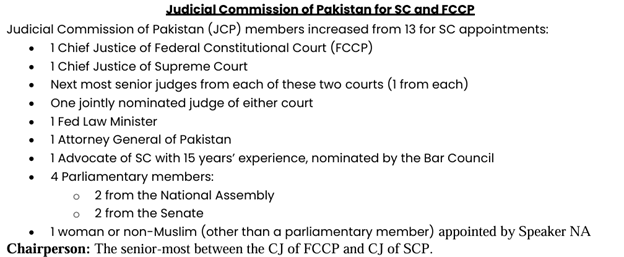
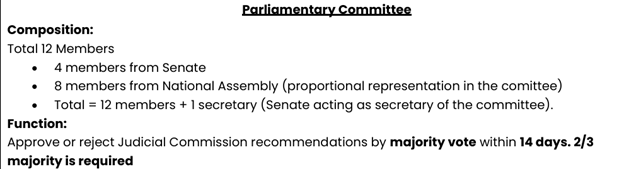
Appointment Procedures
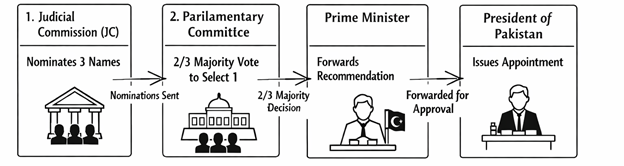
- In-Camera Proceedings:
The amendment introduced provisions, linked to Article 175B and related procedural clauses, that allow for in-camera (private) hearings in constitutional matters, particularly those involving national security or sensitive state interests.
- Judicial Evaluations and Transfers:
Under Articles 175A and 200, the JCP is now mandated to conduct annual performance evaluations of High Court judges. Additionally, the President can transfer High Court judges between provinces without their consent; refusal to accept a transfer results in the judge being “deemed retired.”
- Lifetime Immunity for High Offices:
Article 248 was amended to grant the President of Pakistan lifetime immunity from criminal prosecution and arrest. This immunity was also extended to the newly created office of Chief of Defence Forces (CDF) and the other five-star military ranks (Field Marshal, Marshal of the Air Force, Admiral of the Fleet).
- Restructuring of Military Command:
Article 243 was revised to abolish the post of Chairman Joint Chiefs of Staff Committee (CJCSC) and establish the Chief of Defence Forces (CDF) as the supreme head of all armed services branches.
| Feature | Relevant Article(s) |
| Creation of Federal Constitutional Court (FCC) | Articles 175B to 175L |
| Executive Influence on Appointments | Article 175A (Reconstituted JCP) |
| Annual Judicial Performance Evaluations | Article 175A (Clauses 18, 19, 20) |
| Non-Consensual Transfer of Judges | Article 200 |
| In-Camera Proceedings | Article 175E |
| Lifetime Immunity for President/CDF | Article 248 |
| New Military Command Structure | Article 243 |
Role of the 27th Amendment in Weakening Constitutionalism and Rule of Law
- Erosion of Judicial Independence Hampering Basic Structure
The 27th Amendment’s role in weakening constitutionalism begins with a systematic erosion of judicial independence, which serves as a direct assault on the Basic Structure Doctrine. By carving out a separate Federal Constitutional Court and divesting the Supreme Court of its traditional powers, the amendment bypasses the settled hierarchy that historically shielded the judiciary from executive whim. This fragmentation of judicial authority runs counter to the spirit of the Objectives Resolution (Article 2A), which is not merely a preamble but a substantive part of the Constitution that mandates the independence of the judiciary as an inalienable fundamental. When the highest arbiter of the law is structurally subordinated, the concept of limited government becomes a theoretical facade, as the very institution meant to check executive excesses is itself redesigned by the executive.
- Politicization of Judicial Appointments
This institutional decay is further exacerbated by the blatant politicization of judicial appointments through the reconstituted Judicial Commission of Pakistan. By altering the numerical balance within the JCP to favor treasury benches and political nominees over judicial members, the appointment process has been transformed from a peer-driven meritocracy into a mechanism for political patronage. Such a shift constitutes a manifest violation of the UN Basic Principles on the Independence of the Judiciary (1985), which explicitly state that any method of judicial selection must safeguard against appointments for improper motives. When judges perceive that their elevation is contingent upon political alignment rather than jurisprudential excellence, the impartiality of the bench is compromised, effectively poisoning the well of justice at its source.
- Violation of Due Process and Transparency
The introduction of in-camera proceedings for constitutional matters further dismantles the rule of law by sacrificing transparency at the altar of state secrecy. Under the newly inserted Article 175E, the ability to conduct closed-door hearings on issues of immense public importance directly conflicts with the Right to a Fair Trial under Article 10A. Moreover, it stifles the Right to Information enshrined in Article 19A, which is essential for a functioning democracy. Additionally, this shift bypasses the very heart of Article 68, which imposes a strict restriction on discussion in Majlis-e-Shoora regarding the conduct of any judge of the Supreme Court or a High Court in the discharge of their duties, undermining the constitutional shield designed to prevent political debates on judicial actions, thereby gutting a primary safeguard of judicial independence.
Read more relevant content: Judicial Activism vs Judicial Overreach
- The Annual Performance Evaluations as Sword of Damocles
Furthermore, the implementation of annual judicial performance evaluations under Article 175A functions as a metaphorical “Sword of Damocles” hanging over the heads of High Court judges. While accountability is a noble pursuit, the use of annual reviews by a politically influenced Commission to determine “efficiency” creates an environment of perpetual insecurity. This mechanism stands in sharp contrast to international norms, such as the European Standards (Magna Carta of Judges), which warn that evaluations must never be used to influence or intimidate judicial decisions. By making a judge’s tenure dependent on satisfying periodic efficiency metrics, the amendment risks incentivizing executive-friendly rulings, as judges may fear that dissenting opinions could be weaponized against them during their annual review.
- Selective Lifetime Amnesties Hampering Constitutional Fundamental Rights
The amendment’s impact on fundamental rights is perhaps most visible in the granting of selective lifetime amnesties, which fundamentally hamstrings the principle of legal equality. By amending Article 248 to shield the President and the Chief of Defence Forces from criminal liability for life, the state has created a privileged class that exists above the reach of the law. This categorical immunity is a prima facie violation of Article 25 (Equality of Citizens) and Article 4 (Right of individuals to be dealt with in accordance with law). Such a provision suggests that accountability is a burden intended only for the common citizen, while the highest echelons of power are granted a “get out of jail free” card, thereby undermining the moral and legal authority of the entire constitutional framework.
- Undermining Checks and Balances with Unbalanced Accountability
Ultimately, these changes culminate in a profound undermining of the system of checks and balances, leading to an era of unbalanced accountability where the executive reigns supreme. The doctrine of the Separation of Powers requires that no single branch of government becomes dominant. However, by controlling judicial appointments, influencing tenures through evaluations, and granting itself immunity, the executive has effectively dismantled the barriers that prevent absolute rule. This concentration of power contradicts the separation of powers doctrine inherent in the constitutional framework, replacing a system of mutual oversight with one of executive dominance. In doing so, the 27th Amendment does not reform the judiciary; it captures it, leaving the rule of law in a precarious state where the constitution serves the rulers rather than the ruled.
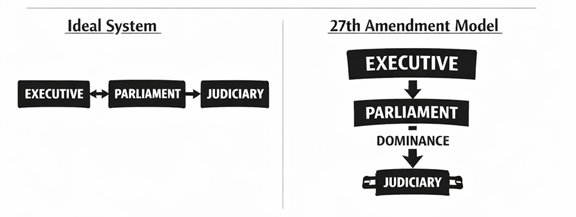
Critical Analysis
Although the government justifies the sweeping changes as a necessary remedy for the chronic backlog of cases and the judicial overreach of previous decades, the rapid and haphazard nature of the legislative process contradicts the very nature of the “Social Contract” where people are masters of the laws. By rushing the amendment through Parliament without meaningful public debate or cross-party consensus, the state has bypassed the democratic deliberative process. This procedural haste undermines the spirit of Article 239, which, although granting Parliament the power to amend the Constitution, implies that such changes should reflect the collective will of the people rather than the immediate interests of a ruling coalition. Moreover, in the legal realm, justice cannot be measured by a mere tally of disposed cases; it requires the intellectual freedom to challenge state power when necessary. By subjecting judges to frequent reviews by a politically dominated Commission, the 27th Amendment essentially treats the judiciary as a subordinate administrative department. When the executive gains the power to transfer judges at will under Article 200 or influence their career trajectory through subjective evaluations, the neutrality of the court becomes a myth, leaving the citizen defenseless against state excesses.
Conclusion
In a nutshell, Pakistan is moving toward a model of executive-led constitutionalism. A Constitution is, by its very nature, a living social contract designed to protect the people from the state, not the rulers from the law. Although judicial accountability is undeniably necessary, the 27th Amendment’s current form risks converting the third branch of government into a subordinate entity. Likewise, lifetime amnesties and centralizing control over judicial appointments and tenures, the amendment fractures the delicate balance of power. For the rule of law to survive, the judiciary must remain an autonomous guardian of the Constitution. Therefore, it is imperative to revise these provisions, prioritizing transparency, seniority, and merit, to ensure that the legal system remains a source of justice for the public rather than a tool of survival for the political elite.
CSS 2026 Solved Pakistan Affairs
| 2- | Conduct a Comprehensive Appraisal of the Similarities and Differences Between Iqbal’s Philosophical Ideas and Jinnah’s Political Interpretation of the Pakistan Ideology. |
| 3- | “The Instability in Afghanistan Continues to Influence Pakistan’s Internal Security, Regional Diplomacy, and Counter Terrorism Strategy”. Critically Examine the Above Statement and Suggest Policy Measures to Address the Issue/Challenge. |
| 4- | To What Extent Does the 27th Constitutional Amendment Strengthen or Weaken Constitutionalism and Rule of Law in Pakistan? Justify Your Stance with Valid Arguments. |
| 5- | Critically Assess How Youth Perspectives, Digital Activism, and Civil Society Movements are Influencing Civil-Military Relations. |
| 6- | Undertake a Concise Assessment of the Key Economic Challenges Currently Confronting Pakistan. Illustrate How the IMF’s Conditions Can Shape the Country’s Path Towards Economic Stabilization and Long-Term Financial Sustainability? |
| 7- | “The Unresolved Kashmir Issue Exposes the Inherent Weakness in the United Nations Security Council’s Architecture.” Critically Examine the Role of the UNSC in Resolving the Kashmir Issue |
| 8- | Critically Assess the Performance of the Health and Education Sectors after Being Handed Over to the Provinces Under the 18th Amendment and Suggest a Way Forward. |
CSS Solved Past Papers’ Essays
Looking for the last ten years of CSS and PMS Solved Essays and want to know how Sir Kazim’s students write and score the highest marks in the essays’ papers? Then, click on the CSS Solved Essays to start reading them.
CSS Solved Essays
CSS Solved General Science & Ability Past Papers
Want to read the last ten years’ General Science & Ability Solved Past Papers to learn how to attempt them and to score high? Let’s click on the link below to read them all freely. All past papers have been solved by Pakistan’s top CSS GSA coach having the highest score of their students.
General Science & Ability Solved Past Papers