CSS 2026 Solved Current Affairs Past Papers | Pakistan’s Heightened Vulnerability and Policy Measures
The following question of CSS Current Affairs 2026 is solved by Sir Ammar Hashmi, the best Current Affairs coach, on the guided pattern of Sir Syed Kazim Ali, which he taught to his students, scoring the highest marks in compulsory subjects for years. This solved past paper question is uploaded to help aspirants understand how to crack a topic or question, how to write relevantly, what coherence is, and how to include and connect ideas, opinions, and suggestions to score the maximum.

Question Breakdown
In this question, the examiner has asked multiple problems with far-sighted policy suggestions. Rather than wasting time on one issue, balance the breakdown by giving equal time to all problems with a balanced policy suggestion at each point. Do not overwrite on one, leaving others unexplored. Providing successful models on the given issues can work best in this regard.
Outline
1-Introduction
2-The Current Situation of the Poly Crises State of Pakistan
- 2.1. Unending Climate Shocks and Environmental Stresses
- Case in Point: Pakistan consistently ranked among the top ten most climate change-affected countries according to the World Bank
- 2.2. Rapid Population Growth and Demographic Pressure
- Case in Point: Pakistan’s Annual Population Growth Rate is about 2.55 percent, with Bangladesh’s standing at 1.2 percent
- 2.3. Governance Gaps and Institutional Weaknesses
- Case in Point: The November 2025 Governance and Corruption Diagnostic Report revealing that reversing deep-seated corruption could boost GDP by 6.5 percent
- 2.4. Non-Traditional Security Threats
- Case in Point: The 2021-2026 National Security Policy of Pakistan, highlighting water scarcity, food insecurity, and cyberattacks as the most pressing non-traditional security threats
- 2.5. Intense Fiscal Stress and Economic Fragility
- Case in Point: Pakistan’s fiscal deficit of the Fiscal Year 2025-26 recorded at 5.4 percent of GDP with only 6 percent of populating paying eighty percent of the tax
3- Policy Measures for Building Stable, Secure and Disaster-Resilient Pakistan
- 3.1. To Focus on the Comparative Advantage in the Value-added products Exports
- Case in Point: NordoPolitic of South Korea and Doi-Moi Policy model of Vietnam
- 3.2. Population Management and Human Capital Development through Education and Entrepreneurship
- Case in Point: Yozma Venture Capitalist Program of Israel, Empowering the Youth to Innovate and Develop
- 3.3. To Widen the Tax-Net Adding the Feudals and Real-estate under the tax Umbrella
- Case in Point: Global Tax/GDP standard remains at 15 percent minimum according to the World Bank
- 3.4. To Ensure Intelligence-Based Smart Border Management and Regional Collaboration for Coordinated Security
- Case in Point: Turkiye’s AI-enabled Border Surveillance and European Union’s Travel Information and Authorization Systems
- 3.5. To Develop Climate Resilient Economic and Agricultural Infrastructure
- Case in Point: Netherlands’ Delta Works and Living with the Water Project with floating plazas being declared as 7th wonder of the modern world
4- Steps Already Taken by Pakistan to Deal with the Heightened National Vulnerability
- 4.1- Pakistan China CPEC 2:0 Revival and Pakistan USA Mineral Deal 2025
- 4.2- Uraan Pakistan Economic Revival Plan 2025
- 4.3- The Revised National Action Plan to Counter Terrorism
- 4.4- The Global Advocacy for the Loss and Damage Fund
5- Conclusion
Introduction
The contemporary geopolitical and socioeconomic landscape of Pakistan is currently defined by a formidable “polycrisis,” a phenomenon where disparate systemic failures coalesce to create an existential threat greater than the sum of its parts. At this precarious juncture, the nation finds itself at a decisive crossroads, grappling with a lethal convergence of erratic climate patterns, an unbridled demographic explosion, systemic governance paralysis, and a suffocating fiscal straitjacket. This multifaceted vulnerability is not merely a transient phase of instability but a structural manifestation of decades of policy inertia and strategic myopia. To critically evaluate the assertion that Pakistan is at a turning point is to acknowledge that the traditional paradigms of national security, once focused solely on kinetic deterrence and territorial integrity, are now obsolete. The modern battlefield is defined by melting glaciers, a shrinking tax base, and the silent encroachment of food and water insecurity. Consequently, the transition toward a stable, secure, and disaster-resilient state necessitates a radical departure from status-quo adventurism toward a sophisticated, multi-sectoral policy framework that prioritizes human security and institutional transparency.
The Current Situation of the Poly Crises State of Pakistan
- Unending Climate Shocks and Environmental Stresses
The gravity of the situation is perhaps most visibly articulated through the lens of environmental cataclysm. Pakistan serves as a tragic microcosm of global climate injustice, as it remains a negligible contributor to global carbon emissions yet bears a disproportionate burden of its consequences. The World Bank consistently ranks Pakistan among the top ten most climate change-affected countries, a harrowing distinction that translates into tangible economic devastation. The persistence of unending climate shocks—ranging from the biblical proportions of the 2022 floods to the relentless heatwaves and glacial lake outburst floods in the north—has created a state of perpetual recovery. These environmental stresses do not act in isolation; they act as “threat multipliers,” exacerbating existing resource scarcities and displacing millions, thereby straining an already fragile social fabric. The ecological fragility of the Indus River Basin, the lifeline of the nation’s agrarian economy, signifies that without immediate and massive investment in climate adaptation, the very foundations of Pakistan’s food security remain under constant duress.
- Rapid Population Growth and Demographic Pressure
Compounding this environmental vulnerability is the relentless pressure of demographic expansion, which threatens to neutralize any incremental gains in economic growth. The stark disparity in regional population trends highlights a deepening crisis: Pakistan’s annual population growth rate hovers around 2.55 percent, a figure that stands in sharp contrast to Bangladesh’s more controlled 1.2 percent. This demographic trajectory is unsustainable for a state with dwindling natural resources and a stagnant job market. Instead of reaping a “demographic dividend,” the nation risks a “demographic disaster” where a burgeoning youth population, deprived of quality education and vocational opportunities, becomes susceptible to radicalization and social unrest. The sheer volume of human capital requiring health, housing, and employment outpaces the state’s capacity to provide, creating a widening gap between public expectations and institutional delivery.
- Governance Gaps and Institutional Weaknesses
The chasm is further exacerbated by profound governance gaps and the erosion of institutional integrity. The mechanics of the Pakistani state have long been impeded by “elite capture,” where policy outcomes are skewed to favor a narrow segment of the citizenry at the expense of the collective good. The November 2025 Governance and Corruption Diagnostic Report revealed the staggering cost of this dysfunction, suggesting that reversing deep-seated corruption and streamlining bureaucratic efficiency could boost the national GDP by as much as 6.5 percent. The lack of transparency in public procurement, the politicization of the civil service, and the glacial pace of judicial redressal have collectively fostered an environment of impunity. When the state fails to uphold the rule of law or ensure the equitable distribution of resources, the social contract is fundamentally breached, leaving the populace disillusioned and the national structure vulnerable to internal fragmentation.
- Non-Traditional Security Threats
Simultaneously, the nature of threats to the state has evolved from conventional military confrontation to a more insidious array of non-traditional security challenges. These threats operate in the gray zones of human and digital security, often bypassing traditional defense mechanisms. The 2021-2026 National Security Policy of Pakistan explicitly shifted the focus toward these emerging frontiers, identifying water scarcity, food insecurity, and cyberattacks as the most pressing contemporary dangers. Water insecurity, in particular, is an existential sword of Damocles; as per capita water availability plummets toward the “scarcity” threshold, the potential for inter-provincial conflict over riparian rights intensifies. Furthermore, the digitalization of the global economy has made Pakistan’s critical infrastructure vulnerable to cyber-warfare, while hybrid threats and disinformation campaigns continue to polarize the domestic discourse, undermining national cohesion from within.
- Intense Fiscal Stress and Economic Fragility
Underpinning all these vulnerabilities is a state of intense fiscal stress and chronic economic fragility that limits the government’s maneuverability. The national treasury is currently burdened by a debt-servicing cycle that leaves little room for development spending or social safety nets. The fiscal deficit for the 2025-26 fiscal year was recorded at a staggering 5.4 percent of GDP, a deficit deepened by an egregiously narrow tax base where only 6 percent of the population is responsible for paying 80 percent of the total tax revenue. This structural imbalance reflects a profound inequity in the fiscal regime, where the informal economy thrives and powerful interest groups remain shielded from the tax net. The resulting reliance on external borrowing and international financial institution bailouts has compromised sovereign decision-making, leaving Pakistan in a state of “stabilization without growth.”

Policy Measures for Building Stable, Secure and Disaster-Resilient Pakistan
- To Focus on the Comparative Advantage in the Value-added products Exports
To navigate this labyrinth of crises, Pakistan must adopt a policy of aggressive economic restructuring that prioritizes value-added exports over raw commodity dependence. The path to stability lies in emulating successful developmental models that transformed stagnant economies into global manufacturing hubs. Drawing inspiration from the ‘Nordopolitik’ of South Korea and the ‘Doi-Moi’ policy model of Vietnam, Pakistan must pivot its industrial policy toward high-tech manufacturing and specialized services. By providing targeted incentives for research and development and fostering a “Ease of Doing Business” environment that attracts foreign direct investment into the productive sectors, the nation can move beyond its current “import-substitution” trap. This transition requires a dedicated focus on the country’s comparative advantages—such as its strategic location and its potential in the IT sector—to create a self-sustaining cycle of foreign exchange earnings that can eventually retire the national debt.
- Population Management and Human Capital Development through Education and Entrepreneurship
Parallel to economic reform, the management of human capital through robust population control and modern entrepreneurship is imperative. The state must move beyond rhetorical commitments to family planning and implement community-based interventions to reduce the fertility rate. Simultaneously, the youth must be equipped with the tools of the fourth industrial revolution. The Yozma Venture Capitalist Program of Israel provides a stellar blueprint for empowering youth through state-backed innovation funds. By creating a domestic venture capital ecosystem that rewards risk-taking and technological disruption, Pakistan can transform its youth from job-seekers into job-creators. Investing in vocational training centers that align with global market demands will ensure that the Pakistani workforce remains competitive in an increasingly automated world, thereby securing a steady stream of high-value remittances.
- To Widen the Tax-Net Adding the Feudal and Real-estate under the Tax Umbrella
Furthermore, the restoration of fiscal sanity demands a courageous expansion of the tax net to include previously insulated sectors. The current paradigm, which disproportionately burdens the manufacturing sector and salaried individuals, is both unjust and economically stifling. In alignment with the World Bank’s global standard, which posits a minimum Tax-to-GDP ratio of 15 percent for sustainable development, Pakistan must bring the landed aristocracy and the speculative real estate sector under a progressive tax umbrella. Eliminating the “SRO culture” of discretionary tax exemptions and digitizing the Federal Board of Revenue to minimize human interface will not only increase revenue but also restore public trust in the fiscal system. A broadened tax base is the only sustainable way to fund the massive infrastructure and social investments required to build resilience against the aforementioned climate and demographic shocks.
- To Ensure Intelligence-Based Smart Border Management and Regional Collaboration for Coordinated Security
In the realm of security, the evolution of threats necessitates a departure from traditional kinetic approaches toward intelligence-based, technologically sophisticated paradigms. The porous nature of the state’s frontiers has long facilitated the illicit flow of contraband and the movement of non-state actors, undermining both the economy and internal stability. Drawing from the successes of Turkiye’s AI-enabled border surveillance and the European Union’s Travel Information and Authorization Systems, Pakistan must modernize its border management through the integration of biometric verification, drone patrolling, and real-time data analytics. This digital firewall must be complemented by regional collaboration; security is no longer a zero-sum game played within national silos but a collective endeavor. By spearheading a coordinated regional framework for counter-terrorism and intelligence sharing, Pakistan can mitigate the spillover effects of regional instability and secure its trade corridors, turning its geographical position from a strategic liability into a transit-economy asset.
- To Develop Climate Resilient Economic and Agricultural Infrastructure
However, no amount of fiscal or security reform can yield lasting stability if the nation’s physical foundations remain defenseless against the elements. The transition toward a disaster-resilient Pakistan requires a monumental shift in engineering and agricultural philosophy. The country must move away from reactive disaster management and toward proactive climate-resilient infrastructure. A pertinent case in point is the Netherlands’ Delta Works and the “Living with Water” project, where floating plazas and sophisticated surge barriers have been declared a wonder of the modern world. Pakistan must adapt these models to its own unique topography by developing “sponge cities” that can absorb urban flooding and by constructing resilient irrigation networks that minimize water transit losses. In the agricultural sector, the introduction of climate-smart techniques and heat-resistant crop varieties is essential to safeguard the livelihoods of millions. This infrastructure must be viewed as a strategic investment; the cost of building resilience today is a fraction of the cost of reconstruction tomorrow.
Steps Already Taken by Pakistan to Deal with the Heightened Vulnerability
Critically, it would be a mistake to view Pakistan as a passive victim of these circumstances, as several strategic initiatives are already underway to pivot away from this heightened vulnerability. The transition toward CPEC 2.0 and the revival of the Pakistan-China economic partnership, alongside the 2025 Pakistan-USA Mineral Deal, represents a concerted effort to diversify the nation’s economic base. These agreements signal a shift toward the “geo-economics” envisioned in the national security policy, aiming to tap into the country’s untapped metallic and mineral wealth to generate sustainable revenue. By leveraging international partnerships, the state is attempting to anchor itself in global value chains, thereby creating a buffer against unilateral economic shocks and providing a much-needed influx of foreign exchange.
On the domestic front, the Uraan Pakistan Economic Revival Plan of 2025 serves as a comprehensive roadmap for structural reform, targeting the removal of bureaucratic bottlenecks and the promotion of a digital-first economy. This plan is synchronized with the Revised National Action Plan to Counter Terrorism, which now increasingly incorporates measures to tackle the digital and financial lifelines of extremist networks. Furthermore, Pakistan’s leadership in global advocacy for the Loss and Damage Fund at international climate forums has successfully shifted the discourse toward climate justice, forcing the global community to recognize its financial obligations toward climate-vulnerable nations. While these steps are commendable, their success hinges on the continuity of policy and the insulation of economic decision-making from the turbulence of the political cycle.
Conclusion
In the nutshell, the convergence of climate, demographic, and fiscal crises has stripped away the luxury of incrementalism. Pakistan stands at a juncture where the cost of the status quo has become prohibitive. Building a stable and secure nation requires more than just administrative tweaks; it demands a fundamental reimagining of the state’s priorities. The transition from a state defined by its vulnerabilities to one defined by its resilience is achievable through the synergy of value-added economic growth, rigorous population management, fiscal equity, and climate-smart governance. By harnessing the resilience of its people and aligning its strategic goals with the realities of the twenty-first century, Pakistan can transform this polycrisis into a catalyst for national renewal. The turning point is here; the choice remains between a descent into further fragility or an ascent toward a coordinated, technologically empowered, and disaster-resilient future.
CSS 2026 Solved Current Affairs
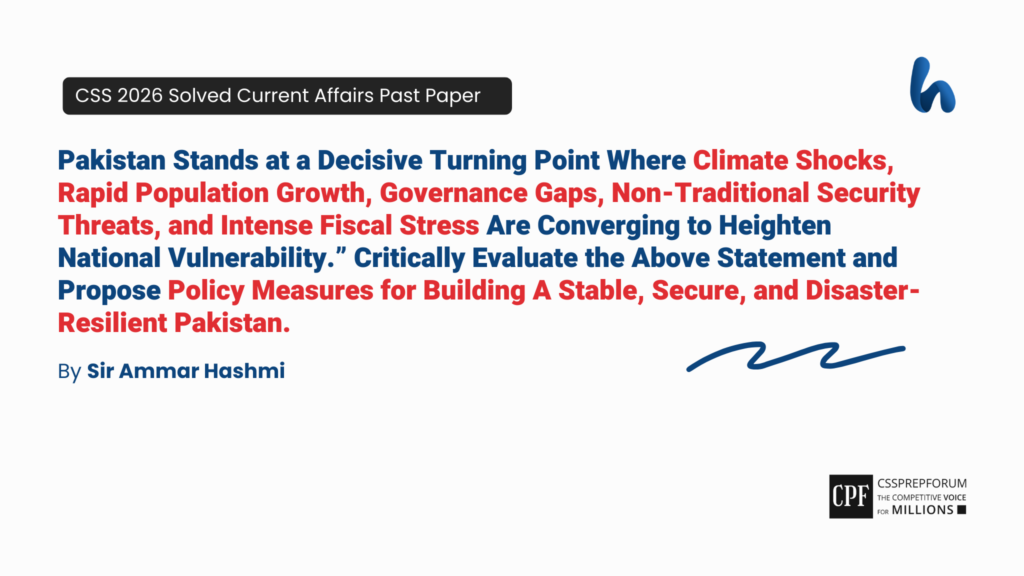
| 2- | “Pakistan Stands at a Decisive Turning Point Where Climate Shocks, Rapid Population Growth, Governance Gaps, Non-Traditional Security Threats, and Intense Fiscal Stress Are Converging to Heighten National Vulnerability.” Critically Evaluate the Above Statement and Propose Policy Measures for Building A Stable, Secure, and Disaster-Resilient Pakistan. |
| 3- | “Brain drain threatens Pakistan’s ability to achieve its Sustainable Development Goals (SDGs) by 2030”. Write a comprehensive note on the causes and consequences of brain drain from Pakistan, focusing on its impact on achieving SDGs (you may choose any three SDGs for answering this question). |
| 4- | Critically Appraise the Following Statement with Relevant Examples. Furthermore, Draw Relevant Lessons and Propose a Way Forward for Pakistan. “Natural Resources, Though Desirable for the Development of a Country, Can Become a Source of Conflict and Instability.” |
| 5- | Non-Governmental Organizations (NGOs), once called “force multipliers”, are now having trust issues as public skepticism about the virtues and advantages of NGOs has dropped. Critically examine why NGOs’ space is shrinking in many parts of the world, with specific reference to Pakistan. |
| 6- | COP – the annual climate negotiation, Conference of the Parties to the UN Framework Convention on Climate Change (UNFCCC) is organized every year since 1995. What are the significant achievements of COPs in general and COP-30 in particular |
| 7- | Conduct a critical analysis of the prospects of resolution of the Palestinian conflict with special reference to the UN Security Council’s recently approved US-drafted resolution for peace in Gaza. Can Pakistan play any role in this initiative? |
| 8- | Write short notes on any TWO of the following: (i) Pros and cons of food production through Genetically Modified Organisms (GMOs) (ii) Implications of depopulation (iii) Role of China in evolving world order |
CSS Solved Past Papers’ Essays
Looking for the last ten years of CSS and PMS Solved Essays and want to know how Sir Kazim’s students write and score the highest marks in the essays’ papers? Then, click on the CSS Solved Essays to start reading them.
CSS Solved Essays
CSS Solved General Science & Ability Past Papers
Want to read the last ten years’ General Science & Ability Solved Past Papers to learn how to attempt them and to score high? Let’s click on the link below to read them all freely. All past papers have been solved by Pakistan’s top CSS GSA coach having the highest score of their students.
General Science & Ability Solved Past Papers