
CSS Solved Political Science 2026 Past Paper | Impact of the Cold War on International Relations
The following question of CSS Political Science 2026 is solved by Miss Ayesha Irfan, a renowned CSS coach for Islamiat and Political Science. Moreover, the question is attempted using the same pattern taught by Sir Syed Kazim Ali to his students, who have scored the highest marks in compulsory and optional subjects for years. This solved past paper question is uploaded to help aspirants understand how to crack a topic or question, write relevantly, what coherence is, and how to include and connect ideas, opinions, and suggestions to score the maximum.

Question Breakdown
This question is primarily argumentative, as it requires an analysis of cause-and-effect relationships and the evaluation of how specific geopolitical shifts (like the rise of the US and USSR) fundamentally restructured global interactions. While it contains descriptive elements regarding historical events, the “analysis” demand pushes it into the argumentative sphere, requiring a stance on how profoundly these dynamics altered the international system.
Outline
1- Introduction
2- Contextual Background
3- Impact of the Cold War on international relations
- The Structural Shift: From Multipolarity to Bipolarity
- Institutionalized Alignment: The Rise of Military Blocs
- The Globalization of Friction: Impact on the Third World
- Nuclear Diplomacy and the Concept of Deterrence
- Economic Bifurcation: Trade as a Weapon
- The Paralysis of Collective Security (The UN)
4- Critical Analysis: The Erosion of State Sovereignty
5- Conclusion

Answer to the Question
Introduction
The post-1945 world did not witness a return to traditional peace, but rather a transition into a “long peace” defined by the shadow of total annihilation. The collapse of the Axis powers and the exhaustion of traditional European empires created a profound geopolitical vacuum. In this void, two opposed systems rose to define the new global order. This essay argues that the Cold War fundamentally restructured international relations by institutionalizing a bipolar system, where the emergence of the US and USSR as superpowers subordinated global sovereignty to the rigid, ideological demands of bloc politics.
Contextual Background
The transition from a multipolar Europe to a bipolar world was cemented at the Yalta and Potsdam Conferences. As Britain and France faced economic exhaustion and decolonization, the United States and the Soviet Union remained the only nations with the industrial and military capacity to project influence globally. This disparity in power necessitated a new form of diplomacy—one based on containment, ideological purity, and the formalization of permanent military alliances that effectively split the globe into two competing spheres of influence.
Impact of the Cold War on international relations
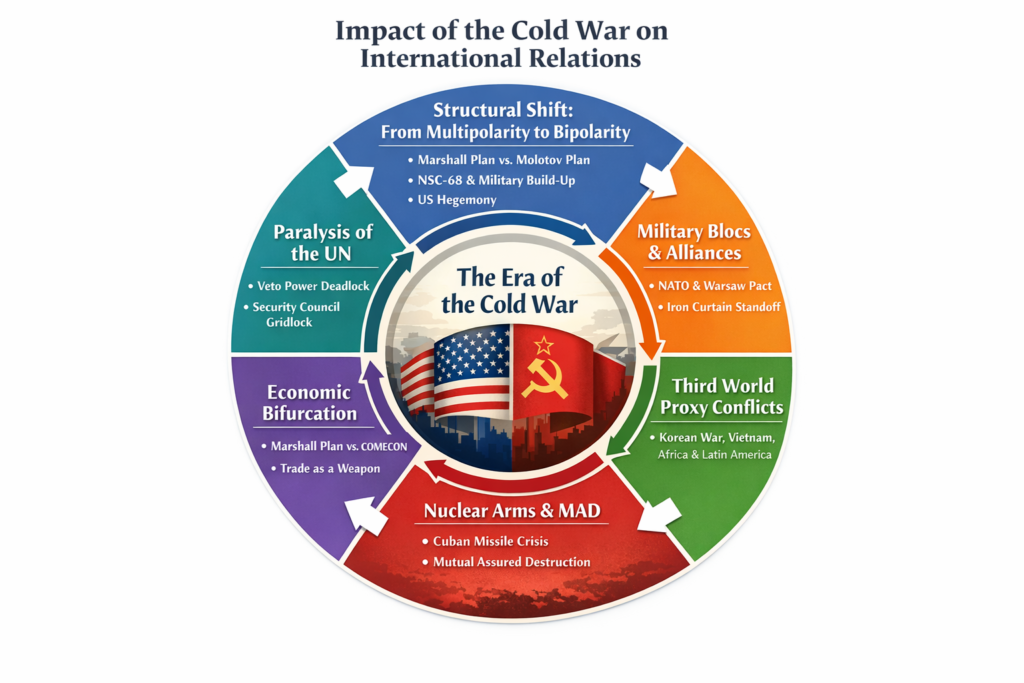
- The Structural Shift: From Multipolarity to Bipolarity
The emergence of superpowers replaced the “Great Power” model with a binary hierarchy. A primary example is the Marshall Plan vs. the Molotov Plan, where economic recovery was used to draw hard lines across Europe. Statistically, by 1950, the US possessed 50% of the world’s wealth, providing the capital to anchor the Western bloc. The NSC-68 document explicitly called for a massive military buildup to “contain” Soviet expansion. This evidence demonstrates that the US shift from isolationism to global hegemony was a calculated response to the perceived Soviet monolith.
- Institutionalized Alignment: The Rise of Military Blocs
Bloc politics institutionalized alignment through military frameworks like NATO and the Warsaw Pact. A real-time example of this “bloc discipline” was the 1956 Hungarian Uprising, where Soviet tanks crushed dissent to prevent a crack in the Eastern sphere. By the 1960s, these blocs maintained over 6 million active troops along the Iron Curtain. The North Atlantic Treaty (1949), specifically Article 5, established the principle of collective defense. This treaty transformed local security issues into potential triggers for global thermonuclear war, effectively ending the era of independent European defense.
- The Globalization of Friction: Impact on the Third World
The Cold War exported European friction to the Global South through proxy conflicts. The Korean War served as the first “hot” manifestation of this global tension, where local grievances were subsumed by ideological rivalry. It is estimated that over 11 million deaths occurred in Cold War-related proxy conflicts in Asia, Africa, and Latin America. The Bandung Conference (1955) communiqué gave birth to the Non-Aligned Movement, representing a third of the world’s population. This movement was a direct textual rejection of the bipolar “bloc” trap, though it struggled to remain truly independent of superpower pressure.
- Nuclear Diplomacy and the Concept of Deterrence
Nuclear diplomacy and the concept of MAD created a paradoxical “hostile stability.” The Cuban Missile Crisis of 1962 remains the most harrowing example of the world teetering on the brink of collapse. At the height of the arms race, global nuclear stockpiles peaked at roughly 70,000 warheads. The Limited Test Ban Treaty (1963) served as one of the first formal efforts to regulate this existential threat. This evidence suggests that while nuclear weapons prevented a direct “Hot War” between superpowers, they institutionalized a permanent state of global anxiety.
- Economic Bifurcation: Trade as a Weapon
Economic bifurcation served as a primary tool of bloc politics, creating two non-communicating spheres. The Berlin Airlift was a real-time response to the Soviet attempt to economically choke West Berlin into submission. To secure loyalty, the US injected $13 billion through the Marshall Plan into Western Europe. Conversely, the COMECON Charter was designed to integrate Eastern economies under Soviet central planning. This economic segregation ensured that trade became a subset of military strategy, used to bolster “friendly” regimes while effectively isolating the ideological opponent.
- The Paralysis of Collective Security (The UN)
The Cold War effectively neutralized the United Nations’ primary mission of maintaining global peace through collective security. A real-time example of this paralysis was the Korean War, where the UN only managed to intervene because the Soviet Union was boycotting the Security Council at the time. Statistically, the impact of bloc politics is evident in the veto records; by 1955, the Soviet Union had used its veto 80 times to block Western-led initiatives. Article 27 of the UN Charter, which grants permanent members the power of veto, became the ultimate tool of superpower obstruction. This evidence demonstrates that the UN was transformed from a peacekeeping body into a diplomatic battlefield where collective action was consistently sacrificed for the strategic interests of the two superpowers.
4- Critical Analysis: The Erosion of State Sovereignty
The Cold War fundamentally restructured international relations by institutionalizing bipolarity and entrenching bloc politics under the dominance of the United States and the Soviet Union. Rather than producing direct military confrontation between the two superpowers, it generated a prolonged strategic rivalry that globalized ideological conflict between capitalism and communism. The creation of rival military alliances such as NATO and the Warsaw Pact formalized bloc politics, compelling states to align within rigid security frameworks that limited foreign policy autonomy. This bipolar order stabilized great-power war through nuclear deterrence, particularly under the doctrine of Mutually Assured Destruction, yet simultaneously destabilized the Global South through proxy wars in regions such as Korea, Vietnam, and Afghanistan. While the superpower rivalry accelerated technological advancement and institutionalized international diplomacy, including arms control agreements, it also entrenched militarization, securitized development, and reduced multilateral institutions to arenas of ideological contestation. Critically, the Cold War did not merely divide the world into two camps; it reshaped sovereignty itself, as smaller states navigated dependency, non-alignment, or clientelism within a hierarchically structured international system.
5- Conclusion
The Cold War’s legacy is the structural blueprint of modern international relations. By elevating the US and USSR to superpower status, it replaced flexible, multipolar diplomacy with a binary system of “us vs. them.” While the Soviet Union eventually collapsed, the mechanisms of bloc politics, most notably NATO, endure. The era proved that in a bipolar world, the security of the superpower often comes at the expense of the autonomy of the smaller state, leaving a permanent mark on global governance.

CSS Solved General Science & Ability Past Papers
Want to read the last ten years’ General Science & Ability Solved Past Papers to learn how to attempt them and to score high? Let’s click on the link below to read them all freely. All past papers have been solved by Miss Iqra Ali & Dr Nishat Baloch, Pakistan’s top CSS GSA coach, having the highest score of their students.
CSS Solved Islamiat Past Papers
Want to read the last ten years’ CSS Islamiat Solved Past Papers to learn how to attempt them and maximize your score? Click the link below to access all papers for free. Each past paper has been meticulously solved by Miss Ayesha Irfan, a top CSS Islamiat coach renowned for producing consistently high-scoring students.