CSS 2026 Solved Current Affairs Past Papers | Analysis of the US-Drafted UNSC Peace Resolution for Gaza
The following question of CSS Current Affairs 2026 is solved by Sir Ammar Hashmi, the best Current Affairs coach, on the guided pattern of Sir Syed Kazim Ali, which he taught to his students, scoring the highest marks in compulsory subjects for years. This solved past paper question is uploaded to help aspirants understand how to crack a topic or question, how to write relevantly, what coherence is, and how to include and connect ideas, opinions, and suggestions to score the maximum.

Question Breakdown
In this question, the examiner has explicitly asked three questions: US-Drafted Peace Resolution on Gaza, prospects with analysis of prospects, and the potential role of Pakistan. Thus, split each part sagaciously and solve with required evidence.
Outline
1-Introduction
2- An Overview of the UNSC-approved US-drafted Resolution of the Palestinian Conflict for Peace in Gaza
- Hamas Disarmament and Phased Withdrawal of Israeli Defence Forces
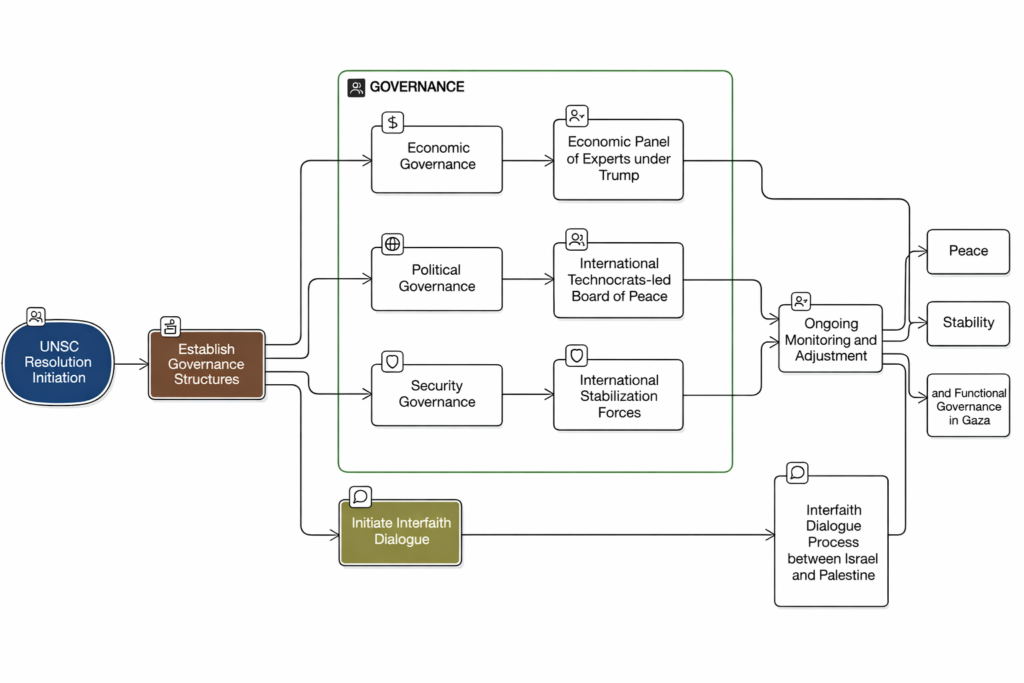
- Economic Governance of Gaza to be led by a Specialized Economic Panel of Experts under Trump
- Political Governance is to be led by an International Technocrats-led Board of Peace
- Security Governance is to be led by the International Stabilization Forces (ISF) from all over the World
- An interfaith Dialogue Process between Israel and Palestine
3- Critical Analysis of the UNSC Approved Resolution for Peace in Gaza
3.1- Potential Prospects
- The immediate ceasefire and peace
- The economic reconstruction of Gaza
- The pledge of a “Free Palestine and Gaza”
- The international oversight to keep check on Israel
3.2- Perceived Challenges
- “Phased” withdrawal of IDF on the Condition of Hamas complete surrender meaning no withdrawal
- A dictated Plan without “Right to the Self Determination (Article 1 of UN Charter)” of Gaza people:
- The establishment of Board of Peace under “one man” outside the auspices of the UN as a threat to Multilateralism
- The materialization of Gaza Riviera Dream of Trump on Mediterranean front without Palestinian input and development
4- Potential Role of Pakistan in “Peace for Gaza Resolution”
- The membership of Board of Peace and input in Gaza’s Redevelopment
- The contribution to the International Stabilization Forces and the Security of Gaza
- The enhanced humanitarian role and aid for peace efforts
5- Conclusion

Introduction
The resolution of the Palestinian conflict has long remained the most elusive objective of modern diplomacy, representing a Gordian knot of historical grievances, territorial disputes, and profound humanitarian suffering that has defied the efforts of successive generations. The recent adoption of the United Nations Security Council Resolution 2803, a US-drafted framework aimed at achieving a comprehensive ceasefire and peace in Gaza, marks a pivotal, albeit contentious, juncture in Middle Eastern geopolitics. This initiative seeks to move beyond temporary truces toward a structured termination of hostilities, yet its architecture reveals a complex tapestry of ambitious goals and structural contradictions. As the international community grapples with the fallout of unprecedented violence, this resolution attempts to synthesize security imperatives with a radical administrative overhaul. It is not merely a cessation of kinetic warfare but an audacious blueprint for the total reconfiguration of the Gazan sociopolitical fabric. By examining the intricacies of this document, one observes a departure from traditional “two-state” rhetoric toward a more technocratic and security-heavy paradigm, raising fundamental questions about the future of Palestinian sovereignty and the efficacy of international intervention in a landscape defined by decades of mistrust.
An Overview of the UNSC-approved US-drafted Resolution of the Palestinian Conflict for Peace in Gaza
The architecture of this newly minted peace initiative is predicated on a multi-phased approach that begins with the Hamas disarmament and the subsequent phased withdrawal of Israeli Defence Forces (IDF) from populated areas. This sequence is intended to create a security vacuum that is immediately filled by neutral actors rather than partisan militias. Central to the long-term viability of this plan is a shift in how the territory is managed. Under this framework, the economic governance of Gaza is slated to be led by a specialized economic panel of experts, a move aimed at transforming a decimated landscape into a viable economic entity often referred to as the “Gaza Riviera” concept. Simultaneously, the political governance is to be led by an International Technocrats-led Board of Peace, effectively sidelining traditional political factions in favor of a professionalized, non-partisan administration. To ensure the durability of these arrangements, the security governance is to be led by International Stabilization Forces (ISF) from all over the world. This multinational force is designed to act as a buffer and a guarantor of order, facilitating a transition toward a permanent settlement through an interfaith dialogue process between Israel and Palestine aimed at addressing the deep-seated psycho-social and religious animosities that fuel the fire of conflict. U.S. President Joe Biden emphasized the weight of this moment, stating that “the Palestinian people have endured sheer hell… this proposal is a roadmap to a lasting ceasefire and the release of all hostages.”
Critical Analysis of the UNSC Approved Resolution for Peace in Gaza
A-Potential Prospects
Although the implementation remains fraught with logistical hurdles, the potential prospects for stability are anchored in the immediate cessation of violence and the institutionalization of recovery.
- The immediate ceasefire and peace
The primary prospect of this resolution is the immediate ceasefire and peace, which offers a desperate reprieve to a civilian population currently facing an existential humanitarian crisis. By mandating a total stop to military operations, the resolution creates the necessary atmospheric conditions for diplomacy to supersede artillery. This cessation is not merely a tactical pause but is intended to be a permanent bridge toward a final status agreement. The global community has rallied behind this immediate necessity to prevent further regional escalation. European Commission President Ursula von der Leyen reinforced this by asserting
“The world is calling for an immediate ceasefire… it is the only way to end the suffering and begin the long journey toward reconciliation.”
- The economic reconstruction of Gaza
Furthermore, the economic reconstruction of Gaza offers a glimpse of a future where the territory is integrated into the Mediterranean economy rather than remaining a blockaded enclave. The proposed specialized economic panel is tasked with modernizing infrastructure, restoring utilities, and creating a sustainable trade environment. This vision moves beyond simple aid dependency, seeking to utilize Gaza’s strategic coastal location to foster a self-sufficient economy. UK Prime Minister Rishi Sunak highlighted the importance of this economic dimension, noting that peace is only sustainable if it is accompanied by the economic renewal of the Palestinian territories. Thus, if successful, this transformation could turn a site of ruins into a hub of commerce, providing the youth of Gaza with tangible opportunities for advancement
- The pledge of a “Free Palestine and Gaza”
The resolution also carries a symbolic and legal weight through the pledge of a “Free Palestine and Gaza,” serving as a vital rhetorical benchmark. This commitment reaffirms the international community’s recognition of Palestinian national aspirations and the ultimate goal of statehood. By embedding this pledge within a UNSC resolution, it elevates the status of Gaza from a mere conflict zone to a proto-sovereign entity under international protection. This commitment is intended to reassure the Palestinian people that the interim technocratic governance is a path toward, not away from, national independence.
- The international oversight to keep check on Israel
Equally critical is the provision for international oversight to keep a check on Israel, ensuring that the withdrawal of forces is monitored and that the subsequent security environment does not allow for unilateral military incursions. The presence of international observers and the ISF provides a transparent mechanism to document compliance and report violations to the Security Council. This oversight is designed to mitigate the power imbalance that has historically characterized the Israeli-Palestinian relationship, offering a degree of legal and physical protection to the inhabitants of Gaza. UN Secretary-General António Guterres has been vocal about this necessity, stating
“The presence of international monitors is essential to ensure that both sides adhere to their commitments and that international law is upheld.”
B- Perceived Challenges
Despite these optimistic projections, a series of perceived challenges threaten to derail the initiative before it gains substantial momentum.
- “Phased” withdrawal of IDF on the Condition of Hamas complete surrender meaning no withdrawal
A significant challenge lies in the “phased” withdrawal of IDF on the condition of Hamas’ complete surrender, a requirement that many analysts believe translates into no withdrawal at all. If the definition of “surrender” or “disarmament” remains subjective and determined by the occupying power’s intelligence assessments, the transition may be indefinitely delayed. This conditionality risks creating a permanent state of suspended animation where the military presence remains under the guise of an incomplete security transition. The resolution’s language on withdrawal remains dangerously vague and could lead to a permanent military presence.
- A dictated Plan without “Right to the Self Determination (Article 1 of UN Charter)” of the Gaza people
Furthermore, the framework has been critiqued as a dictated plan without the “Right to Self-Determination (Article 1 of UN Charter)” of the Gazan people. By imposing a technocratic board and an economic panel without a clear electoral mandate or local consultation, the resolution risks being perceived as a modern form of trusteeship. True peace requires the organic consent of the governed, and a top-down administrative structure may lead to local resentment and a lack of indigenous legitimacy.
- The establishment of Board of Peace under “one man” outside the auspices of the UN as a threat to Multilateralism
The establishment of the Board of Peace under a specialized leadership outside the traditional UN framework is viewed by many as a threat to multilateralism. This move suggests a shift away from established diplomatic protocols toward a more ad hoc, “coalition of the willing” approach to global crisis management. Such a precedent could undermine the authority of the United Nations in the long run, creating a parallel governance track that is more susceptible to the political whims of major powers. Chinese Foreign Minister Wang Yi expressed concerns regarding this trend, noting
“Multilateralism must be the bedrock of global governance, and any peace board must operate strictly under the mandate and oversight of the United Nations.”
- The materialization of Gaza Riviera Dream of Trump on Mediterranean front without Palestinian input and development
There is also the burgeoning concern regarding the materialization of the Gaza Riviera dream on the Mediterranean front without sufficient Palestinian input. While the project promises development, critics fear it may prioritize foreign investment and high-end real estate over the return of displaced persons and the preservation of local heritage. If the development of the coastline is managed by external experts without a focus on social equity, it could lead to the gentrification of a war zone rather than the restoration of a homeland. Evidence suggests that for such a panel to succeed, it must secure sovereign control over Gaza’s natural gas reserves (the Gaza Marine field), ensuring that the wealth generated from these resources is used for local reconstruction rather than being siphoned off by external contractors.

Potential Role of Pakistan in “Peace for Gaza Resolution”
- The membership of Board of Peace and input in Gaza’s Redevelopment
In evaluating the efficacy of the US-drafted resolution, the potential role of Pakistan emerges as a critical factor in bridging the gap between Western-led diplomacy and the socio-religious realities of the Muslim world. Regarding the membership of the Board of Peace and input in Gaza’s redevelopment, Pakistan possesses a robust reservoir of bureaucratic and technical expertise, having managed large-scale post-conflict and disaster-related reconstruction within its own borders. By integrating Pakistani technocrats into the proposed governance structure, the initiative would gain a much-needed layer of regional legitimacy, ensuring that the “Board of Peace” is not perceived as an exclusively Western imposition. Pakistan’s Permanent Representative to the UN, Munir Akram has consistently articulated this potential,
“Pakistan remains ready to contribute its administrative and diplomatic expertise to any framework that ensures the dignified recovery and sovereign rights of our Palestinian brothers.”
- The contribution to the International Stabilization Forces and the Security of Gaza
Furthermore, the contribution to the International Stabilization Forces (ISF) and the security of Gaza represents perhaps the most tangible avenue for Pakistani involvement. Pakistan is historically one of the largest and most professional contributors to UN Peacekeeping operations, with its troops frequently lauded for their neutrality and ability to operate in complex Muslim-majority environments. The deployment of Pakistani personnel within the ISF would provide a reassuring presence to the Gazan population, acting as a buffer that is culturally sensitive and professionally disciplined. Pakistan’s commitment to international peace through its troop contributions as a cornerstone of the UN’s collective security system has been appreciated internationally multiple times, making them an ideal candidate to ensure the security of Gaza during its fragile transition. FO Spokesperson Tahir Andrabi said,
“Pakistan will remain engaged with international efforts for peace and security in Gaza, leading to a lasting solution to the Palestine issue in accordance with United Nations resolutions.”
- The enhanced humanitarian role and aid for peace efforts
Finally, Pakistan’s enhanced humanitarian role and aid for peace efforts can serve as the “soft power” vanguard of the resolution’s implementation. Beyond military and administrative support, Pakistan has a long-standing tradition of providing medical relief, educational scholarships, and engineering assistance to the Palestinian people. By scaling these efforts within the framework of the new resolution, Pakistan can help mitigate the immediate suffering of the Gazan people while contributing to the long-term human capital development required for a “Free Palestine.”
Conclusion
In conclusion, the UNSC-approved US-drafted resolution for peace in Gaza represents a high-stakes, multi-dimensional attempt to end one of the world’s most enduring conflicts through a mixture of technocratic governance and international security guarantees. While the prospects of an immediate ceasefire and economic rejuvenation provide a glimmer of hope for a devastated population, the perceived challenges of conditional withdrawal and the potential erosion of self-determination remain significant hurdles that could undermine the entire project. The success of this initiative hinges on its ability to evolve from a dictated framework into a partnership with the Palestinian people. In this context, Pakistan’s multifaceted role, as a security guarantor, a diplomatic mediator, and a humanitarian leader, is essential to provide the legitimacy and technical support needed to tip the scales toward a successful resolution. Only through such inclusive and principled participation can the international community hope to transform a fragile ceasefire into a lasting, sovereign, and dignified peace for the people of Gaza.
CSS 2026 Solved Current Affairs
| 2- | “Pakistan Stands at a Decisive Turning Point Where Climate Shocks, Rapid Population Growth, Governance Gaps, Non-Traditional Security Threats, and Intense Fiscal Stress Are Converging to Heighten National Vulnerability.” Critically Evaluate the Above Statement and Propose Policy Measures for Building A Stable, Secure, and Disaster-Resilient Pakistan. |
| 3- | “Brain drain threatens Pakistan’s ability to achieve its Sustainable Development Goals (SDGs) by 2030”. Write a comprehensive note on the causes and consequences of brain drain from Pakistan, focusing on its impact on achieving SDGs (you may choose any three SDGs for answering this question). |
| 4- | Critically Appraise the Following Statement with Relevant Examples. Furthermore, Draw Relevant Lessons and Propose a Way Forward for Pakistan. “Natural Resources, Though Desirable for the Development of a Country, Can Become a Source of Conflict and Instability.” |
| 5- | Non-Governmental Organizations (NGOs), once called “force multipliers”, are now having trust issues as public skepticism about the virtues and advantages of NGOs has dropped. Critically examine why NGOs’ space is shrinking in many parts of the world, with specific reference to Pakistan. |
| 6- | COP – the annual climate negotiation, Conference of the Parties to the UN Framework Convention on Climate Change (UNFCCC) is organized every year since 1995. What are the significant achievements of COPs in general and COP-30 in particular |
| 7- | Conduct a critical analysis of the prospects of resolution of the Palestinian conflict with special reference to the UN Security Council’s recently approved US-drafted resolution for peace in Gaza. Can Pakistan play any role in this initiative? |
| 8- | Write short notes on any TWO of the following: (i) Pros and cons of food production through Genetically Modified Organisms (GMOs) (ii) Implications of depopulation (iii) Role of China in evolving world order |
CSS Solved Past Papers’ Essays
Looking for the last ten years of CSS and PMS Solved Essays and want to know how Sir Kazim’s students write and score the highest marks in the essays’ papers? Then, click on the CSS Solved Essays to start reading them.
CSS Solved Essays
CSS Solved General Science & Ability Past Papers
Want to read the last ten years’ General Science & Ability Solved Past Papers to learn how to attempt them and to score high? Let’s click on the link below to read them all freely. All past papers have been solved by Pakistan’s top CSS GSA coach having the highest score of their students.
General Science & Ability Solved Past Papers