CSS 2026 Solved Pakistan Affairs Past Papers | Comparative Analysis of Iqbal’ Ideas and Quaid’s Interpretations
The following question of CSS Pakistan Affairs 2026 is solved by Miss Iqra Ali on the guided pattern of Sir Syed Kazim Ali, which he taught to his students, scoring the highest marks in compulsory subjects for years. This solved past paper question is uploaded to help aspirants understand how to crack a topic or question, how to write relevantly, what coherence is, and how to include and connect ideas, opinions, and suggestions to score the maximum.

Question Breakdown
In this Question, the examiner has asked for the comparison and contrast between the philosophical ideas of Iqbal and the political insight of Jinnah with respect to Pakistan’s Ideology. First, after an introduction, write a paragraph on the Situation of Muslims in the subcontinent that shaped the ideas of Iqbal and Quaid. Compare the similarities in both ideas on Pakistan’s ideology, proving each point with their quotes. Then, write the difference between those that are supported by evidence. Also, try adding analysis of the renowned authors to prove were more similar in their thoughts on different.
Outline
1- Introduction
2- A Bird Eye View on the Then Situation of the Subcontinent that shaped the political ideas of Iqbal and Quaid
3- Similarities between Iqbal’s Philosophical Ideas and Jinnah’s political interpretation of the Pakistan ideology
- 3.1. Idea of The Two-Nation Theory
- 3.2. Islam as a Complete Social Order
- 3.3. Rejection of Western Territorial Nationalism
- 3.4. Protection of Minorities
- 3.5. Demand for a Separate Homeland
4- Differences between Iqbal’s Philosophical Ideas and Jinnah’s political interpretation of the Pakistan ideology
- 4.1. The Point of Departure as Evolution vs. Revelation
- 4.2. Nature of the State as Pan-Islamism vs. Nationalism
- 4.3. Methodology as Revolution vs. Constitution
- 4.4. Interpretation of “Islamic Law”
- 4.5. Inclusion vs. Exclusivity in Early Thought
5- Critical Analysis
6- Conclusion

Introduction
The creation of Pakistan stands as a unique event in twentieth-century history, representing the birth of a nation-state founded not on linguistic or ethnic homogeneity, but on a distinct ideological consciousness. It was neither an accident of history nor a sudden political bargain struck behind closed doors; rather, it was the culmination of two long intellectual and political processes shaped by two towering personalities: Allama Muhammad Iqbal and Quaid-e-Azam Muhammad Ali Jinnah. While the two men differed in their professional temperaments, one a poet-philosopher immersed in Eastern and Western metaphysics, the other a rigorous constitutional lawyer trained in the British legal tradition, their political thoughts eventually converged into a singular, unstoppable movement. Iqbal serves as the “Ideological Architect,” providing the philosophical, spiritual, and moral justification for a separate Muslim identity. He diagnosed the “why” of Pakistan. Jinnah, conversely, acted as the “Principal Architect,” the master strategist who translated these abstract philosophical ideals into a concrete political reality and a sovereign state. To understand Pakistan’s ideology, one must conduct a comprehensive appraisal of the similarities that bind them and the differences that define their unique contributions.
A Bird’s Eye View of the Then Situation of the Subcontinent that shaped the political ideas of Iqbal and Quaid
The political ideas of Allama Iqbal and Muhammad Ali Jinnah did not emerge in a vacuum. They were shaped by the complex realities of the Indian subcontinent during the late nineteenth and early twentieth centuries. Muslim decline after the collapse of Mughal authority had produced a deep sense of insecurity. British colonial rule, after the 1857 mutiny, introduced modern education and administrative structures but also created new political competition among communities. The introduction of representative institutions gradually transformed the demographic majority into political dominance, threatening Muslims to be turned into a “permanent minority” in a Hindu-dominated India. Moreover, the failure of the Khilafat Movement, the rejection of the Nehru Report (1928), and the increasingly exclusionary rhetoric of the Hindu Mahasabha created an environment of existential anxiety. For Iqbal, this situation signaled a threat to the spiritual and cultural “internal harmony” of Islam. For Jinnah, it represented a breakdown of constitutional fair play. These pressures forced both men to reconsider the “One-Nation” theory of the Indian National Congress, leading them toward the conclusion that the only path to survival for Muslims lay in political self-determination.
Similarities between Iqbal’s Philosophical Ideas and Jinnah’s political interpretation of the Pakistan ideology
Despite differences in personality and method, there were profound similarities between their visions. These similarities formed the backbone of Pakistan’s ideology.
- The Two-Nation Theory
Both leaders rejected the notion that India constituted a single nation. They argued that Hindus and Muslims represented two distinct nations because religion shaped every aspect of social life, including law, culture, literature, and worldview. Iqbal articulated this position most clearly in his presidential address at the All-India Muslim League session held in Allahabad in 1930.
“India is a continent of human groups belonging to different races, speaking different languages, and professing different religions. Their behaviour is not at all determined by a common race-consciousness. Even the Hindus do not form a homogeneous group…The Muslim demand for the creation of a Muslim India within India is, therefore, perfectly justified.”
He described India as a continent composed of diverse human groups with different religions and traditions. His proposal for a consolidated Muslim state in the northwest was therefore rooted in sociological realism rather than mere sentiment.
Jinnah later echoed similar reasoning during the Lahore session of 1940, where the famous Lahore Resolution was adopted. He emphasized that Hindus and Muslims belonged to different civilizations and that forcing them into one political framework would lead to instability.
”The Hindus and Muslims belong to two different religious philosophies, social customs, and literature[s]. They neither intermarry nor interdine together, and indeed they belong to two different civilisations which are based mainly on conflicting ideas and conceptions. Their aspects [=perspectives?] on life, and of life, are different….Very often the hero of one is a foe of the other, and likewise, their victories and defeats overlap. To yoke together two such nations under a single state, one as a numerical minority and the other as a majority must lead to growing discontent, and final. destruction of any fabric that may be so built up for the government of such a state.”
In other words, both leaders recognized that political unity without cultural harmony would be a house built on sand. Both rejected the concept of a unified “Indian Nation,” asserting that Hindus and Muslims formed two separate nations due to profound differences in religion, culture, and social structures.
- Islam as a Complete Social Order
Neither Iqbal nor Jinnah viewed Islam as a mere set of private rituals. They saw it as a comprehensive system of life.Iqbal stated,
“Islam is itself Destiny and will not suffer a destiny….The religious ideal of Islam, therefore, is organically related to the social order which it has created. The rejection of the one will eventually involve the rejection of the other.”
Likewise, Jinnah described the Quran as a “general code of the Muslims,” encompassing religious, social, civil, commercial, military, judicial, criminal, and penal aspects, regulating everything from religious ceremonies to daily life.
“We wish our people to develop to the fullest our spiritual, cultural, economic, social, and political life… in consonance with our own (Islamic) ideals.”
- Rejection of Western Territorial Nationalism
Both leaders were critical of the Western model of nationalism based on geographical boundaries, arguing that Muslim identity is rooted in shared faith (the Millat) rather than territory. In his poetry, Iqbal cautioned against territorial nationalism, which he believed would undermine the religious solidarity of Muslims. “The principle of European democracy cannot be applied to India without recognising the fact of communal groups.”
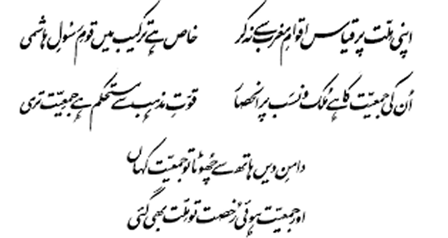
Muhammad Ali Jinnah alsomaintained the idea that was more vividly expressed by M. A. Jinnah in an article in the London weekly Time & Tide on 9 March 1940. Jinnah wrote,
”Democratic systems based on the concept of homogeneous nations such as England, are very definitely not applicable to heterogeneous countries such as India, and this simple fact is the root cause of all of India’s constitutional ills… If, therefore, it is accepted that there is in India a major and a minor nation, it follows that a parliamentary system based on the majority principle must inevitably mean the rule of major nation. Experience has proved that whatever the economic and political programme of any political Party, the Hindu, as a general rule, will vote for his caste-fellow, the Muslim for his coreligionist.”
- Protection of Minorities
Additionally, another crucial similarity was their insistence on the Islamic duty to protect non-Muslims Minorities. Allama Muhammad Iqbal stated that according to the Quran’s teachings, it was his “duty… even to defend their places of worship, if need be”. Similarly, his famous speech on August 11, 1947, Jinnah affirmed the religious freedom of all citizens, stating that people of
“You are free; you are free to go to your temples, you are free to go to your mosques or to any other places of worship in this State of Pakistan. You may belong to any religion or caste or creed — that has nothing to do with the business of the State”.
You can find the full content of this speech in the referenced document. That adequate, effective, and mandatory safeguards shall be specifically provided in the constitution for minorities in the units and in the regions for the protection of their religious, cultural, economic, political, administrative and other rights of the minorities.
- Demand for a Separate Homeland
Last but not least, both leaders were in favour of the separate homeland for muslims, within or outside the dominion of the Britishers. Allam Iqbal explicitly demanded the muslim majority areas for muslims to be governed by muslims,
“I would like to see the Punjab, North-West Frontier Province, Sind and Baluchistan amalgamated into a single State. Self-government within the British Empire, or without the British Empire, the formation of a consolidated North-West Indian Muslim State appears to me to be the final destiny of the Muslims, at least of North-West India.”
Similar idea was stated under Muhammad Ali Jinnah at the Lahore Resolution 1940,
“If the British Government are really in earnest… the only course open… is to allow the major nations separate homelands by dividing India into ‘autonomous national states.” And“Mussalmans are not a minority… Mussalmans are a nation according to any definition of a nation, and they must have their homelands, their territory, and their state.”
Hence, both leaders wanted to part ways with the Hindus and the Congress.
Following are some solved questions relevant to the given topic
Differences between Iqbal’s Philosophical Ideas and Jinnah’s political interpretation of the Pakistan ideology
Although their goals were the same, they differ in certain aspects.
- The Point of Departure as Evolution vs. Revelation
First, intellectual departures of Quaid-e-Azam and Allama Iqbal were distinct meaning the way they arrived at the “Two-Nation Theory” followed different trajectories. Allama Iqbal’s thought was rooted in metaphysics and theology. For Iqbal, a separate state was a spiritual necessity to save the “internal harmony” of the Muslim soul from being crushed by a secular or Hindu-dominated environment. On the other hand, Jinnah, for much of his early career, was the “Ambassador of Hindu-Muslim Unity.” He arrived at the idea of Pakistan through political disillusionment. His shift was based on the “tyranny of the majority” he witnessed within the Congress party and the failure of constitutional safeguards for Muslims.
- Nature of the State as Pan-Islamism vs. Nationalism
They held slightly different views on how the new state should relate to the rest of the Muslim world. Iqbal’s philosophy was deeply Internationalist (Ummah-centric). He saw a North-West Indian Muslim state as a “cell” in a larger body of the global Muslim world. He famously said,
“In the interests of Islam as a moral polity… it is especially necessary to have a consolidated Muslim State.”
Jinnah focused on Statehood and Sovereignty. Although he felt for the Muslim world, his primary concern was the legal definition of Muslims as a “Nation” in the Westphalian sense. He wanted a state that functioned as a modern member of the international community of nations.
“Let us now plan to build and reconstruct and regenerate our great nation and our sovereign state Pakistan…Now is the time, chance and opportunity for every Mussalman to make his or her fullest and best contribution and make the greatest sacrifice and work ceaselessly in the service of our nation and make Pakistan one of the greatest nation of the world.”
- Methodology as Revolution vs. Constitution
The two men differed in how they believed political change should be achieved.
| Feature | Iqbal’s Approach | Jinnah’s Approach |
| Medium | Poetry, Philosophy, and Meta-politics. | Law, Parliamentary Debate, and Diplomacy. |
| Logic | Focused on Khudi (Selfhood) and awakening. | Focused on “Weights and Measures” of political representation. |
| Tone | Emotive, prophetic, and revolutionary. | Cold, rational, and evidence-based. |
- Interpretation of “Islamic Law”
Addittionally, both wanted Islamic principles, but their how differed. Iqbal was a proponent of Radical Reform, Ijtihad. He argued in his “Reconstruction of Religious Thought in Islam” that the power of legislation should be transferred from the Ulema (clerics) to a modern Muslim Legislative Assembly. He wanted to “reconstruct” Islamic law for the modern age.
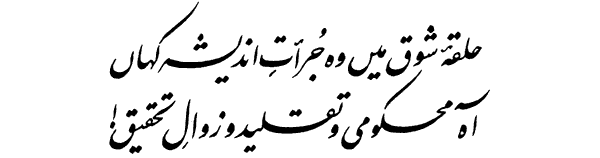
“The mystics, who were keen their faith to spread, are silent now and thought for them a dread. Alas! the state of bondage deprives of zest, slaves tread the beaten path and relinquish quest.”
Jinnah’s vision of “Islamic Principles” was often synonymous with Social Justice and Fair Play. He viewed the Quran as a “General Code” but interpreted its implementation through a modern legal framework.
“But make no mistake: Pakistan is not a theocracy or anything like it. Islam demands from us the tolerance of other creeds…play their part as true and loyal citizens of Pakistan.”
“Islam and its idealism have taught democracy, Islam has taught equality, justice and fair play to everybody.”
- Inclusion vs. Exclusivity in Early Thought
Iqbal was specific from 1930 onwards about the geographical boundaries (the North-West) because he believed the “Muslim culture” was most concentrated there. On the other hand, Jinnah, for a longer period, tried to advocate for Muslims across all of India (the 14 Points) before finally accepting that a separate territory was the only viable solution to the “communal problem.” It took Jinnah another decade to accept that partitioning the land was the only way to save at least a portion of the Muslim population from total domination.
Critical Analysis
Historians analyze that Allama Iqbal provided the intellectual and philosophical foundation for Pakistan’s ideology, which Quaid-e-Azam Muhammad Ali Jinnah translated into a concrete political reality. Sharif al-Mujahid, one of Pakistan’s most respected historians, argues that the correspondence between 1936 and 1937 was a period of ideological fertilization. Mujahid posits that before these letters, Jinnah was still thinking in terms of minority rights and constitutional safeguards within a federal India. It was Iqbal who pushed Jinnah to realize that the problem was not communal but national stating that “Iqbal provided the intellectual armor, but Jinnah wore it into the battlefield.”
Conclusion
In a nutshell, the political thought of Allama Iqbal and Quaid-e-Azam Muhammad Ali Jinnah represents the perfect marriage of philosophy and practice. Iqbal was the “mind” that dreamt of a space where the Islamic spirit could breathe, while Jinnah was the “will” that cleared the obstacles to build that space. Their similarities provided the movement with its core strength: the Two-Nation Theory and the belief in Islam as a social code while their differences allowed the movement to appeal to both the spiritual seeker and the modern political activist. Pakistan’s ideology, therefore, is not a monolith; it is a dynamic blend of Iqbal’s Islamic universalism and Jinnah’s modern democratic constitutionalism. Their complementary legacies remain the dual pillars upon which the identity of Pakistan continues to rest.
CSS 2026 Solved Pakistan Affairs
| 2- | Conduct a Comprehensive Appraisal of the Similarities and Differences Between Iqbal’s Philosophical Ideas and Jinnah’s Political Interpretation of the Pakistan Ideology. |
| 3- | “The Instability in Afghanistan Continues to Influence Pakistan’s Internal Security, Regional Diplomacy, and Counter Terrorism Strategy”. Critically Examine the Above Statement and Suggest Policy Measures to Address the Issue/Challenge. |
| 4- | To What Extent Does the 27th Constitutional Amendment Strengthen or Weaken Constitutionalism and Rule of Law in Pakistan? Justify Your Stance with Valid Arguments. |
| 5- | Critically Assess How Youth Perspectives, Digital Activism, and Civil Society Movements are Influencing Civil-Military Relations. |
| 6- | Undertake a Concise Assessment of the Key Economic Challenges Currently Confronting Pakistan. Illustrate How the IMF’s Conditions Can Shape the Country’s Path Towards Economic Stabilization and Long-Term Financial Sustainability? |
| 7- | “The Unresolved Kashmir Issue Exposes the Inherent Weakness in the United Nations Security Council’s Architecture.” Critically Examine the Role of the UNSC in Resolving the Kashmir Issue |
| 8- | Critically Assess the Performance of the Health and Education Sectors after Being Handed Over to the Provinces Under the 18th Amendment and Suggest a Way Forward. |
CSS Solved Past Papers’ Essays
Looking for the last ten years of CSS and PMS Solved Essays and want to know how Sir Kazim’s students write and score the highest marks in the essays’ papers? Then, click on the CSS Solved Essays to start reading them.
CSS Solved Essays
CSS Solved General Science & Ability Past Papers
Want to read the last ten years’ General Science & Ability Solved Past Papers to learn how to attempt them and to score high? Let’s click on the link below to read them all freely. All past papers have been solved by Pakistan’s top CSS GSA coach having the highest score of their students.
General Science & Ability Solved Past Papers