Learn how to analyse international issues for CSS and PMS by examining causes, stakeholders, implications, and solutions, with the Indus Waters Treaty dispute as a worked example.

International affairs are rarely as simple as the headline suggests. A conflict may start with a border dispute but continue because of security fears, historical grievances, economic interests and great-power rivalry. A treaty may promise cooperation and still create new problems of implementation, sovereignty and trust.
For CSS and PMS aspirants, memorising events, dates and statements is only the first step. Examiners reward candidates who can explain why an issue emerged, who shapes it, how it affects different actors, and what can realistically be done. That is the difference between a descriptive answer and an analytical one.
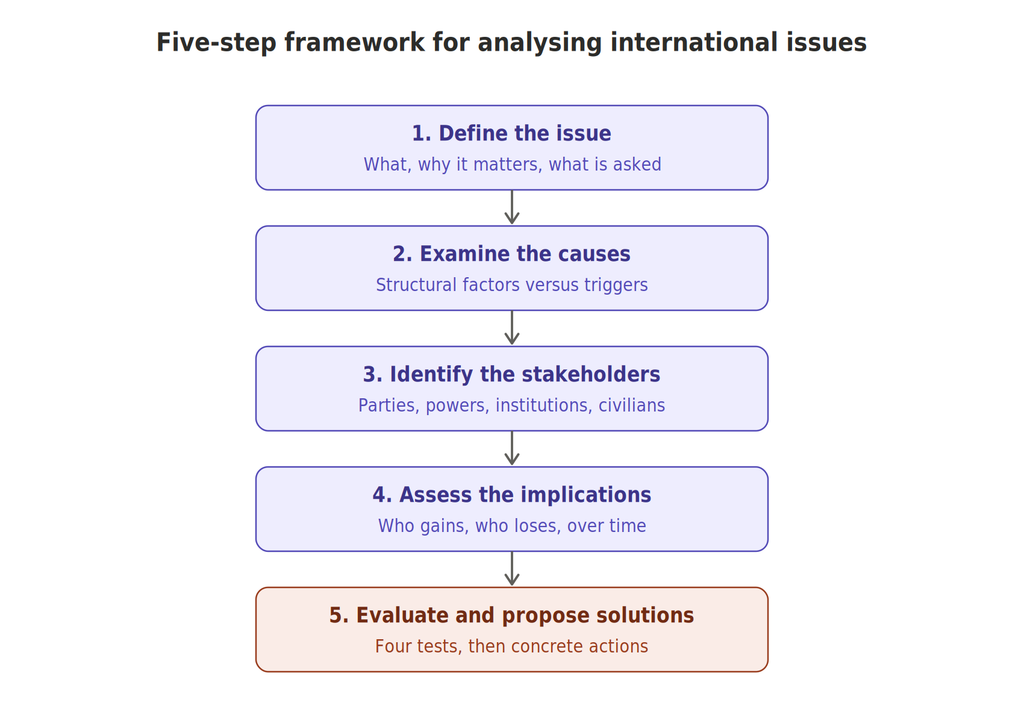
This guide gives you a five-step framework you can use on almost any topic in Current Affairs, International Relations, and Pakistan Affairs
- Define the issue
- Examine the causes
- Identify the stakeholders
- Assess the implications
- Evaluate responses and propose solutions
The framework works for armed conflicts, trade disputes, climate negotiations, regional rivalries, and the role of international institutions. In the second half of this article, we apply it to a topic that matters directly for Pakistan: the Indus Waters Treaty (IWT) dispute with India.
Step 1: Define the Issue Before You Analyse It
Many candidates start writing the moment they read the question. The result is a long answer full of information but with no clear argument. Before anything else, settle three points
- What has happened, and what is the central dispute?
- Why does it matter at the regional or international level?
- What exactly is the question asking: causes, consequences, or solutions?
Take the South China Sea. Do not reduce it to “China versus the USA.” Identify the overlapping maritime claims, freedom of navigation, regional security, and the interests of the Southeast Asian claimants.
Then fix the scope. A question on causes needs a different structure from one on consequences or settlement. Defining scope tells you which evidence to select and which background to leave out.
Exam tip: State the central issue in one or two sentences at the start of your answer. It gives your answer direction and keeps every paragraph relevant.
Step 2: Examine the Causes
International events rarely have a single cause. A good answer separates long-term structural factors, immediate triggers, and decisions that escalated the issue, and then shows how they interacted.
- Historical and political causes
Unresolved borders, colonial-era arrangements, competing national identities, and earlier wars shape present relations. Include history only where it explains the present. The Israeli-Palestinian conflict, for example, cannot be understood through one recent event; it requires attention to competing national claims, displacement, the wars of 1948 and 1967, occupation since 1967, settlement expansion, security concerns and repeated failures to reach a lasting settlement.
- Strategic and security causes
States respond to perceived threats by building up forces, forming alliances or expanding influence, which can make neighbours feel less secure and produce a cycle of suspicion. Compare each party’s stated concerns with its actual policies instead of accepting official justifications at face value.
- Economic and resource-related causes
Competition over energy, water, minerals, trade routes and markets can intensify tensions, although economic interest can also push states towards cooperation. The Grand Ethiopian Renaissance Dam dispute shows both sides of the coin: Ethiopia’s need for electricity and development against Egypt’s concern for Nile water security and Sudan’s interests in water management and dam safety.
- Immediate triggers
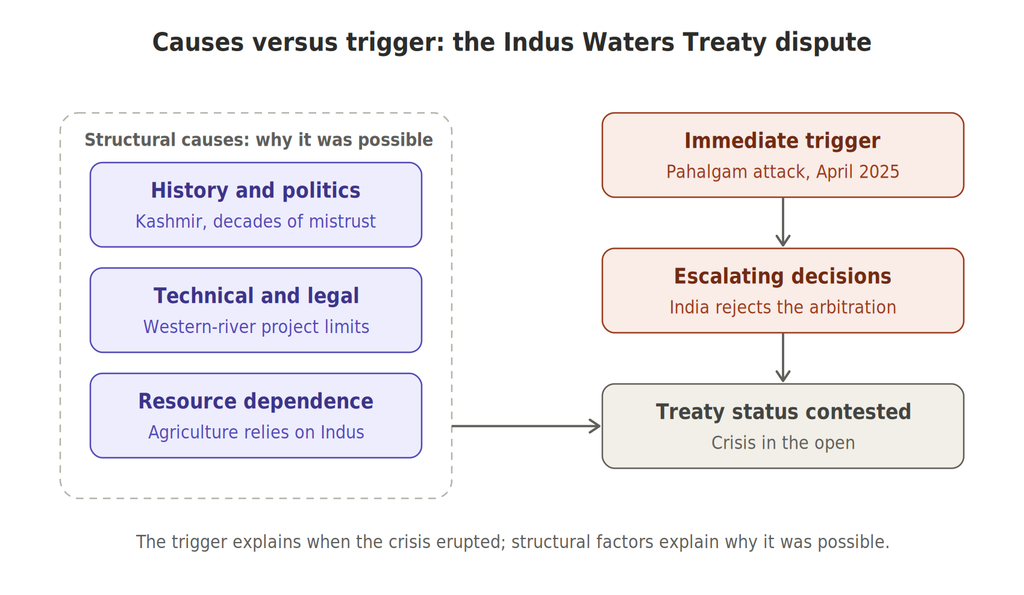
A trigger (an attack, a disputed election, a sanctions announcement, a collapse of talks) brings an existing dispute into the open. Do not confuse it with the underlying cause. The trigger explains when the crisis erupted; the structural factors explain why it was possible.
Step 3: Identify the Stakeholders
Stakeholder analysis stops you from treating international politics as a quarrel between two governments. Look at four layers
- Primary stakeholders: the states or authorities directly involved, with objectives such as territory, security, legitimacy, or development.
- Secondary stakeholders: external powers that influence the dispute through diplomacy, aid, sanctions, arms, or mediation.
- Institutions: the UN, the International Court of Justice, the WTO, the World Bank and regional organisations, whose influence depends on their mandate and on member states’ cooperation.
- Affected populations and non-state actors: civilians, refugees, farmers, businesses, humanitarian groups and civil society.
In the Russia-Ukraine war, for instance, Russia and Ukraine are the principal belligerents; the United States and European states influence events through military assistance, sanctions and diplomacy; the UN and humanitarian agencies play distinct roles; and Ukrainian civilians bear severe costs. As of October 2026, US-brokered talks have continued but have not produced a settlement, with territory in the Donbas remaining a central sticking point.
| Stakeholder | Interests to examine | Question to ask |
| Direct parties | Security, territory, sovereignty | What does each side actually want? |
| External powers | Strategic influence, alliances, economic ties | How do their policies affect the dispute? |
| Institutions | Law, peace, cooperation | What can they realistically do? |
| Affected populations | Safety, livelihoods, rights | Who bears the greatest cost? |
| Businesses, non-state actors | Trade, investment, resources | How are they affected? |
Do not assume a stakeholder has one fixed objective. Governments face domestic pressure and internal disagreement, and external powers may cooperate on one aspect of a dispute while competing on another.
Step 4: Assess the Implications
Implications are the consequences for the actors involved and for the wider system. Separate immediate from long-term effects and direct from indirect ones.
- Political and diplomatic: Weakened trust, hardened alliances, closed communication channels, or, sometimes, new mediation opportunities.
- Economic: Disrupted trade, energy, investment, and supply chains. The war in Ukraine, for example, disrupted agricultural and energy flows and raised concerns about food and energy security, though the impact varied across countries.
- Security: Higher military spending, arms races, escalation risk, refugee flows, and cross-border instability. Distinguish an existing consequence from a possible future risk; present the latter as a scenario, not a certainty.
- Humanitarian and social: Deaths, displacement, lost livelihoods, and food insecurity. When you quote statistics, name the source, date, and what is being measured.
- Environmental: Pollution, damaged infrastructure, and water insecurity. Climate stress can aggravate tensions, but avoid calling it the sole cause of a conflict.
A useful closing question for this section: Who gains, who loses, and how might that change over time?
Step 5: Evaluate Existing Responses, Then Propose Solutions
Before recommending anything, examine what has already been tried, like negotiations, ceasefires, sanctions, court proceedings, peacekeeping, humanitarian aid, or regional cooperation. Judge each on four tests
- Effectiveness: Does it address the core problem or only the symptoms?
- Legitimacy: Is it consistent with international law and accepted procedure?
- Feasibility: Do the actors have the capacity, authority, and political will?
- Sustainability: Does it prevent recurrence or merely buy time?
Solutions must answer the causes you identified earlier. A security dilemma needs confidence-building measures; a resource dispute needs equitable access, monitoring and dispute resolution. The main options are
- Diplomacy and negotiation: Direct talks, mediation and confidence-building measures that address underlying interests.
- Law and institutions: Treaties, arbitration and judicial settlement, whose value depends on jurisdiction, consent and compliance.
- Economic cooperation: Joint projects and transparent resource management, which help but cannot by themselves settle questions of sovereignty or security.
- Humanitarian protection and reconstruction: Access, protection of civilians and rebuilding, which are not a substitute for addressing political causes.
- Monitoring and implementation: Clear responsibilities, timelines, verification and procedures for violations.
A strong recommendation says who will act, what they will do, how, and how progress will be measured. “Promote peace” is not a recommendation.
Applying the Framework: The Indus Waters Treaty Dispute
The Indus Waters Treaty was signed by Pakistan and India in Karachi on 19 September 1960, after nearly a decade of negotiations facilitated by the World Bank. It assigns the three eastern rivers (Ravi, Beas and Sutlej) primarily to India and the three western rivers (Indus, Jhelum and Chenab) primarily to Pakistan, while allowing India limited uses of the western rivers, such as run-of-river hydropower, under specific technical conditions. Pakistan depends heavily on the Indus system for agriculture, so the treaty is directly tied to its food security, economy, and national security.
Step 1: Define the central issue
The central issue is whether India can unilaterally place the treaty “in abeyance,” and what follows if it does. The dispute has two linked layers: a technical one (the design of Indian hydropower projects on the western rivers) and a political-legal one (the treaty’s status).
The timeline you should know
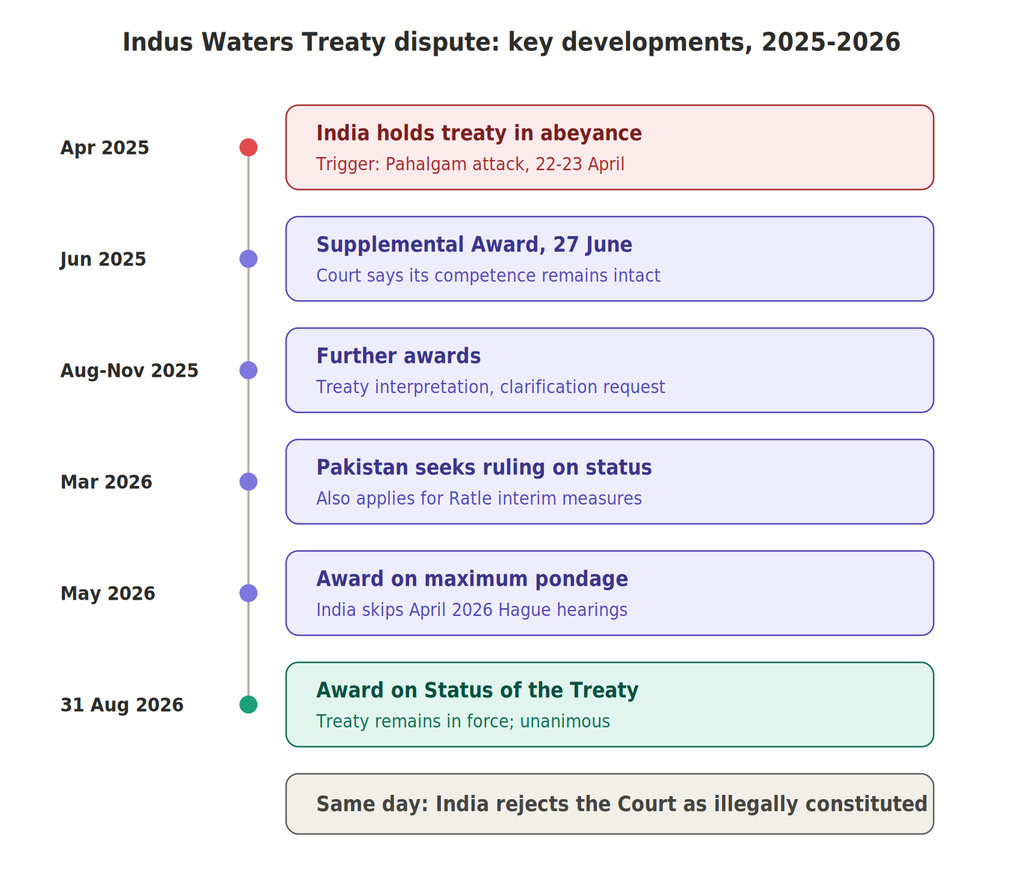
A point many candidates get wrong: the ruling came from the Court of Arbitration, constituted under Annexure G of the treaty. The Permanent Court of Arbitration (PCA) acts as its secretariat. Pakistan’s Foreign Office and much of the media refer to it loosely as a PCA decision, but in an exam answer it is better to write “the Court of Arbitration, administered by the PCA.” Note also that the ruling is dated 31 August 2026, not September.
Step 2: Examine the causes
- Long-term: Disagreement between the two countries over how to interpret treaty limits on Indian projects on the western rivers, and a broader environment of mistrust shaped by Kashmir and decades of bilateral tension.
- Trigger: The Pahalgam attack of April 2025 and India’s decision to link the treaty to its security demands.
- Escalating decisions: India’s rejection of the arbitration process, its statements that it will limit water flows to Pakistan, and Pakistan’s warnings that interference with its water would have serious consequences.
Keep the technical dispute (dam design, pondage, freeboard) separate from the political dispute (the treaty’s status), even though they are connected.
Step 3: Identify the stakeholders
- Pakistan: Protects treaty-based water rights, agriculture and water security, and has chosen the treaty’s own dispute-resolution route.
- India: Presents the treaty as suspended until Pakistan ends cross-border terrorism, and disputes the legitimacy of the Court.
- Court of Arbitration and PCA: The treaty-based forum whose awards are binding under the treaty framework but depend on state consent for enforcement.
- World Bank: Facilitated the treaty and plays a defined role in the dispute-settlement framework, including appointing members to the Court of Arbitration and the Neutral Expert process.
- Farmers and water-dependent communities: Bear the practical risk of uncertainty over flows.
- International community: The UN system and other states may encourage dialogue, but, as of mid-September 2026, few major Western governments had made high-profile public statements on the awards.
Step 4: Assess the implications for Pakistan
- Water and food security: uncertainty complicates irrigation planning, crop management and storage decisions. The actual impact depends on river flows and infrastructure operations, so avoid claiming that Pakistan’s water has already been “stopped” unless you cite a verified source.
- Economy: agriculture, rural livelihoods and water-dependent industries face added uncertainty, which makes water management a national economic priority.
- National security: water becomes another pressure point in an already tense nuclear-armed relationship. Treating it purely as a security confrontation, however, could reduce room for technical cooperation.
- Legal and diplomatic standing: the August 2026 award is a significant legal gain. Its practical value, though, depends on India’s non-compliance and on whether Pakistan can build diplomatic support.
- Regional implications: the case shows how a shared natural resource can become a source of confrontation when political trust declines.
Step 5: Evaluate responses and solutions
Pakistan has so far pursued the legal route successfully, but a legal win is not the same as implementation. A balanced answer should recognise both the achievement and its limits.
- Legal and diplomatic: Continue to use the treaty’s dispute-settlement procedures, document technical evidence carefully, and keep raising the matter at the UN and other forums. Candidates may also discuss further options, such as seeking wider UN engagement, while noting that each has procedural limits and depends on political support.
- Technical and domestic: Build water storage (for example, projects such as Diamer-Bhasha and Mohmand), improve irrigation efficiency, reduce losses, and develop reliable river-flow monitoring. These cannot replace treaty protections but make Pakistan more resilient.
- Capacity building: Strengthen expertise in hydrology, international water law, and transboundary water management.
- Long-term settlement: Any durable arrangement should include data exchange, clear operating procedures, and agreed mechanisms for resolving disagreements, which realistically requires some restoration of trust between the two countries.

What this case teaches aspirants
The IWT dispute shows why description is not enough. A high-scoring answer connects the treaty’s legal status to stakeholder interests, the consequences for Pakistan, the effectiveness of international mechanisms, and the feasibility of solutions. It also demonstrates balanced argumentation: separate verified developments from each government’s position, and separate a legal finding from its practical enforcement.
Turning the Analysis into a High-Scoring Answer
A framework only earns marks when it is converted into a focused answer. Adapt the structure to the exact wording of the question instead of reproducing every section.
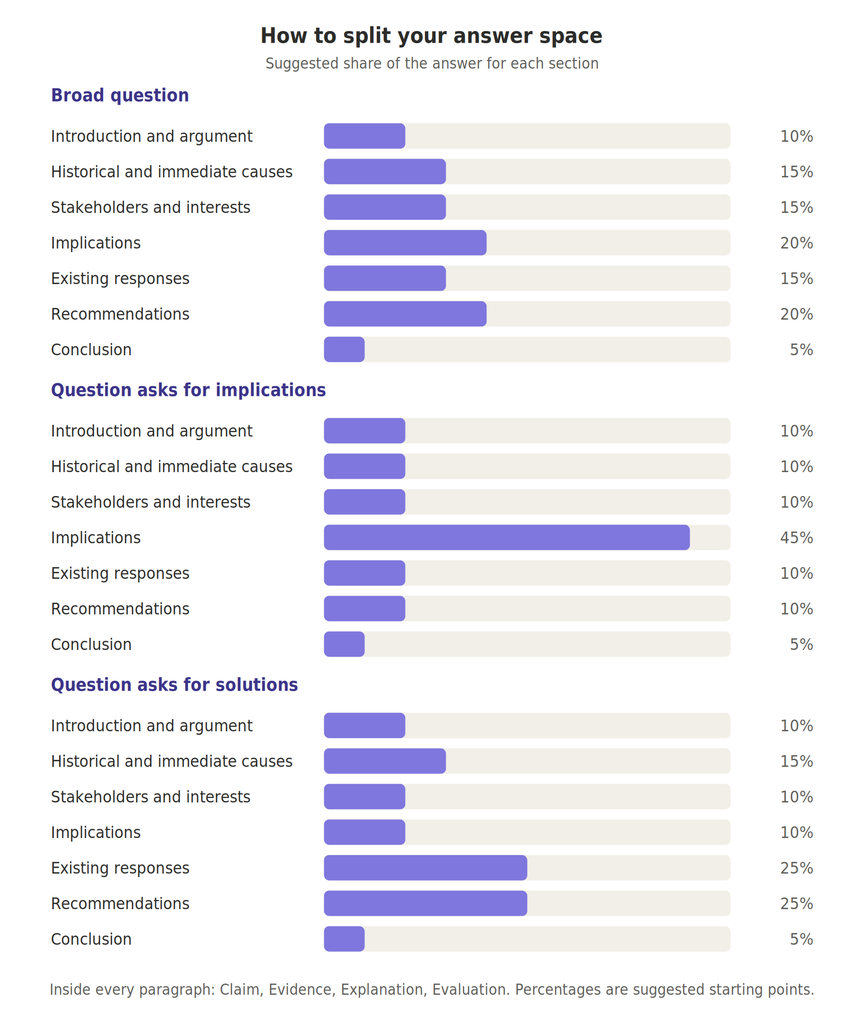
For a broad question, an effective outline is
- Introduction and central argument
- Historical and immediate causes
- Main stakeholders and their interests
- Political, economic, security and humanitarian implications
- Assessment of existing responses
- Practical recommendations
- Conclusion
If the question asks for implications, give most of your space to consequences and treat causes as brief context. If it asks for solutions, identify the underlying problem first, then evaluate options and their feasibility.
Use a simple writing sequence in every paragraph:
Claim, Evidence, Explanation, Evaluation. For example: claim that a maritime dispute threatens regional stability; support it with verified incidents or competing claims; explain how these affect security calculations; evaluate whether diplomatic mechanisms can reduce the risk of escalation.
Avoid three common mistakes
- Writing a chronology without explaining why the events matter.
- Listing stakeholders without analysing their interests and influence.
- Ending with vague recommendations such as “promote peace” or “increase cooperation” without practical steps.
Keep your current affairs updated
Dates, awards and official positions change quickly. Before the exam, verify the latest developments from primary sources (official court documents, Foreign Office statements) and a few reliable newspapers, and write the date next to any figure you plan to quote. You can also practise by reviewing relevant CSS past papers on CSSPrepForum and attempting timed answers.
Final Words
Analysing an international issue means understanding the problem, explaining its causes, mapping the stakeholders, weighing the consequences and judging the possible solutions. The five-step framework gives you a repeatable method for unfamiliar topics in Pakistan Affairs and Current Affairs.
The goal is not to include every detail. It is to select the most relevant evidence and use it to explain the issue, compare competing interests, and reach a reasoned conclusion. Practise the framework on one issue each week, and by exam day it will feel natural.
CSS Solved Past Papers’ Essays
Looking for the last ten years of CSS and PMS Solved Essays and want to know how Sir Kazim’s students write and score the highest marks in the essays’ papers? Then, click on the CSS Solved Essays to start reading them.
CSS Solved Essays
CSS Solved Islamiyat Past Papers
Want to read the last ten years’ Islamiyat Solved Past Papers to learn how to attempt them and to score high? Let’s click on the link below to read them all freely. All past papers have been solved by Pakistan’s top CSS Islamiyat coaches having the highest score of their students.
CSS Solved Islamiyat
CSS Solved General Science & Ability Past Papers
Want to read the last ten years’ General Science & Ability Solved Past Papers to learn how to attempt them and to score high? Let’s click on the link below to read them all freely. All past papers have been solved by Pakistan’s top CSS GSA coachez having the highest score of their students.
CSS Solved General Science & Ability
CSS Solved Pakistan Affairs Past Papers
Want to read the last fifteen years’ Pakistan Affairs Solved Past Papers to learn how to attempt them and to score high? Let’s click on the link below to read them all freely. All past papers have been solved by Pakistan’s top CSS Pakistan Affairs coaches having the highest score of their students.
CSS Solved Pakistan Affairs
CSS Solved Current Affairs Past Papers
Want to read the last fifteen years’ Current Affairs Solved Past Papers to learn how to attempt them and to score high? Let’s click on the link below to read them all freely. All past papers have been solved by Pakistan’s top CSS Current Affairs coaches having the highest score of their students.
CSS Solved Current Affairs