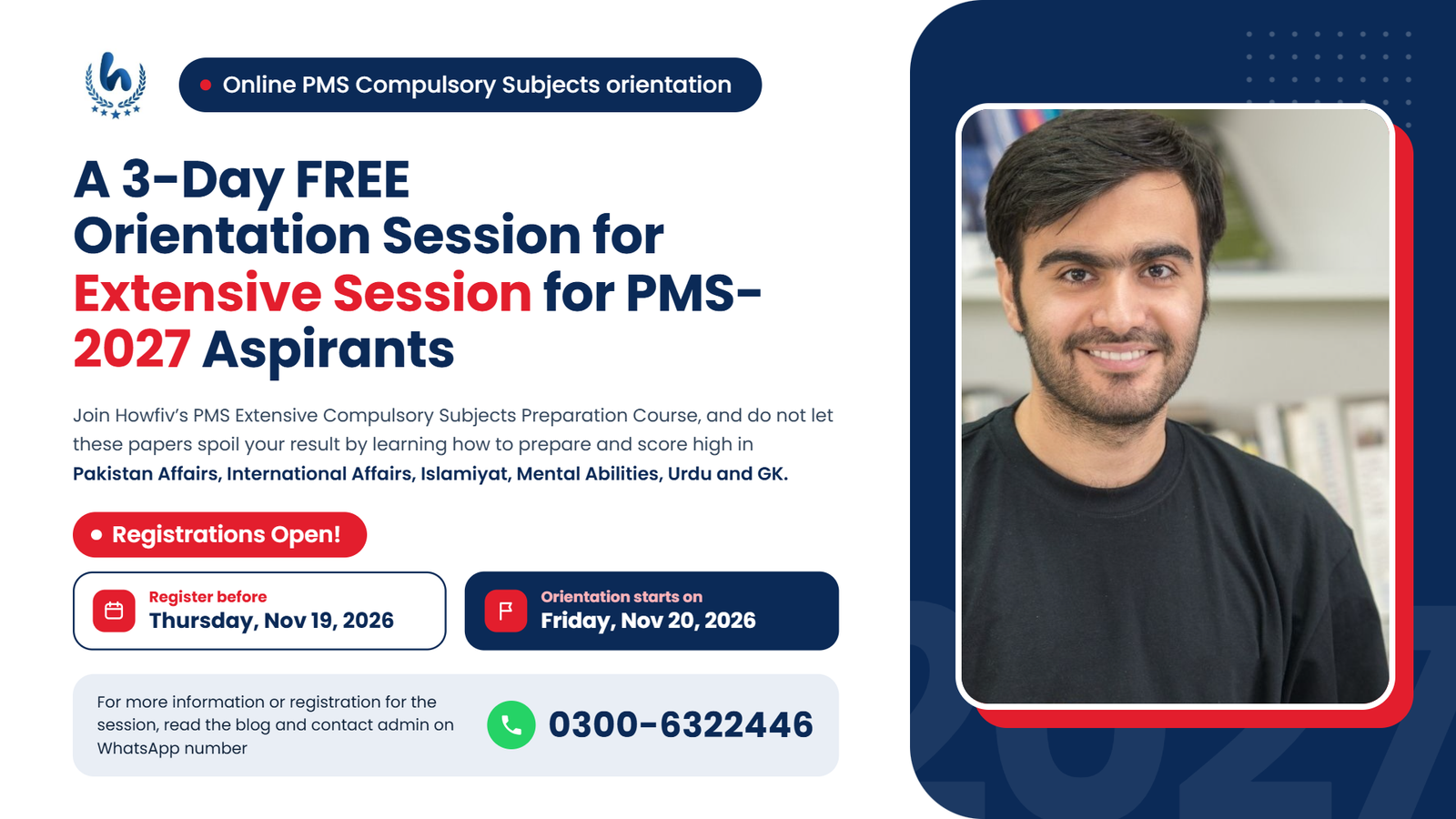
Are you determined to succeed in the PMS 2027 examinations amid the updated syllabus? Join the Extensive Session under the expert guidance of Miss Iqra Ali, Miss Ayesha Irfan, Miss Bushra, and Sir Ammar Hashmi. This session will equip you with advanced strategies to effectively express your ideas and arguments, deepen your understanding of essential subjects, and refine your question-attempting techniques. So, set yourself on the path to triumph in the PMS Exams!
Every year, around 50,000 candidates set out to crack the PMS examinations. Roughly 90% of them never truly prepare. Instead, they chase tips and tricks from past successful candidates, hoping shortcuts will carry them through. The result is predictable: three attempts exhausted, followed by blame directed at the Punjab Public Service Commission (PPSC). The lesson is clear: no one can prepare on your behalf.
The remaining 10% approach the exams with unwavering commitment. They know there are no shortcuts, so they invest in self-development, cut out distractions like social media, and study without watching the clock. Their goal is simple: high scores and the career they have set their sights on. These are the students every educator loves to teach, and the ones our coaches at Howfiv look for.
In the compulsory session at Howfiv, Sir Syed Kazim Ali admits only students who can argue and present their ideas persuasively. This criterion reflects what the PMS exam actually demands: knowledge and presentation, in equal measure.
- Knowledge without presentation: A candidate who cannot convey what they know within the exam’s time limit will leave questions incomplete, and will score low or fail.
- Presentation without knowledge: Polished writing is worthless without substance to fill it.
In short, success depends on the partnership between what you know and how well you write it. Neither works without the other.
That is why Sir Kazim and the compulsory coaches admit only students who have already mastered writing skills. Most come from Sir Kazim’s extensive or crash course sessions, and they reserve their seats two to three months ahead of the compulsory session, because they understand that both knowledge and writing skills decide the outcome.
What is new in PMS Punjab Updated syllabus?
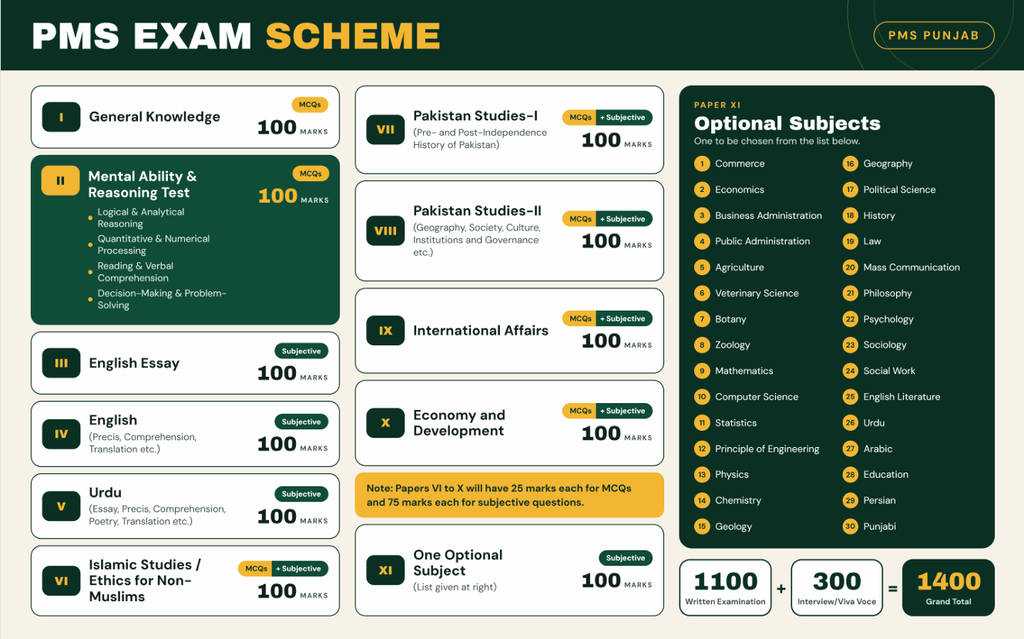
The updated syllabus and structure of PMS Punjab is mentioned below.
What Will You Learn in This Extensive Session?
You will learn the mentioned topics as well as a lot of associated aspects in this PMS extensive course.
PAPER-1: General Knowledge
The GK syllabus is divided into several key headers.
| 1- General Science |
| 2- Pakistan Affairs (pre-partition) |
| 3- Pakistan Affairs (post-partition) |
| 4- Highest, lowest, etc. and Inventions |
| 5- General Questions |
PAPER-2: Mental Ability and Reasoning Test
The Mental Ability and Reasoning test’s syllabus is divided into following several key headers.
Logical & Analytical Reasoning
| 1-Number/Alphabet/Mixed Series |
| 2-Coding-Decoding |
| 3-Blood Relations |
| 4-Direction Sense |
| 5-Ranking/Ordering |
| 6-Analogies (Word/Number) |
| 7-Classification (Odd One Out) |
| 8-Seating Arrangement (Linear/Circular) |
| 9-Venn Diagrams / Set Logic |
| 10-Non-Verbal Reasoning |
| 11-Logical Deduction from Statements |
| 12-Cause and Effect |
Quantitative & Numerical Processing
| 1-Number System |
| 2-Percentage |
| 3-Ratio |
| 4-Proportion |
| 5-Average |
| 6-Profit and Loss |
| 7-Time, Distance, and Speed |
| 8-Time and work |
| 9-Ages |
| 10-Simplication/BODMAS |
| 11-Data Interpretation |
| 12-Probability |
| 13-Permutation & Combination |
| 14-Mensuration |
| 15-Basic Algebra |
Reading & Verbal Comprehension
| 1-Verbal Analogies |
| 2-Error Detection |
| 3-One-Word Substitution |
| 4-Para Jumbles (Sentence Rearrangement) |
| 5-Cloze Test |
| 6-Reading Comprehension Passages |
| 7-Synonyms and Antonyms |
Decision-Making & Problem-Solving
| 1-Situational Judgment |
| 2-Case-Study Based Decision Making |
| 3-Data Sufficiency |
| 4-Critical Reasoning — Strengthen/Weaken Argument |
| 5-Course of Action |
| 6-Priority Setting / Resource AllocationPriority Setting / Resource Allocation |
| 7-Ethical Dilemma Reasoning |
| 8-Statement-Argument Evaluation |
PAPER-5: URDU
PAPER-6: Islamiat
1-Introduction to Islam:
- Advent of Islam
- Fundamentals of Islam
- Concepts and their Importance
- Deen and its religious impact on individual and society; spiritual, moral and social impact.
- Basic Beliefs
- Amar Bil maroof and Nahi anil Munkir.
2-Seerat-un-Nabi:
- Prophet Muhammad (PBUH) as a Messenger
- As a Reformer
- As an Administrator
- As an Educator
- As a Diplomat
- As a Statesman
- As a Military Leader etc
3-Early Islamic History up to Khulfa-e-Rashideen
4-Human Rights in Islam:
- Including Status of Women
- Rights of Minorities.
5-Islam and the World:
- Impact on the West and vice versa
- Role in the modern world
- Contemporary challenges for the Muslim world and Muslim minorities
6-Islamic Code of Life:
- Salient features of the Islamic socio-political and economic system
- judicial system and administrative system
- Ijtihad & its forms
PAPER-7: Pakistan Affairs-1
Pre-Partition Period
| 1-Evolution of a Muslim Society & its Dynamics |
| 2-Downfall and Deformation of Muslim Society/Rule in the Sub-continent & its factors |
| 3-Missionaries/Invaders/Rulers in the sub-continent & its vicinities |
| 4-Sheikh Ahmed Sirhindi |
| 5-Shah Waliullah |
| 6-Syed Ahmed Shaheed and his Jihadi Movement |
| 7-Haji Sharee’tullah and his Faraizi Movement |
| 8-Sir Syed Ahmed |
| 9-Aligarh Movement |
| 10-Deoband Movement (Dar-ul-Uloom Deoband) |
| 11-Aligarh v/s Deoband |
| 12-Nadwat-e-Ulema |
| 13-Indian Act of 1892 |
| 14-Partition of Bengal (1905) |
| 15-Shimla Deputation (1906) |
| 16-Formation of All India Muslim League (1906) |
| 17-Minto-Morley Reforms (1909) |
| 18-Annulment of Bengal (1911) |
| 19-Reaction of Muslims on the Annulment of Bengal |
| 20-Lucknow Pact (1916) |
| 21-Chelmsford-Montagu Reforms (1919) |
| 22-Indian Act of 1919 |
| 23-Elections of 1920 and 1923 |
| 24-Khilafat Movement (1919-1922) |
| 25-Muslim League Resolution of 1924 |
| 26-Nehru Report (1928) |
| 27-All India Muslim Conference |
| 28-Quaid-e-Azam’s Fourteen Points |
| 29-Simon Commission (1930) |
| 30-Round Table Conferences |
| 31-Gandhi-Irwin Pact (1931) |
| 32-Communal Award (1932) |
| 33-Indian Act of 1935 |
| 34-Elections of 1937 |
| 35-All India Muslim League Annual Session (1938) |
| 36-Lahore Resolution (1940) |
| 37-Cripps Mission (1942) |
| 38-Jinnah-Gandhi Talks |
| 39-Shimla Conference |
| 40-Elections of 1945-46 |
| 41-Muslim League Legislators |
| 42-Cabinet Mission (1946) |
| 43-3rd June Plan |
| 44-Radcliffe Award (1947) |
Post-Partition Period
| 1-Early Problems: Administrative Problems, Financial Constraints, Refugee Problems, Constitutional Crisis, Territorial Disputes, and Canal and Water Disputes |
| 2-Delay in Constitution Making in various eras |
| 3-Judicial development and history of Judicial Activism in Pakistan (Molvi Tamizzudin Case, Dasso Case, Asma Jahangir Case) |
| 4-1970 elections and the fall of Dhaka |
| 5-Constitutional History of Pakistan since 1947 |
| 6-Constitutional Amendments and Federalism in Pakistan – The 18th Amendment |
| 7-Political evolution and challenges of Pakistan since 1947 |
| 8-Political instability and political polarization |
| 9-Role of digital democracy in the political system of Pakistan |
| 10-Social Issues: Poverty, Unemployment, Terrorism, Education |
| 11-Economic History and Issues of Pakistan since 1947 |
| 12-Challenges to National Security and Sovereignty: Proxy War, Hybrid Warfare, 5th Generation Warfare, and National Security Policy |
| 13-Making of new provinces |
| 14-Contemporary legal debates, Constitutional amendments, and the judiciary |
PAPER-8: Pakistan Affairs-2
1-Geography
- Location, physical features and administrative divisions
- Climate, rivers and the Indus Basin system
- Natural resources (minerals, energy, water)
- Agriculture and irrigation
- Industry and economic geography
- Environmental issues and climate change
- Strategic and geopolitical importance (CPEC, Gwadar, regional connectivity)
2-Society
- Demography (population, urbanization, migration)
- Ethnic, linguistic and religious composition
- Family structure, women and minorities
- Education and health
- Social issues (poverty, unemployment, extremism, sectarianism)
- Civil society and the role of media
3-Culture
- Cultural heritage and historical sites
- Regional languages and literature
- Arts, architecture and music
- Customs, festivals and traditions
- Sufism and its cultural influence
- National identity, plurality and cultural policy
4-Institutions
- Constitutional institutions (Parliament, Executive, Judiciary)
- Civil and military bureaucracy
- Election Commission and accountability bodies
- Provincial and local government institutions
- Federal-provincial relations (18th Amendment, NFC Award)
- Role and evolution of political parties
5-Governance
- Constitutional history (1956, 1962, 1973 and amendments)
- Democratic evolution and civil-military relations
- Public policy and service delivery
- Rule of law and judicial reforms
- Corruption, transparency and accountability
- Decentralization and local government
- Governance challenges and reforms
PAPER-9: International Affairs
| 1-Foreign Policy Basics |
| 2-Pakistan-China Relations |
| 3-Pakistan-India Relations |
| 4-Pakistan-Afghanistan Relations |
| 5-Pakistan-Iran Relations |
| 6-Pakistan-USA Relations |
| 7-Pakistan-Russia Relations |
| 8-Pakistan-Muslim World Relations |
| 9-US-India Relations |
| 10-Regional Organizations (SAARC, SCO, ASEAN, ECO, BRICS+) |
| 11-Important Economic Corridors (CPEC, IMEC, B3W) |
| 11-International Organizations (UN, OIC, EU, NATO) |
| 12-Broader Indo-Pacific with Alliances (QUAD, AUKUS) |
| 13-South China Sea |
| 14-Palestine-Israel conflict |
| 15-Russia-Ukraine Issue |
| 16-Syrian Crisis |
| 17-Contemporary Iran-Israel conflict with US role |
| 18-Kashmir Issue |
| 19-China-Taiwan Issue |
| 20-Joint Comprehensive Plan of Action (JCPOA) |
| 21-Iranian proxies in the region |
| 22-Balochistan Crisis |
| 23-Pakistan’s Internal energy crisis with External Factors |
| 24-African theatre-civil wars (Sudan crisis) |
| 25-Changing world order |
| 26-Iran-US conflict |
| 27-US-China trade war |
PAPER-10: Economy and Development
TBD
Important International Topics, Especially for Essay
| 1-Feminism |
| 2-Climate change |
| 3-Economy |
| 4-Education |
| 5-Globalization |
| 6-AI and technnology |
| 7-Governance |
| 8-Corruption |
| 9-Democracy and Human Rights |
| 10-Media |
What More Do You Get Out of the PMS Extensive Compulsory Course
- The course will also cover various aspects of Political Science, Indo-Pak History, and Essay Hot Topics
- Will Learn How to Attempt a 20-Mark Question to Score the Maximum Marks
- Time and Stress Management
- 3 full Mock Exams series (all subjects)
- Individual Extensive and Rigorous Evaluation
Course Details
| Coaches Names | Miss Iqra Ali (Lecturer – PA Coach) Miss Bushra {PMS Qualifier (AR)} Sir Ammar Hashmi (CSS Qualifier – Int. Affairs Coach) Miss Ayesha Irfan (Islamiat Coach) |
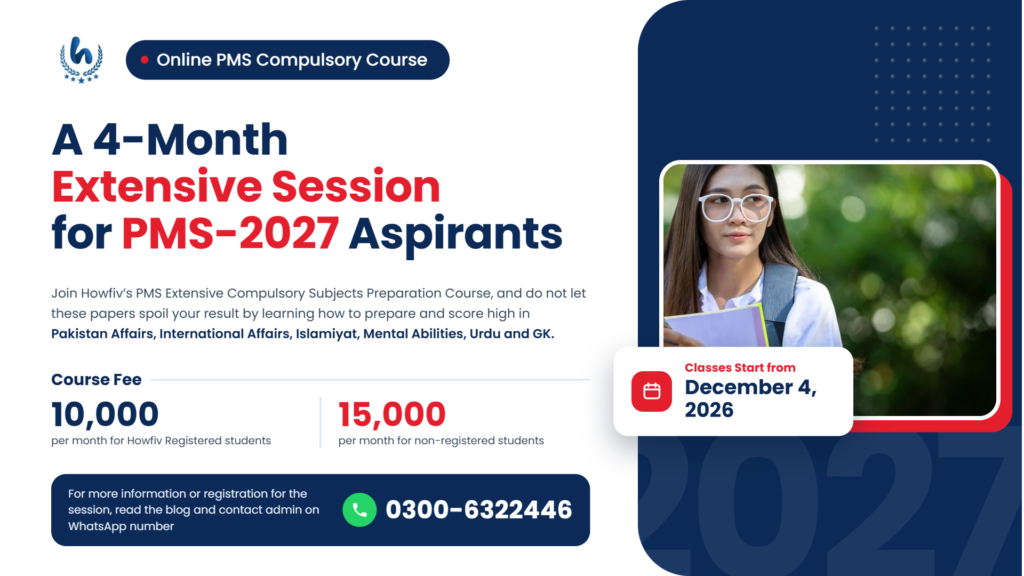
| Course Availability | All Year |
| Course Yearly Schedule | April, August, December |
| Course Registration Deadline | Thursday, December 03, 2026 |
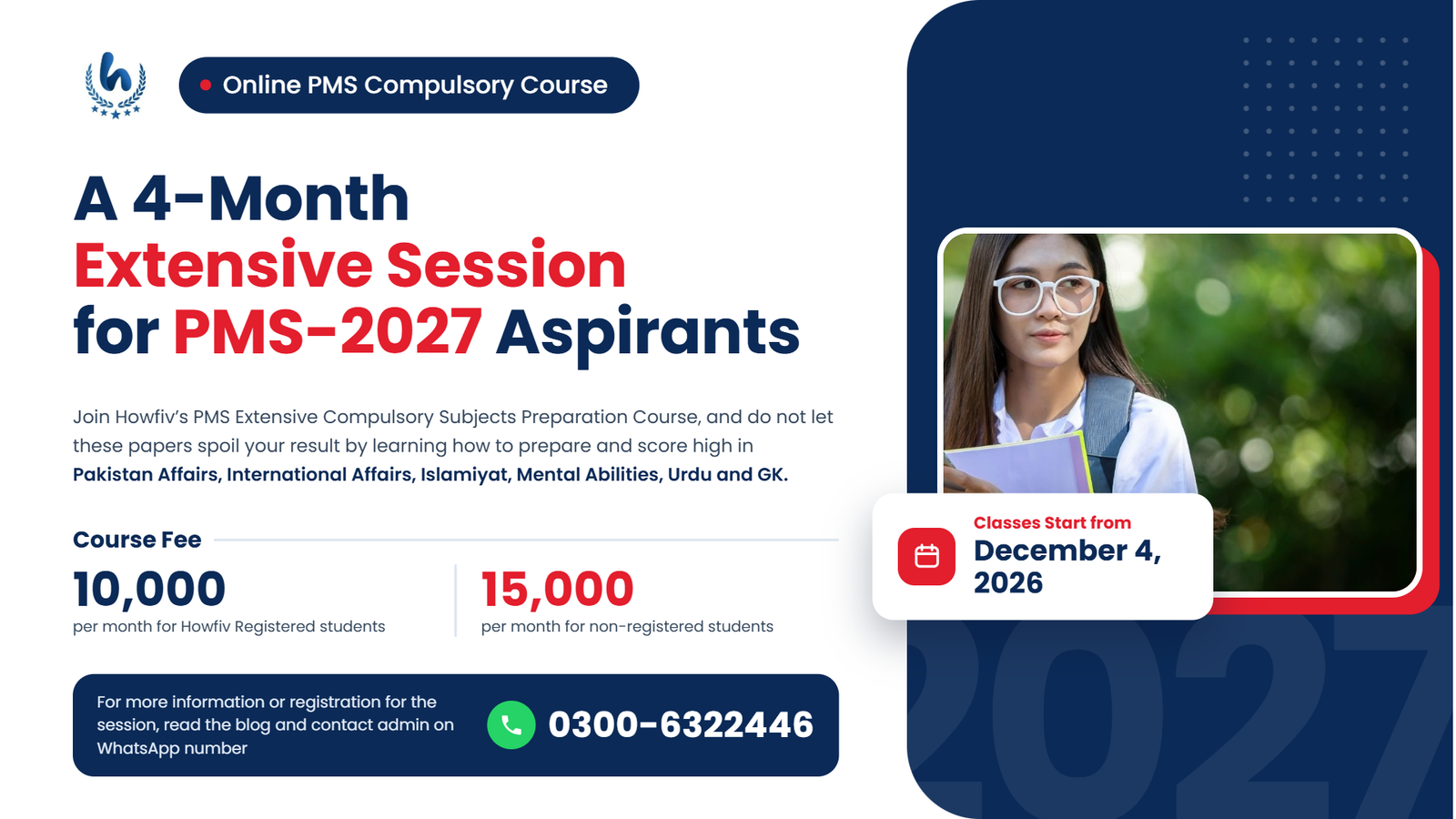
| Course Starts on | Friday, December 04, 2026 |
| Course Duration | 4 Months |
| Lecture Modality | Online (via Zoom) |
| Lectures per Week | Eight Lectures per Week (2 – 3 hours a class) Monday-Thursday: One class each day Friday & Saturday: Two classes each day |
| Available Seats | 25 Seats Only |
Course Schedule
The Extensive Compulsory Course for PMS exams starts in the following months.
- April
- August
- December
Fee Structure
The fee for the PMS compulsory session for registered and non-registered students is the following:
- For Howfiv registered students: Rs. 10,000 per month.
- For non-registered students: Rs. 15,000 per month.
Fee Refund Policy
The fee refund will be processed in accordance with the following policy. Also note that informing prior is compulsory.
Within a week
- 100 percent refund.
Within 2 weeks
- 50 percent refund.
After a month
- No refund.
How to Secure Admission to the Howfiv PMS Compulsory Session?
You can apply for the course by sending your particulars to the admin at the following contact number. If you are granted admission to the course, the admin will contact you for further processing.
Here is the list of particulars you need to send to the WhatsApp number 0300-6322446.
- Full Name
- Contact Number
- Email Address
- Qualifications
- Going to appear in PMS in which year? (2027 or 2028)
- Are You a Registered Student of Howfiv? (Yes/No)
Your seat in the course is reserved once your particulars are completed and the fee is paid.
So, to secure your future, enrol in Howfiv’s Extensive Compulsory Course, which provides exceptional guidance and support to excel in the PMS examination and achieve your aspirations!
CSS Solved General Science & Ability Past Papers
Want to read the last ten years’ General Science & Ability Solved Past Papers to learn how to attempt them and to score high? Let’s click on the link below to read them all freely. All past papers have been solved by Miss Iqra Ali & Sir Ammar Hashmi, Pakistan’s top CSS GSA coaches having the highest scores of their students. General Science & Ability Solved Past Papers
CSS Solved Current Affiars Past Papers
Want to read the last fifteen years’ CSS Current Affairs Solved Past Papers to learn how to attempt them and to score high? Let’s click on the link below to read them all freely. All past papers have been solved by Sir Ammar Hashmi, Pakistan’s top CSS Current Affairs coach having the highest score of their students. Current Affairs Solved Past Papers
You can also read editorials regarding Current Affairs topics. Current Affairs editorials.
CSS Solved Islamiat Past Papers
Want to read the last ten years’ CSS Islamiat Solved Past Papers to learn how to attempt them and to score high? Let’s click on the link below to read them all freely. All past papers have been solved by Miss Ayesha Irfan, Pakistan’s top CSS Islamiat coach having the highest score of their students. Islamiat Solved Past Papers
Want to read the details about the CSS exam subjects? Let’s click on the link below to read the details. CSS exam subjects