Real PMS Ministerial quota guidance from an Assistant Commissioner’s journey: eligibility, syllabus, essay strategy, and mentor advice.
Every year, a fresh batch of in-service government employees opens a browser, types “PMS Ministerial quota exam guidance,” and lands on a dozen pages that repeat the same eligibility table and syllabus breakdown. What they rarely find is an honest account of what actually separates the candidates who clear the exam from the ones who attempt it two or three times and fall short.
That account exists. It belongs to Imran Khan, an engineer-turned-Assistant-Commissioner who qualified the PMS-2025 Ministerial Exams after 8–12 months of focused preparation under Sir Syed Kazim Ali. His full student review is worth reading in its entirety. This article pulls out the guidance embedded in it: the eligibility mechanics, the essay-writing traps, the mentor-selection logic, and frames it for anyone currently preparing for the ministerial quota.
What the PMS Ministerial Quota Exam Actually Is
The PMS Ministerial Quota is a reserved pathway within the Provincial Management Service, set aside for in-service government employees who already hold a regular post and meet a minimum service requirement, typically five to eight years, depending on current pay scale, alongside a Master’s degree, a four-year Bachelor’s, or an LL.B. It is not open merit, and it is not conducted on a fixed annual calendar; the Punjab Public Service Commission (PPSC) announces it only when vacancies arise within the ministerial cadre.
Because the trigger is unpredictable, candidates who wait for the advertisement before they start preparing are almost always behind. For a deeper breakdown of the exam’s phases and full syllabus, our sister platform HowTests has already covered the mechanics in detail in What Is the PMS Ministerial Exam, and When Is It Conducted?. This article focuses on something that piece doesn’t: what it actually takes to pass it, told through someone who did.
Imran Khan’s Starting Point: An Engineer With a Writing Problem
Imran Khan didn’t come from a humanities background. He was an engineer by qualification, already serving in government as a Sub-Inspector in Punjab Police, technically qualified for the ministerial quota on paper. What he lacked was the one skill the exam actually tests under pressure: the ability to organize ideas, construct a defensible thesis, and hold a reader’s attention across an English essay.
That gap is common. Government employees eligible for the ministerial quota are usually strong on domain knowledge and service record; that’s how they became eligible in the first place, but the written papers don’t reward service record. They reward argument. Khan has been candid about this in his review, crediting a colleague and fellow PMS qualifier for pointing him toward structured mentorship rather than self-study alone.
Why “One or Two Months of Prep” Is a Trap
One of the more useful pieces of guidance buried in Khan’s review has nothing to do with Sir Kazim specifically. Instead, it’s a warning about how aspirants misjudge timelines. Essay writing, in his account, cannot be compressed into four or eight weeks of last-minute effort. A short sprint might teach someone the basic shape of an essay: introduction, body, conclusion. However, it does not build the underlying skill the exam demands, i.e., staying relevant under a twisted or unfamiliar prompt, connecting paragraphs logically, and sustaining an argument for the full length of the paper.
This matters more for ministerial-quota candidates than for open-merit CSS aspirants, precisely because the exam’s irregular schedule tempts people to prepare reactively. The candidates who clear it, in Khan’s experience, are the ones who treat writing as a standing discipline rather than a task to switch on once PPSC issues an advertisement.
The Readymade-Notes Trap Ministerial Candidates Should Avoid
Khan is equally direct about a second failure pattern: leaning on readymade outlines, pre-written essays, or officer-shared notes. The appeal is obvious: polished material feels like a shortcut past the hard part of preparation. But it produces a specific kind of failure in the exam hall. When the actual prompt is phrased differently from anything the candidate has memorized, borrowed material offers no way to adapt. Worse, it stops candidates from developing the judgment to decide what belongs in an essay and what doesn’t, a skill examiners can spot instantly, because recycled frameworks read as recycled.
For ministerial-quota aspirants specifically, this is worth repeating: your competition is not a stranger with an unknown background. It’s a colleague from another department who has spent the same number of years in service and is reading the same three or four popular note sets everyone shares in office WhatsApp groups. Original, well-reasoned writing is what actually separates a merit-list finish from a repeat attempt.
How Khan Chose a Mentor, And Why the Criteria Apply to Anyone
Khan’s review lays out a mentor-selection framework that is arguably more transferable than any single writing tip. He argues the right mentor is judged on four things: whether they can make a difficult subject simple, whether their past students show measurable improvement, whether their teaching holds up over a long preparation cycle rather than one good lecture, and whether they give honest, specific correction rather than general motivation.
This is why he ultimately chose Sir Syed Kazim Ali’s English Essay and Precis Course over relying on advice from officers who had already qualified. His reasoning: a successful officer can describe what worked for them, but describing a personal journey is not the same as diagnosing why a different candidate’s introduction is weak or why their argument loses relevance halfway through the body. Ministerial-quota aspirants, many of whom get informal advice from colleagues who cleared the exam years earlier, should weigh that distinction carefully before assuming a senior’s notes are a substitute for structured, corrective feedback.
What Structured Mentorship Actually Changed
Concretely, Khan points to a handful of techniques he still uses; decoding what an essay prompt is really asking, framing a precise thesis statement early, building topic sentences that carry the argument forward, and using transitions deliberately instead of stitching paragraphs together. None of this is exotic. What made it effective, in his account, was continuity, feedback that didn’t stop when the course formally ended, but continued through outline reviews and corrections until his exam.
That continuity is also where platforms matter. Alongside his coursework, Khan credits CSSPrepForum for model essays and PMS-specific guidance, and HowTests for downloadable MCQ books and self-mocks that let him track his own General Knowledge progress, the objective paper that forms the first filter in the ministerial screening process.
A Practical Prep Roadmap for Ministerial Quota Aspirants
Drawing on both Khan’s account and the exam’s actual structure, a working preparation sequence looks like this.
- Confirm eligibility early. Check your current BPS, years of service, and qualification against the criteria published on the PPSC official website. Eligibility requirements shift slightly between advertisements, so don’t rely on a previous year’s cutoff.
- Treat the General Knowledge paper as a daily habit, not a cram subject. It covers Pakistan Affairs, Current Affairs, World Affairs, Geography, Islamic Studies, English Grammar, Urdu, Computer, Everyday Science, etc, all subjects that reward consistent reading over months, not weeks. HowTests’ mock tests and MCQ books are built for this kind of spaced practice.
- Start essay writing before the advertisement is announced. Given the exam’s irregular schedule, waiting for a notification before you begin means you’re preparing under pressure. Solved essays under the PMS Ministerial Essays category on CSSPrepForum are a useful benchmark for structure and depth.
- Get feedback from someone who corrects, not just motivates. Whether that’s structured mentorship or a study partner willing to critique honestly, Khan’s account is consistent on this: unreviewed writing tends to repeat the same errors indefinitely.
- Don’t neglect the Urdu essay or the psychological assessment. Both are formal components of the written and final stages, and candidates who over-invest in the English paper alone often lose ground here.
Key Takeaways From Imran Khan’s Story
Imran Khan’s path from engineer to Sub-Inspector to Assistant Commissioner wasn’t built on natural writing talent or a quick crash course. It was built on treating essay writing as a skill requiring sustained, corrected practice and on choosing a mentor based on evidence of student improvement rather than reputation alone. For anyone currently eligible for the PMS Ministerial Quota and searching for a starting point, his review is less a testimonial and more a preparation checklist in disguise.

Frequently Asked Questions
Who is eligible for the PMS Ministerial Quota exam?
In-service government employees in Punjab holding a regular post, with a Master’s degree, four-year Bachelor’s degree, or LL.B, and a minimum of five to eight years of service depending on their current basic pay scale, are eligible. Exact criteria are confirmed in each PPSC advertisement.
How is the PMS Ministerial Quota exam different from the regular PMS exam?
The ministerial quota exam is shorter and narrower: three papers totaling 150 marks, covering General Knowledge, English Essay, and Urdu Essay, and is open only to eligible in-service employees. The regular PMS exam is open to the general public and includes a much broader set of compulsory and optional papers.
How long does it take to prepare for the PMS Ministerial exam?
Based on accounts like Imran Khan’s, meaningful preparation typically spans several months to about a year, particularly for the GK paper English MCQs, and essay components. One or two months is rarely enough to build the argumentative control the exam demands.
Is coaching necessary, or can I prepare on my own?
Self-study can cover General Knowledge and grammar reasonably well. Essay writing, however, benefits strongly from external correction, since candidates often can’t diagnose their own structural weaknesses.
When is the PMS Ministerial exam conducted?
It does not follow a fixed annual calendar. The PPSC announces it only when vacancies open within the ministerial cadre, which is why continuous preparation matters more than reactive preparation.
Where can I find solved PMS Ministerial essays and MCQ practice?
CSSPrepForum hosts solved essays under its PMS Ministerial Essays category, and HowTests offers downloadable MCQ books and mock tests for the General Knowledge paper.
Where can I read Imran Khan’s complete student review?
You can read the full review here: How Sir Kazim Helped Me Qualify for PMS and Become an AC.
How can I join Sir Syed Kazim Ali?
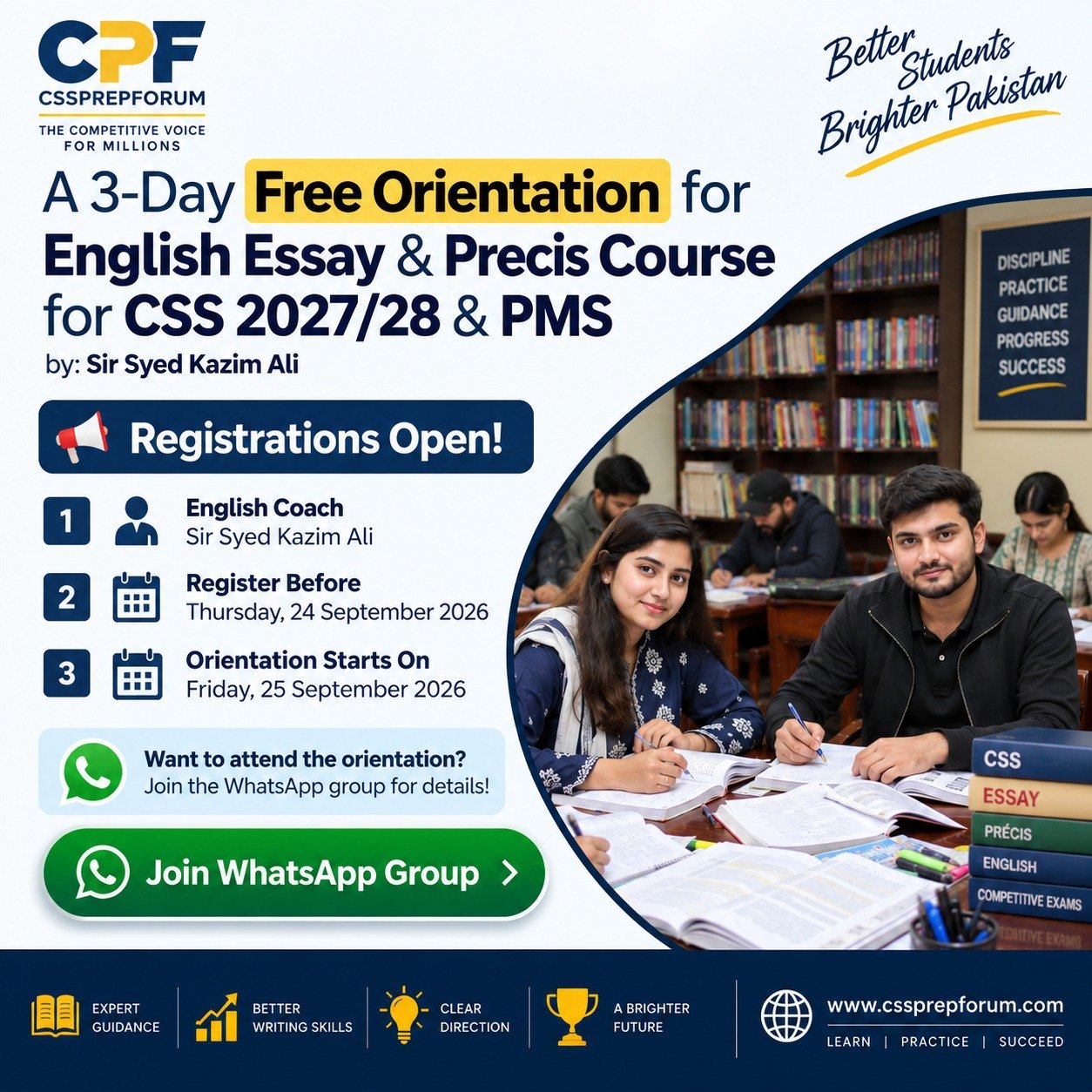
You can explore Sir Syed Kazim Ali’s English Essay and Precis Course or join the free 3-day orientation for CSS and PMS aspirants.