
CSS Solved Criminology Past Paper 2020 | Nature vs. Nurture Debate in Criminology

Question Breakdown
In this question, the examiner has inquired about the aspirant’s position on the nature vs. nurture debate in criminology. The above query comprises of two main parts that require explanation which include; nature vs. nurture debate in criminology and the aspirant’s stance on that debate. Aspirants should start their answer by defining criminology and explaining the nature as well as nurture perspectives. Then, the position on the nature vs. nurture debate in criminology ought to be delineated. Addition of scholarly references, definitions and examples will make the answer outstanding. Moreover, flow charts, diagrams, tables and relevant quotations can further ameliorate the quality of the answer.
Outline
1-Introduction
2-Definition of Criminology
3-The Nature Perspective in Criminology
- ✓Biological Foundations
- ✓Genetic Predispositions and Crime
- ✓Neurobiological Factors
- ✓Hormonal Influences
4-The Nurture Perspective in Criminology
- ✓Environmental Influences
- ✓Urbanization and Crime
- ✓Lack of Opportunities
- ✓Socio-economic Causes of Crime
5-Position on the Nature vs. Nurture Debate
- ✓Understanding the Underlying Causes of Crime
- ✓Importance of Social Environment as well as Biological Characteristics
- ✓Policy Implications
- ✓Protecting Human Rights
6-Critical Analysis
7-Conclusion

Answer to the Question
Introduction
Criminology is the youngest, most dynamic, and fascinating field of study in understanding crime and criminals. It is multidisciplinary in nature, as it examines criminal behavior and social as well as legal responses through the application of scientific methods. In addition, criminology is the analysis of the nature of crime, its causes, the formation of criminal law, the enforcement of law, and the control of crime. It is developed through various schools of thought, including pre-classical, classical, positivist, sociological, neoclassical, modern, and Islamic schools. Nonetheless, criminology has long been influenced by the nature versus nurture controversy, which questions whether social circumstances or biological predispositions are thought to be responsible for crime. There is a substantial discussion in criminology that explores the reasons behind crime and whether criminals are “born” or “made.” Modern criminology acknowledges the interaction between the two, whereas early criminologists frequently tended toward biological determinism. In the contemporary era, the research accentuates the significance of both factors. In “The Anatomy of Violence: The Biological Roots of Crime”, A. Raine puts forth,
“Brain abnormalities may predispose individuals to violence, yet without environmental stressors, such predispositions often remain dormant.”
Defining Criminology
Criminology is a Latin expression, and the word is a combination of two words: ‘crimen’, which means ‘accusation’, and ‘ologia’, which means ‘theory or philosophy’. The term ‘criminologia’ was coined by Raffaele Graffalo in 1885, and ‘criminologie’ was coined by Paul Topinard in 1887. By criminology, they meant the science whose purpose is to discover the causes of crime and study criminality in its entirety. It emerged as a separate subject in the nineteenth century. According to Justice Krishna Iyer,
“Criminology is a special field of knowledge, a systematic discipline, a nidus of criminal law on the sociological plane, dealing with crime and deviance and those individuals who violate law, how they are arrested, how they are prosecuted, how they are convicted, how they are put in prison, how they are tried.”
According to Elliott,
“Criminology is the scientific study of crime and its treatment.”
Sage dictionary defines criminology as,
“The study of crime, attempt to it, attitude to it.”
In addition, according to Sutherland,
“Criminology is the process of law-making, law-breaking, and reacting towards law-breaking.”
Furthermore, Donald Taft defines criminology as,
“A modern youngest discipline. Its contents are analyzing causes of crimes, explaining theories of crimes, motives, and elements of crime, and preventive strategies for combating new emerging crimes.”
The Nature Perspective in Criminology
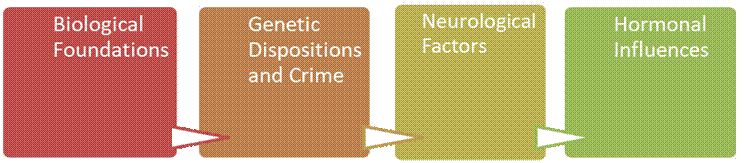
Figure 1: The Nature Perspective
Biological Foundations
According to Cesare Lombroso, criminals are believed to inherit criminal behavior, and they can be distinguished from law-abiding citizens based on physical characteristics. This is known as atavism, which was explained by him in his book titled “The Criminal Man” in 1876. Furthermore, the Body Type Theory by William Sheldon suggests that the body generates crime, not the mind, and that mesomorphs, or muscular individuals, are often associated with criminal behavior.
Genetic Predispositions and Crime
The modern research emphasizes that genetics contributes to criminal behavior. For instance, twin studies conducted in the United States and Denmark showed higher concordance rates of crime, ranging from 50% to 60%, among monozygotic twins compared to dizygotic twins, which was approximately 20%. Despite this, genes such as MAOA-L have been associated with impulsivity as well as aggression.
Neurobiological Factors
Research on brain imaging accentuates that impulsivity, a lack of empathy, and aggression are associated with dysfunction in the prefrontal cortex and amygdala. Violent crimes are frequently associated with neurological deficits.
Hormonal Influences
According to research, substance abuse (such as methamphetamine and cannabis) and serotonin deficiency, as well as testosterone, may heighten antisocial behavior and aggression.
The Nurture Perspective in Criminology
On the other hand, sociological theories and the nurture perspective in criminology suggest that crime results from social and cultural definitions of physical characteristics, social inequality, poverty, environmental influences, as well as weak institutions.
Environmental Influences
There are certain definitions of one’s physical characteristics that are society-bound. For instance, fat people are usually considered jolly, whereas tall men and redheaded women are considered aggressive. On the other hand, criminal behavior is often observed in people living in regions with harsh climate conditions, such as those near the North and South Poles. This is because people cannot adapt to the changing climate conditions.
Urbanization and Crime
According to the Social Disorganization Theory by Emile Durkheim, Henry Shaw, and McKay, lawlessness, poverty, urbanization, industrialization, and the expansion of cities are the causes of the increase in crime. The 2022 report by the Pakistan Bureau of Statistics revealed that in Karachi, increased population density, combined with a lack of law enforcement, has led to a rise in criminal activity.
Lack of Opportunities
Despite this, Robert K. Merton explains in Strain Theory that poverty is not the cause of crime; however, stress, injustice, social inequality, and economic disparity are the causes of criminal behavior. Lack of opportunities and discrimination increases strain and become a cause of crime. Besides, lack of moral regulations and structural tensions are the causes of crime because there is a conflict between socially defined goals and legitimized means. The Federal Investigative Agency (FIA) reported that in Pakistan, lack of opportunities and youth unemployment (23% in 2023) are the primary reasons behind rising urban theft and cybercrime.
Socio-economic Causes of Crime
According to the United Nations Office on Drugs and Crime (UNODC), juvenile delinquency in Pakistan is caused by a lack of attention by parents and domestic violence experienced by the juveniles. It is higher among children from broken families. Furthermore, the Differential Association Theory, as proposed by Sutherland, suggests that criminal behavior is learned through interactions with peers or family members. For example, gangs in Lahore and Karachi show that criminal norms are transmitted across generations.
Position on the Nature versus Nurture Debate
Both nature and nurture hold significant importance in the cause of crimes, as, despite genetic risks, the environment serves as a triggering factor for criminal activities.
Figure 2: Position on Nature versus Nurture Debate in Criminology
Understanding the Underlying Causes of Crime
Various perspectives of criminology explain the causes of crime. For instance, in the classical school of thought, Cesare Beccaria and Jeremy Bentham have highlighted that man is a rational being who commits a crime after conducting a cost-benefit analysis. In addition, the biological perspective of criminology, as outlined by Cesare Lombroso, suggests that an individual’s physical and psychological characteristics can predict their likelihood of engaging in criminal behavior. In 2023, the Pakistan Bureau of Statistics unveiled that the key factors causing crime in Pakistan are poverty and unemployment because 39.4% of people are living below the poverty line.
Importance of Social Environment as well as Biological Characteristics
Environment explains the differences between siblings raised in the same household, while genetics accounts for approximately 40–50% of the variance in antisocial behavior. Neurocriminology demonstrates how disparities in the brain interact with peer pressure, poverty, or abuse to affect criminal outcomes. According to data from the Pakistan Bureau of Statistics, 90% of theft, burglaries, and street crimes take place in urban areas with the highest levels of inequality. This emphasizes the importance of nurture factors. Nonetheless, habitual offenders contend that biological vulnerabilities might perpetuate criminal cycles.
Policy Implications
Stigmatization could result from a purely biological explanation. Biological vulnerabilities are often overlooked in favor of a purely social explanation. The most successful strategies combine mental health treatment, education, poverty alleviation, and rehabilitation. In the United Kingdom, early intervention programs demonstrated the dominance of nurture by reducing youth recidivism. Besides, in Scandinavia, despite comparable genetic risks among populations, rehabilitation-focused justice reduced reoffending rates. In Pakistan, despite the prevalence of punitive measures, crime continues, exposing neglected environmental causes.
Human Rights Considerations
Placing too much emphasis on biology runs the risk of legitimizing discrimination based on race or class. On the other hand, an overemphasis on the environment runs the risk of neglecting accountability. A well-rounded position guarantees justice and equity.
Critical Analysis
The strength of a natural perspective in criminology lies in its capacity to identify biological risk factors, such as genetic predispositions and neurochemical imbalances, that may increase susceptibility to crime and to explain persistent behavioral traits. However, the main flaw in this perspective is that it fails to consider the sharp swings in crime rates, which are often caused by political, social, or economic changes rather than genetic ones. On the other hand, by connecting criminal behavior to social conditions such as inequality, inadequate education, and disorganized communities, the nurture perspective offers strong policy relevance. It is particularly effective in explaining cross-cultural variations in crime. Its drawback, however, is that it cannot explain why people who grow up in the same family or surroundings might behave differently, some turning into criminals while others follow the law. Since poverty, unemployment, urbanization, and institutional weaknesses, rather than biological inheritance, are closely linked to crime trends in Pakistan, empirical evidence strongly favors the nurture argument. Therefore, even though both viewpoints offer insightful information, Pakistan’s socioeconomic realities confirm that environmental influences have a greater influence on criminal behavior.
Conclusion
In brief, an interactionist framework offers the most comprehensive understanding of the nature versus nurture debate in criminology. Genetic predispositions influence potential for crime, but environmental and social triggers ultimately determine criminal behavior. The data of various countries, including Pakistan, shows that poverty, unemployment, and lack of law enforcement are far more important factors in crime than biology. Nevertheless, biological vulnerabilities should not be disregarded as they influence results in conjunction with environmental factors. To ensure a comprehensive strategy for crime prevention, the most successful criminological approach integrates social reform, education, and rehabilitation with an understanding of biological influences. In the “Handbook of Crime Correlates”, L. Ellis, K. M. Beaver, and J. Wright put forth,
“The most convincing account of crime recognizes that biology and environment are not rivals but partners in shaping human conduct.”

CSS Solved Past Papers’ Essays
Looking for the last ten years of CSS and PMS Solved Essays and want to know how Sir Kazim’s students write and score the highest marks in the essays’ papers? Then, click on the CSS Solved Essays to start reading them.
CSS Solved Essays
CSS Solved General Science & Ability Past Papers
Want to read the last ten years’ General Science & Ability Solved Past Papers to learn how to attempt them and to score high? Let’s click on the link below to read them all freely. All past papers have been solved by Pakistan’s top CSS GSA coach having the highest score of their students.
General Science & Ability Solved Past Papers