CSS Solved Political Science 2026 Past Paper | Pakistan’s Foreign Policy Goals and its Relations
The following question of CSS Political Science 2026 is solved by Miss Ayesha Irfan, a renowned CSS coach for Islamiat and Political Science. Moreover, the question is attempted using the same pattern taught by Sir Syed Kazim Ali to his students, who have scored the highest marks in compulsory and optional subjects for years. This solved past paper question is uploaded to help aspirants understand how to crack a topic or question, write relevantly, what coherence is, and how to include and connect ideas, opinions, and suggestions to score the maximum.

Question Breakdown Paragraph
The question requires a structured analytical discussion of Pakistan’s foreign policy objectives and their practical manifestation in its relations with India, China, and the USA. It demands more than a descriptive account of bilateral ties; rather, it calls for an examination of the strategic goals guiding Pakistan’s external behavior, such as security, economic development, regional stability, and international standing. The answer must link these overarching goals with Pakistan’s complex rivalry with India, its strategic partnership with China, and its fluctuating yet significant relationship with the United States. A critical approach should evaluate how these relationships reflect continuity and change in Pakistan’s foreign policy and assess the challenges and opportunities emerging from shifting regional and global dynamics.
Outline
1- Introduction
2- Survival, Security, and Sovereignty: The Core Drivers of Pakistan’s Foreign Policy
3- Pakistan–India Relations (Perpetual Rivalry or Managed Competition?)
- Partition legacy and the Kashmir dispute
- Security dilemma and nuclear deterrence stability
- Diplomatic deadlocks and limited engagement
- Implications for South Asian peace
4- Pakistan–China Strategic Convergence (All-Weather or Strategic Necessity?)
- Evolution from tactical alignment to strategic partnership
- Defense cooperation and regional balancing
- Economic transformation under the China-Pakistan Economic Corridor
- Geopolitical significance in Asia
5- Pakistan–United States Relations (Allies, Aid, and Ambiguity)
- Cold War alliances and security cooperation
- Post-9/11 partnership in counterterrorism
- Trust deficit and policy divergences
- Recalibration amid US–China competition
6- Critical Analysis: The Challenge of Bipolar Balancing
7- Conclusion

Answer to the question
Introduction
Pakistan’s foreign policy has evolved under the shadow of geography and the weight of history. Born out of partition in 1947, Pakistan inherited unresolved territorial disputes, mass migration trauma, and an immediate security imbalance with India. Located at the intersection of South Asia, Central Asia, and the Middle East, Pakistan’s strategic environment has compelled it to think defensively while acting pragmatically. Over time, its diplomatic priorities have revolved around three principal relationships: a rivalry with India, a deepening strategic convergence with China, and a fluctuating yet consequential engagement with the United States. These relationships together illuminate the structural drivers and enduring dilemmas of Pakistan’s external behavior.
Survival, Security, and Sovereignty: The Core Drivers of Pakistan’s Foreign Policy
From its inception, Pakistan’s foreign policy has been anchored in the imperative of survival. The early wars with India, continuing tensions along disputed borders, and internal security threats reinforced a perception that sovereignty could not be taken for granted. Consequently, national security became the organizing principle of diplomacy.
A significant proportion of national resources continues to be allocated to defense, with military spending remaining around 3 to 4 percent of GDP in recent years. This sustained prioritization reflects the belief that credible deterrence is indispensable in a volatile regional environment. Official foreign policy statements consistently emphasize territorial integrity and sovereign equality, underscoring that Pakistan’s engagement with the world is filtered through a security lens. Thus, rather than being purely ideological or economic, Pakistan’s diplomacy has largely been shaped by structural vulnerabilities and perceived external threats.
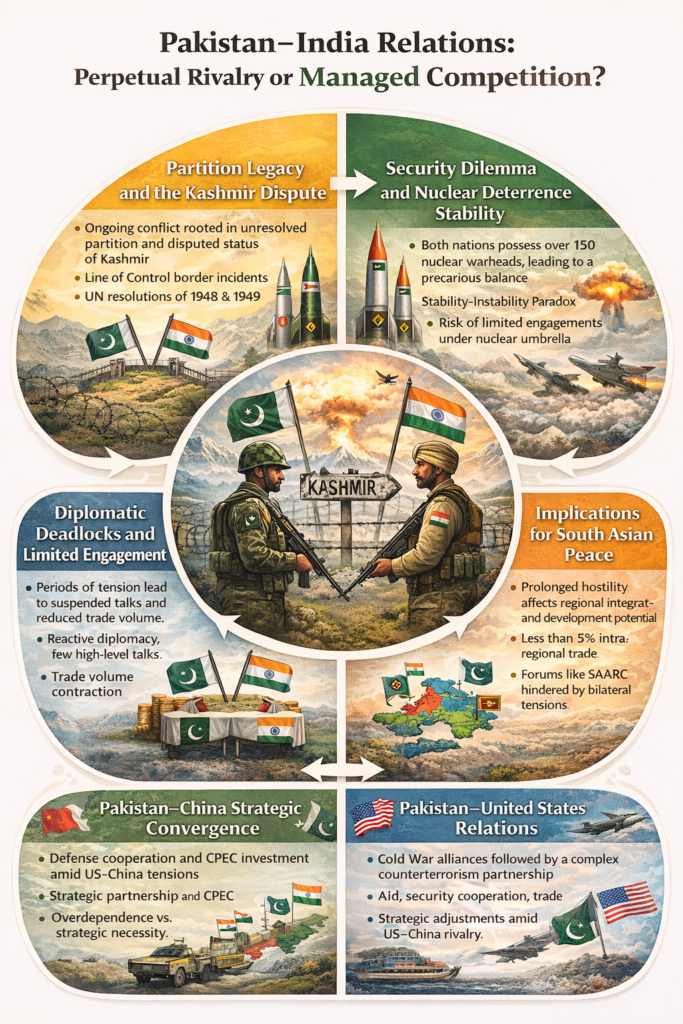
Pakistan–India Relations: Perpetual Rivalry or Managed Competition?
Partition Legacy and the Kashmir Dispute
The rivalry between Pakistan and India is rooted in the unresolved legacy of partition and the contested status of Kashmir. The dispute remains central to Pakistan’s diplomatic narrative, frequently framed in reference to United Nations Security Council resolutions of 1948 and 1949 that called for a plebiscite. Periodic escalations along the Line of Control, including the crisis following the Pulwama incident in 2019, demonstrate how quickly tensions can intensify.
Although a reaffirmation of the 2003 ceasefire agreement in 2021 reduced cross-border firing, the underlying political dispute remains unresolved. This persistence of conflict has institutionalized mistrust, making reconciliation politically sensitive in both countries.
Security Dilemma and Nuclear Deterrence Stability
The overt nuclearization of South Asia in 1998 introduced a deterrence framework that fundamentally altered the strategic equation. Both states are now estimated to possess over 150 nuclear warheads each, establishing a precarious balance. While nuclear capability has reduced the probability of full-scale conventional war, it has not eliminated crises. Instead, it has created a stability-instability paradox in which limited engagements remain possible under the nuclear umbrella.
This dynamic underscores the complex interplay between deterrence and escalation. The absence of sustained confidence-building measures further compounds uncertainty, leaving both sides reliant on signaling rather than trust.
Diplomatic Deadlocks and Limited Engagement
Despite cultural proximity and economic potential, bilateral trade and dialogue have steadily declined during periods of tension. Trade volumes that once crossed 2 billion dollars annually have contracted sharply following political crises. Diplomatic talks are frequently suspended, and high-level engagements remain rare.
The result is a relationship characterized by reactive diplomacy rather than structured engagement. Economic rationality often yields to domestic political pressures and security narratives, reinforcing a cycle of disengagement.
Implications for South Asian Peace
The enduring rivalry has broader regional consequences. South Asia remains one of the least economically integrated regions globally, with intra-regional trade accounting for less than 5 percent of total trade. Forums such as SAARC have struggled to achieve meaningful progress due to bilateral tensions. Consequently, the Pakistan–India impasse not only constrains bilateral normalization but also limits the developmental prospects of the entire region.
Pakistan–China Strategic Convergence: All-Weather or Strategic Necessity?
Evolution from Tactical Alignment to Strategic Partnership
Pakistan’s ties with China began as a cautious diplomatic engagement in the 1950s but gradually evolved into a comprehensive strategic partnership. Shared concerns regarding regional balance, particularly in relation to India, laid the foundation for deeper cooperation. Regular high-level visits and joint military exercises illustrate the institutionalization of this partnership.
Over time, the relationship has expanded beyond security to encompass political coordination in international forums, reflecting mutual trust and strategic alignment.
Defense Cooperation and Regional Balancing
Defense collaboration forms the backbone of Pakistan–China ties. China has emerged as Pakistan’s largest arms supplier, accounting for a substantial share of its military imports over the past decade. Joint production projects and technology transfers have enhanced Pakistan’s defense capabilities while solidifying China’s influence in South Asia.
This cooperation not only strengthens Pakistan’s deterrence posture but also contributes to regional balancing amid evolving Indo-Pacific dynamics.
Economic Transformation under the China-Pakistan Economic Corridor
The launch of the China-Pakistan Economic Corridor in 2015 marked a turning point in bilateral relations. Valued at over 60 billion dollars in announced investments, the corridor includes energy, infrastructure, and connectivity projects. Early harvest energy initiatives added thousands of megawatts to Pakistan’s national grid, significantly alleviating chronic power shortages that had constrained industrial output.
Beyond infrastructure, CPEC has elevated Pakistan’s geoeconomic relevance by linking western China to the Arabian Sea. Official joint statements describe it as a flagship of broader regional connectivity, highlighting its strategic and economic dimensions.
Geopolitical Significance in Asia
In the wider Asian context, Pakistan’s partnership with China carries implications that extend beyond bilateral interests. The corridor enhances China’s access to maritime routes while positioning Pakistan as a transit hub. As the US–China rivalry intensifies, this alignment acquires greater geopolitical significance, compelling Pakistan to manage its partnerships carefully to avoid overdependence.
Pakistan–United States Relations: Allies, Aid, and Ambiguity
Cold War Alliances and Security Cooperation
Pakistan’s alignment with the United States during the Cold War was driven by the search for security guarantees and military modernization in the face of regional asymmetry. By joining US-backed alliances such as SEATO in 1954 and CENTO in 1955, Pakistan positioned itself within the Western security architecture. This alignment translated into substantial assistance: between 1954 and 1965, Pakistan received approximately $2.5 billion in US economic and military aid, a significant sum for a newly independent state with a modest GDP. Military grants enabled the modernization of Pakistan’s armed forces, including aircraft and armored systems, while economic assistance supported infrastructure and development planning.
However, the relationship proved transactional rather than treaty-bound in the strictest sense. During the 1965 and 1971 wars with India, US military supplies were suspended, exposing the conditional nature of the partnership. Thus, while Cold War alignment strengthened Pakistan’s defense capacity in its formative decades, it also demonstrated the limits of reliance on external patronage when interests diverged.
Post-9/11 Partnership in Counterterrorism
Following the attacks of September 11, 2001, Pakistan once again assumed strategic importance for Washington. As a frontline state in the US-led intervention in Afghanistan, Pakistan provided logistical routes, intelligence cooperation, and operational support. Between 2001 and 2018, Pakistan received over $30 billion in US assistance, including Coalition Support Funds and security-related aid. This period also saw intensified military operations in Pakistan’s tribal areas, with thousands of Pakistani security personnel and civilians losing their lives in counterterrorism efforts. At the same time, the economic dimension of the relationship deepened. The United States became one of Pakistan’s largest export markets, absorbing a significant share of its textile exports. Yet despite overlapping counterterrorism objectives, the partnership was complicated by cross-border militancy, drone strikes, and differing endgames in Afghanistan. Consequently, cooperation coexisted with friction, illustrating how shared interests did not automatically translate into strategic trust.
Trust Deficit and Policy Divergences
Even at the height of cooperation, mistrust persisted on both sides. US concerns regarding militant sanctuaries and Pakistan’s regional strategy clashed with Islamabad’s emphasis on strategic depth and border security. This divergence culminated in periodic aid suspensions, including the freezing of nearly $1.3 billion in security assistance in 2018. Public rhetoric in both capitals reflected growing skepticism, and high-level engagements became less frequent. Trade figures, however, revealed continued economic interdependence. Bilateral trade has hovered around $6 to $9 billion annually in recent years, with the United States remaining Pakistan’s largest single-country export destination. This contrast between political strain and economic continuity underscores the layered complexity of the relationship. While security cooperation fluctuated, economic ties provided a stabilizing undercurrent.
Recalibration amid US–China Competition
In recent years, the US strategic focus has shifted toward managing China’s rise. For Pakistan, this evolving rivalry presents both opportunity and risk. While China remains a primary source of investment and defense cooperation, the United States continues to be a significant export destination and a key diplomatic actor. Consequently, Pakistan has sought to maintain selective engagement with Washington while deepening ties with Beijing, attempting to preserve strategic flexibility in a polarized environment. Nonetheless, Pakistan’s exports to the US have exceeded $5 billion annually in recent years, reinforcing the importance of American markets for foreign exchange earnings. Simultaneously, engagement with international financial institutions, where US influence remains substantial, further illustrates the interconnected nature of the relationship. Consequently, Pakistan has pursued a calibrated approach, maintaining dialogue with Washington while deepening economic and strategic cooperation with Beijing. This balancing act reflects an effort to preserve autonomy and avoid zero-sum alignment in an increasingly polarized global order.
Critical Analysis: The Challenge of Bipolar Balancing
Pakistan’s foreign policy today is defined by the challenge of balancing between major powers without sacrificing autonomy. Trade patterns illustrate this complexity, with China emerging as Pakistan’s largest trading partner while Western markets remain crucial for exports. Overreliance on any single partner could generate economic vulnerability or diplomatic isolation. Therefore, the sustainability of Pakistan’s external strategy depends not only on external alignments but also on internal reform. Economic resilience, institutional coherence, and regional outreach are essential for transforming balancing from a reactive posture into a proactive strategy.
Conclusion
Pakistan’s foreign policy reflects a continuous effort to reconcile security imperatives with economic aspirations. Rivalry with India underscores the enduring impact of history, partnership with China highlights strategic and developmental convergence, and engagement with the United States demonstrates the complexities of transactional alliances. Moving forward, the imperative is clear: Pakistan must complement credible deterrence with economic diversification and diplomatic agility. By strengthening internal stability and broadening external partnerships, it can shift from a survival-driven approach to a more confident and geoeconomic vision of its role in the international system.

CSS Solved General Science & Ability Past Papers
Want to read the last ten years’ General Science & Ability Solved Past Papers to learn how to attempt them and to score high? Let’s click on the link below to read them all freely. All past papers have been solved by Miss Iqra Ali & Dr Nishat Baloch, Pakistan’s top CSS GSA coach, having the highest score of their students.
CSS Solved Islamiat Past Papers
Want to read the last ten years’ CSS Islamiat Solved Past Papers to learn how to attempt them and maximize your score? Click the link below to access all papers for free. Each past paper has been meticulously solved by Miss Ayesha Irfan, a top CSS Islamiat coach renowned for producing consistently high-scoring students.