CSS Solved Political Science 2026 Past Paper | The Epicureans, Concept of Asbiya, Aristotle’s scheme of Government
The following question of CSS Political Science 2026 is solved by Miss Ayesha Irfan, a renowned CSS coach for Islamiat and Political Science. Moreover, the question is attempted using the same pattern taught by Sir Syed Kazim Ali to his students, who have scored the highest marks in compulsory and optional subjects for years. This solved past paper question is uploaded to help aspirants understand how to crack a topic or question, write relevantly, what coherence is, and how to include and connect ideas, opinions, and suggestions to score the maximum.

Question breakdown
The question requires the candidate to write detailed explanatory notes on any two of the three given topics: the Epicureans, the concept of Asbiya, and Aristotle’s scheme of government. It tests conceptual clarity, historical context, and analytical understanding rather than argumentative discussion. A high-scoring response should define each selected topic, explain its key principles and features, mention its intellectual background, and briefly highlight its significance in political or philosophical thought, particularly referencing thinkers such as Aristotle where relevant.
The Epicureans
Outline
1- Introduction (The Epicurean Way—Philosophy of Tranquility)
2- Historical Background
3- The Physical Foundation: Atomism and Materialism
4-Core Philosophical Principles
- Concept of Pleasure (Hedonism Properly Understood)
- Ataraxia and Aponia
- Theory of Knowledge and Nature
- Overcoming Existential Fears: The Tetrapharmakos
5- Social and Political Views
6- Significance and Criticism
7- Conclusion
Answer to the Question
Introduction (The Epicurean Way-Philosophy of Tranquility)
Epicureanism, founded by Epicurus in the fourth century BCE, represents a distinctive philosophical approach aimed at achieving personal happiness through mental and physical tranquility. The pursuit of happiness is often mistaken for a chaotic chase after sensory indulgence, yet for the Epicureans, it was a rigorous, rational endeavor. Emerging as a “medicine for the soul,” this philosophy was designed to heal the existential anxieties of a turbulent Hellenistic world. By shifting the focus from divine favor to the understanding of nature, Epicurus proposed a life of calculated serenity. The Epicurean way is a materialist system that seeks happiness through the attainment of ataraxia (mental peace) and aponia (physical ease) by understanding the limits of desire and the nature of the universe.
Historical Background
Epicureanism arose in the late 4th century BCE, a period of profound political upheaval following the death of Alexander the Great. As the Greek city-states lost their autonomy, individuals felt a growing sense of powerlessness and dread. Epicurus established “The Garden” in Athens, a secluded community that offered an alternative to the public-facing philosophies of the Stoics. Unlike other schools of the time, it famously welcomed women and slaves, emphasizing a private, inclusive path to tranquility that prioritized personal well-being over the crumbling civic structures of the ancient Mediterranean.
The Physical Foundation: Atomism and Materialism
Epicurean philosophy is grounded in a materialist worldview inspired by Democritus. According to Epicurus, everything in the universe, including the soul, consists of atoms moving in the void. There is no supernatural causation; natural phenomena, life, and death are explained through physical interactions. This materialist perspective removes fear of divine punishment and supports rational inquiry, allowing humans to understand the world without superstition. For example, diseases are natural processes rather than divine retribution, which liberates individuals from irrational anxieties.
Core Philosophical Principles
- Concept of Pleasure (Hedonism Properly Understood)
The Epicurean concept of pleasure is frequently misunderstood as “vulgar hedonism,” but it is actually a philosophy of refined restraint. True pleasure is the absence of pain (aponia) and mental disturbance. Simple pleasures, like friendship, reading, or philosophical reflection, contribute more to long-term happiness than fleeting physical gratification. For instance, Epicurus famously preferred a modest meal with friends over feasting in opulent surroundings.
- Ataraxia and Aponia
The ultimate goal of the Epicurean life is the dual state of Ataraxia and Aponia. Aponia refers to the absence of physical pain, while Ataraxia is the pinnacle of mental untroubledness. Real-time examples of this are seen in the Epicurean lifestyle, which favored simple bread and water over luxury to avoid the “hangover” of excess. Textual evidence from Epicurus’s “Letter to Menoeceus” explains that once the pain of need is removed, further luxury does not increase pleasure. Thus, the highest pleasure is simply the total absence of suffering through a balanced life.
- Theory of Knowledge and Nature
The Epicurean theory of knowledge, or “Canonics,” posits that sensation is the primary and infallible source of truth. They argued that our senses cannot deceive us; error only arises when our minds add incorrect interpretations to sensory data. For example, seeing a distant tower as round when it is square is a failure of judgment, not sight. By relying on empirical evidence, the Epicureans sought to understand the “laws of nature” to banish terrors. This empiricism was a precursor to the modern scientific method, prioritizing observable reality over abstract metaphysics.
- Overcoming Existential Fears: The Tetrapharmakos
To achieve tranquility, one must apply the “Tetrapharmakos” or the Four-Fold Cure. This mental toolkit addresses the primary sources of human misery: fear of gods, death, and pain. The textual evidence for this is found in the Philodemus papyri, which state: “God is not to be feared, death is not to be felt, the good is easy to get, and the painful is easy to endure.” By viewing death as a permanent state of non-sensation, the Epicurean eliminates the dread of the afterlife, allowing for a focused, peaceful appreciation of the present.
Social and Political Views
Socially, Epicureans prioritized friendship over the “vain” pursuits of politics and fame. Their motto, “Lathe Biosas” (Live in Hiding), encouraged withdrawal from the public eye to avoid the inevitable stress of ambition. Justice was viewed not as a divine law, but as a social contract, a mutual agreement to neither harm nor be harmed. Real-time evidence of this is seen in the structure of The Garden, where community members supported each other’s needs. This focus on private bonds over state duty made Epicureanism a radical, “apolitical” alternative to traditional civic life.
Significance and Criticism
Epicureanism significantly influenced later philosophical and ethical thought, particularly in promoting rationalism, empiricism, and ethical individualism. Its focus on moderation, friendship, and mental peace continues to resonate with modern humanist perspectives. However, it has faced criticism for encouraging withdrawal from civic duties and political engagement. Critics argue that by prioritizing personal tranquility over public responsibility, Epicureanism risks fostering passivity and disengagement from collective social and political life.
Conclusion
Epicureanism remains a profound guide for achieving tranquility through reason, simplicity, and empirical understanding. Grounding human existence in the material world and deconstructing existential fears, it offers a path to happiness that is entirely within human control. While often slandered as a philosophy of excess, its true heart lies in the quiet joy of a pain-free body and a calm mind. In an era of constant global noise, the Epicurean call to return to nature and friendship remains a timeless necessity.

Concept of Asbiya
Outline
1- Introduction
2- Defining Asabiyyah: The Linguistic and Sociological Essence
3- The Foundations of Asabiyyah
4- The Lifecycle of Civilizations: The Five Stages of the Dynasty
- Phase of Conquest
- Phase of Consolidation
- Phase of Peak (Luxury)
- Phase of Contentment
- Phase of Decay
5- The Conflict: Badawah(Nomadic) vs. Hadirah(Sedentary)
6- Asabiyyah in the Modern State
7- Conclusion
Introduction
The rise and fall of empires is rarely a product of mere coincidence; rather, it follows a biological cycle of social energy known as Asabiyyah. Developed by the 14th-century scholar Ibn Khaldun in his seminal work, the Muqaddimah, this concept serves as the “sinew” of civilization, binding disparate individuals into a formidable political force. Asabiyyah represents the collective consciousness and social solidarity that determines a group’s ability to seize and maintain power. It is the fundamental driving force of political power, acting as the collective bond that enables groups to transition from nomadic wandering to the establishment of a lasting dynasty.
Defining Asabiyyah: The Sociological Essence
Asabiyyah is essentially the force that binds individuals into a unified group, derived linguistically from the word ‘Asaba’, meaning to bind or the nerves that hold the body together. In the Khaldunian framework, it is the “collective consciousness” that allows a group to prioritize the survival of the whole over the ego of the individual. Real-time examples can be seen in the rapid expansion of early Islamic tribes, where a shared identity allowed them to overcome much larger, more fragmented empires. Textual evidence from the Muqaddimah describes this as a “social heat” that makes a group invincible until it is cooled by the comforts of urban life.
The Foundations of Asabiyyah
The primary and most potent source of this cohesion is found in kinship and blood ties, particularly within nomadic or tribal structures (Badawah). Shared hardship in a desert environment acts as a forge, creating an unbreakable bond that urban environments cannot replicate. Statistical observations of historical tribal conquests suggest that groups with high “lineage solidarity” consistently defeat sedentary populations. Furthermore, when Religion is added to Asabiyyah, it acts as a “force multiplier.” As Khaldun noted, religious conviction removes jealousy and competition, turning a tribal bond into a universal, unstoppable mission.
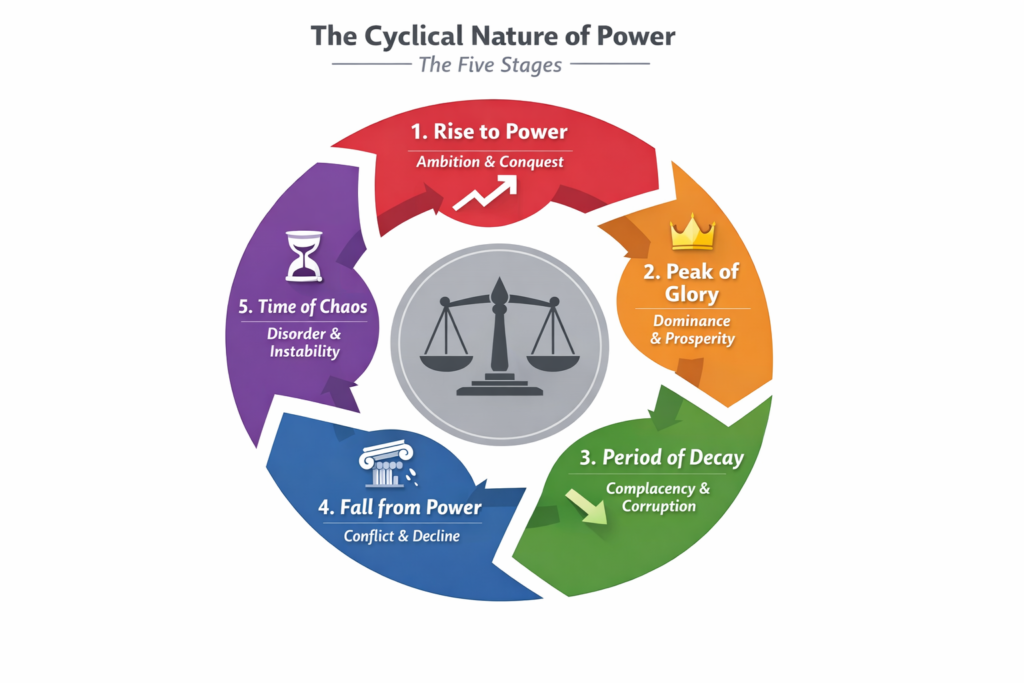
The Cyclical Nature of Power (The Five Stages)
Ibn Khaldun proposed a rigid cycle of five stages through which every dynasty must pass, lasting roughly 120 years (three generations). The first stage is Conquest, where a group with raw, desert-forged Asabiyyah seizes power from a decaying state. In the second stage, the leader Consolidates absolute rule, often distancing himself from his tribal roots to avoid sharing power. By the third stage, the dynasty reaches its Peak, where focus shifts to architecture, arts, and urban luxury. Historical data on the Umayyad and Abbasid dynasties perfectly mirror this progression from desert warriors to cosmopolitan patrons of the arts.
The fourth stage is Contentment and Imitation, where the new generation loses the “fighting spirit” of their ancestors and simply imitates the luxuries of the past. Finally, the fifth stage is Waste and Decay, characterized by the total dissipation of Asabiyyah. In this stage, the ruling class becomes obsessed with physical pleasure and spends the state’s wealth on self-indulgence. Textual evidence shows that at this point, the dynasty becomes a “sick man,” vulnerable to the next group of “barbarians” from the periphery who possess fresh, potent social cohesion, thus restarting the cycle.
The Conflict: Badawah (Nomadic) vs. Hadirah (Sedentary)
The inherent conflict between Badawah (nomadic life) and Hadirah (sedentary life) represents the paradox of civilizational success. The very act of building a city, the goal of every successful tribe, contains the seeds of its own destruction. Urban comfort acts as a “luxury trap”, softening the warrior spirit and diluting the communal bonds that originally brought the group to power. As the state moves toward bureaucracy, it replaces organic loyalty with paid mercenaries. Real-time evidence shows that once a state relies on paid soldiers rather than bound kinsmen, its collapse is inevitable, as mercenaries lack the psychological “Asabiyyah” to die for a cause.
Asabiyyah in the Modern State
In the context of the modern state, Asabiyyah remains highly relevant as it underpins national identity, civic unity, and collective purpose. Strong social bonds foster political legitimacy, citizen participation, and resilience against internal and external threats, while weak Asabiyyah can lead to factionalism, corruption, and institutional decay. Contemporary examples include the role of civic nationalism in sustaining democracies, the mobilization of social reform movements, and the challenges faced by multi-ethnic or ideologically fragmented states, where the absence of cohesive solidarity often undermines governance and social stability. In essence, Asabiyyah in the modern state emphasizes that political authority and societal prosperity depend not only on legal frameworks but also on the strength of collective identity and mutual trust among citizens.
Conclusion
Asabiyyah remains the definitive lens for understanding the rise and fall of human collectives. It reminds us that the strength of a civilization is not measured by its technological advancements or its architectural wonders, but by the internal unity of its people. Ibn Khaldun’s theory illustrates that history is a biological process of social energy, rising with sacrifice and falling with indulgence. As long as human beings associate in groups, the “sinew” of Asabiyyah will continue to be the pulse that dictates the life and death of nations.

Aristotle’s scheme of Government
1- Introduction
2- The Historical and Intellectual Foundation of Aristotle’s Politics
3- The Two-Dimensional Classification Criteria
4- The “Right” Forms of Government
5- The “Perverted” Forms of Government
6- The Practicable Ideal: The “Polity”
7- Conclusion
Introduction
Aristotle, the father of political science, viewed the state not as a mere contract but as a natural growth intended for the achievement of the “Good Life” (Eudaimonia). In his treatise, Politics, he approached governance as a “Master Science” that dictates the ethical and structural boundaries of human association. Unlike his predecessor, Plato, Aristotle sought a realistic and stable “Middle Path” through empirical analysis. His scheme of government is a dual-criteria classification, based on the number of rulers and the intent of rule, aiming to identify the most stable and virtuous form of political organization.
The Historical and Intellectual Foundation of Aristotle’s Politics
To build this scheme, Aristotle conducted a rigorous comparative study of 158 Greek constitutions. He observed that the primary cause of instability in the polis was the constant struggle between the rich and the poor. By analyzing these real-world examples, he moved beyond utopianism to create a taxonomy that categorized states according to their objective reality. This empirical approach allowed him to build a framework where governance is judged by its ability to maintain the Rule of Law and the common welfare of the citizenry. However, the intellectual foundation of Aristotle’s politics is rooted in Teleology, the belief that everything has a natural purpose or “end.” For Aristotle, the state is the highest of all communities because it is the only one that is self-sufficing. He famously stated that “Man is by nature a political animal,” meaning humans can only achieve full virtue within the structure of a polis.
The Two-Dimensional Classification Criteria
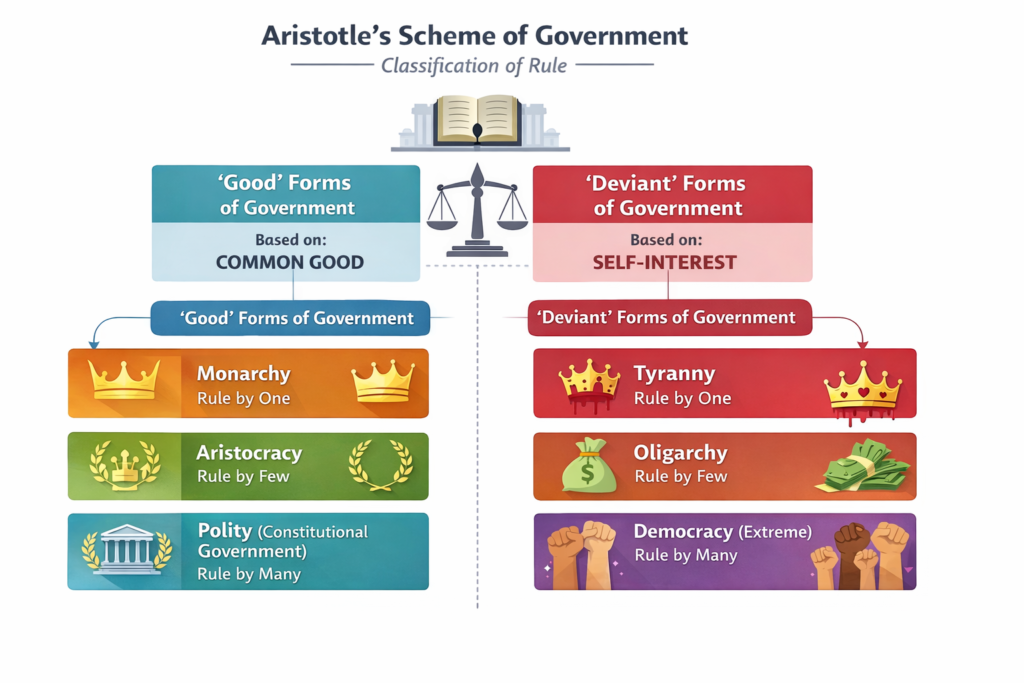
Aristotle’s classification is famously two-dimensional, merging quantitative and qualitative metrics. The quantitative aspect asks: “How many hold sovereign power?” (One, Few, or Many). The qualitative aspect asks: “Is the government Normal or Perverted?” Normal forms serve the common good, while perverted forms serve the selfish interests of the rulers. Statistical evidence from his study suggests that pure forms are rare; most states exist in a state of flux. Textual evidence in Politics emphasizes that the moral purpose of the state is the ultimate decider of its legitimacy, not just its mechanical structure.
The “Right” Forms of Government
The normal forms represent governance where the rulers are guided by virtue and law. Monarchy is the rule of one virtuous man; while Aristotle considered it the “ideal” form, he noted that it is practically impossible to find a man so superior to others. Aristocracy is the rule of the few best men based on merit. Finally, Polity is the rule of the many for the common interest. Historical examples of early Greek city-states were used by Aristotle to show that when rulers prioritize the polis over their own pockets, the state achieves its highest teleological purpose.
The Perverted Forms of Government
Perverted forms occur when the qualitative intent of the ruler shifts toward self-interest. Tyranny is the perversion of Monarchy, where a self-serving despot rules through fear. Oligarchy is the perversion of Aristocracy, where the wealthy rule exclusively for the accumulation of riches. Most notably, Aristotle defined Democracy as the perversion of Polity, where the “needy many” rule for their own class interest at the expense of the rich. Textual evidence shows Aristotle feared that “extreme democracy” leads to mob rule (Ochlocracy), where decrees of the assembly supersede the established law.
The Practicable Ideal: The “Polity”
For Aristotle, the “Polity” (Constitutional Government) represents the most stable and practicable form of government. It acts as the “Golden Mean” by avoiding the extremes of Oligarchy and Democracy. By balancing the interests of the wealthy and the poor, a Polity creates a Mixed Constitution. Real-time examples of stable ancient states often combined the democratic element of “selection by lot” with the aristocratic element of “election by merit.” This synthesis prevents any single class from gaining total dominance, thereby ensuring long-term institutional stability and social harmony.
The structural success of a Polity rests entirely on a strong Middle Class. Aristotle argued that the middle class is the most rational because they are neither “arrogant like the wealthy” nor “malicious like the poor.” Statistical observations in Politics suggest that states with a large middle class are less prone to revolutions (Stasis). He believed that the middle class acts as a buffer, preventing the two extremes from clashing. Textual evidence confirms his view: “The state that is composed of middle-class citizens is necessarily best governed,” as they are the most likely to follow the dictates of reason.
Conclusion
Aristotle’s classification remains the foundational bedrock of Western political science, rooted in the principles of virtue and moderation. His scheme demonstrates that the number of rulers is less important than the intent of their rule and the social stability provided by the middle class. By advocating for the “Polity” as the most practicable ideal, Aristotle provided a blueprint for constitutional governance that balances competing interests. His legacy endures in modern democracy, reminding us that the best government is one that adheres to the Rule of Law for the common good.
CSS Solved General Science & Ability Past Papers
Want to read the last ten years’ General Science & Ability Solved Past Papers to learn how to attempt them and to score high? Let’s click on the link below to read them all freely. All past papers have been solved by Miss Iqra Ali & Dr Nishat Baloch, Pakistan’s top CSS GSA coach having the highest score of their students.
General Science & Ability Solved Past Papers
CSS Solved Islamiat Past Papers
Want to read the last ten years’ CSS Islamiat Solved Past Papers to learn how to attempt them and maximize your score? Click the link below to access all papers for free. Each past paper has been meticulously solved by Miss Ayesha Irfan, a top CSS Islamiat coach renowned for producing consistently high-scoring students.