CSS 2026 Solved Pakistan Affairs Past Papers | Failure of the UNSC Architecture on the Kashmir Issue
The following question of CSS Pakistan Affairs 2026 is solved by Miss Iqra Ali on the guided pattern of Sir Syed Kazim Ali, which he taught to his students, scoring the highest marks in compulsory subjects for years. This solved past paper question is uploaded to help aspirants understand how to crack a topic or question, how to write relevantly, what coherence is, and how to include and connect ideas, opinions, and suggestions to score the maximum.

Question Breakdown
In this question, the examiner has asked students to analyse the role of the United Nations Security Council on the Kashmir issue with special focus to the “failure in the UNSC’s architecture. So, rather than giving vague reasons, you are required to give explicit structural issues of the UNSC thoroughly regarding Kashmir. You can give some suggestions too for reforms.
Outline
1-Introduction
2- Historical Overview of the Role of the UNSC in the Kashmir Issue
- Resolution 39 (establishment of UNCIP) and Resolution 47 (the mandate for a Plebiscite).
- Demilitarization Efforts by McNaughton, Dixon, and Graham
- After 1965, the UNSC largely retreated, leaving the issue to bilateralism
3- An Analysis of the Inherent Weaknesses in UNSC Architecture
- 3.1. The Veto Trap (P5 Interests)
- Historically, the USSR (and now Russia) used the veto to protect India
- 34/36 global conflicts falling victim to a veto where 1% of the population decides the fate of global peace
- 3.2. The Unbinding Nature of the Resolution
- Kashmir resolutions under Chapter VI lacking the “teeth” for enforcement compared to Chapter VII mandate
- 3.3. Lack of Accountability for Non-Compliance
- Iraq (1990) or Kuwait triggered sanctions and no-fly zones, but Kashmir remaining ignored despite systemic violations
- 3.4. The Membership Flaw & Transactional Diplomacy
- India’s pursuit of a permanent seat and how bilateral trade contracts influence P5 behavior over principled stances.
- 3.5. Ambiguity in the Pre-condition “The retreat of both forces”
- UNCIP Resolution 13 August 1948 (Part II) and the prerequisite for the plebiscite leading to perpetual deadlock
- 3.6. Selective Mandates for Intervention in the Selective Countries
- The inconsistent application of the R2P and A4P in the face of nuclear-armed actors
- 3.7. Perceived Bilateralism post 1971 Shimla Agreement
- The institutional silence since 1970 and the erosion of the UN’s role as the final arbiter.
4- Suggested Reforms / Policy Measures to Resolve Kashmir Issue Once and for All
- Restricting veto power in cases involving mass human rights violations or long-standing territorial disputes.
- The UNSC should seek an advisory opinion from the International Court of Justice on the legal status of the Instrument of Accession and the Plebiscite.
- Leveraging the OIC and Gulf Countries to make Kashmir a costly occupation for India through global trade lobbying
- Increasing Efforts as UNSC member (2025 term) for Kashmir to move beyond closed-door meetings.
5- Critical Analysis
6- Conclusion
Introduction
The metamorphosis of the Jammu and Kashmir dispute from a localized decolonization struggle into a perennial flashpoint of nuclear volatility represents the most profound indictment of the United Nations Security Council (UNSC) since its inception. While the UN Charter ostensibly prioritizes the maintenance of international peace and security, the reality of the Kashmir imbroglio reveals a systemic paralysis where the architecture of global governance has been weaponized by geopolitical exigencies. Since 1948, the Kashmir issue has remained the oldest unresolved item on the UNSC agenda, serving not merely as a regional territorial friction but as a structural testament to the triumph of “Power Politics” over “International Law” and the “Right to Self-Determination.” This failure is not a product of legislative ambiguity but a result of a calculated institutional inertia that has allowed a clear legal mandate to be eroded by the tides of bilateralism and the strategic interests of the Permanent Five (P5) members.
Historical Overview of the Role of the UNSC in the Kashmir Issue
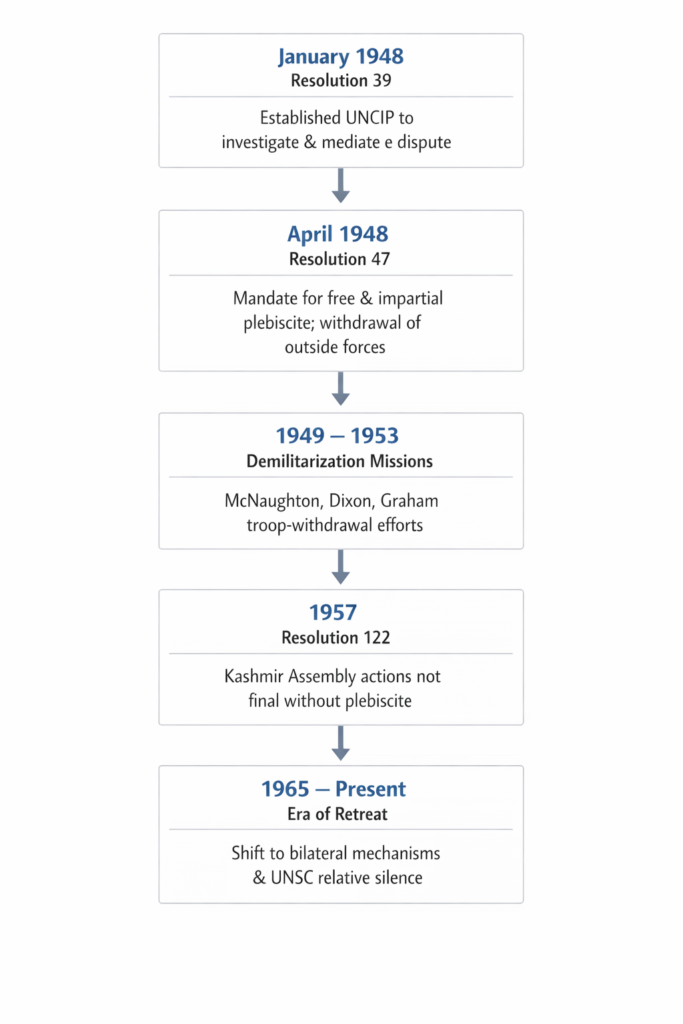
The historical trajectory of the UNSC’s involvement began with an initial burst of normative clarity that quickly succumbed to the rigors of the Cold War, characterized by an era where the Council actively sought a democratic resolution. Following the 1947 partition of the subcontinent, the Council adopted a series of robust measures intended to facilitate an impartial settlement through the expression of the popular will. During this nascent phase, the international community appeared committed to a democratic resolution, appointing luminaries such as General McNaughton, Sir Owen Dixon, and Dr. Frank Graham to oversee demilitarization. However, these efforts were systematically forestalled by India’s refusal to accept synchronized troop withdrawals, leading to a stalemate that the UNSC proved unable, or unwilling, to break. By the mid-1960s, the Council began a long retreat from its executive responsibilities, culminating in a diplomatic vacuum that India exploited to frame the dispute as a purely bilateral matter under the 1972 Shimla Agreement, effectively transforming a multilateral obligation into a private negotiation.
- January 1948: Resolution 39 – Established the United Nations Commission for India and Pakistan (UNCIP) to investigate the dispute and mediate between the two new dominions.
- April 1948: Resolution 47 – Legislated the seminal mandate for a free and impartial plebiscite and instructed the withdrawal of outside forces to ensure a fair environment.
- 1949–1953: Demilitarization Missions – Efforts by General McNaughton (Canada), Sir Owen Dixon (Australia), and Dr. Frank Graham (USA) to synchronize troop withdrawals; Dixon famously concluded that India’s intransigence was the primary obstacle to a plebiscite.
- 1957: Resolution 122 – Reaffirmed that any action taken by the Jammu and Kashmir Constituent Assembly would not constitute a disposition of the state in accordance with the principle of a plebiscite.
- 1965–Present: The Era of Retreat – Following the 1965 war, the UNSC largely deferred to bilateral mechanisms, leading to a half-century of relative institutional silence
An Analysis of the Inherent Weaknesses in UNSC Architecture WRT The Kashmir Issue
Beyond this historical timeline, the inability of the Council to enforce its own dictates necessitates a rigorous critique of the inherent structural flaws within the UNSC architecture.
- The Veto Trap (P5 Interests)
The core of this failure lies in the “Veto Trap,” where the strategic interests of the P5 consistently override the humanitarian imperatives of the broader international community. Throughout the decades, the Soviet Union (and subsequently Russia) consistently employed its veto power to insulate India from any substantive enforcement mechanisms, viewing New Delhi as a vital strategic counterweight in South Asia. This reflects a broader, more alarming statistic: approximately 34 out of 36 major global conflicts have historically fallen victim to the veto, allowing a mere one percent of the global population—represented by the P5—to dictate the fate of millions living in conflict zones. In the context of Kashmir, the veto has functioned as a silencer, ensuring that any motion toward a plebiscite or human rights accountability is strangled in its infancy, creating a moral hazard where an aggressor state can remain defiant so long as it maintains a transactional alliance with a permanent member.
- The Unbinding Nature of the Resolution
This institutional malaise is compounded by the “Unbinding Nature” of the resolutions themselves, which stem from a specific legal taxonomy within the UN Charter. Most Kashmir-related resolutions were passed under Chapter VI (Pacific Settlement of Disputes), which, unlike the enforcement powers of Chapter VII, are generally regarded as non-binding recommendations that lack “teeth.” This legal distinction has allowed the Council to engage in “performative diplomacy”—passing resolutions to pacify public opinion while knowing full well they lack the coercive power to change reality on the ground. By failing to invoke Chapter VII, the UNSC signaled that the denial of self-determination to millions was not a “threat to peace” significant enough to warrant mandatory compliance, thereby allowing the dispute to fester under the guise of an optional diplomatic suggestion.
- Lack of Accountability for Non-Compliance
Consequently, there has been a glaring lack of accountability for non-compliance, creating a double standard in global governance that undermines the Council’s credibility. Unlike the swift and decisive interventions witnessed in Iraq (1990) regarding the occupation of Kuwait, where the UNSC imposed stringent sanctions, established “no-fly zones,” and authorized the use of all necessary means, Kashmir has been relegated to the periphery. Despite documented systemic human rights violations and the unilateral alteration of the region’s status, the Council has never entertained the possibility of sanctions or interventionist measures. This selective enforcement suggests that the “Rule of Law” is only applied when the target is a secondary state without the protection of a P5 patron, leaving the Kashmiri people in a legal limbo where their suffering does not trigger the same protections afforded to other global victims.
- The Membership Flaw & Transactional Diplomacy
The “Membership Flaw” further exacerbates this inertia, as India’s burgeoning economic stature and its aspiration for a permanent seat in the UNSC influence the behavior of current P5 members. Nations like France, the United Kingdom, and the United States often prioritize bilateral trade, defense contracts, and strategic partnerships over a principled stance on Kashmir. As these powers lobby for India’s inclusion in the “global high table,” they become increasingly reluctant to raise “uncomfortable” questions about territorial disputes or human rights. This transactional diplomacy has turned the UNSC into a marketplace for influence rather than a court of global justice, where the economic promise of a billion-person market outweighs the legal obligations toward the disenfranchised inhabitants of a disputed territory.
- Ambiguity in the Pre-condition “The retreat of both forces”
A critical technicality that has historically stifled progress is the “Ambiguity in the Pre-condition” regarding the withdrawal of forces, a prerequisite that India has utilized to forestall the plebiscite indefinitely. The language of UNCIP Resolution of August 13, 1948, specifically Part II, stipulated that the Government of India shall begin to withdraw the bulk of its forces from the State in stages to be agreed upon with the Commission, only after the “tribesmen and Pakistani nationals… have withdrawn.” This sequential requirement created a perpetual deadlock, as both parties remained trapped in a “security dilemma” where neither felt confident to initiate the retreat without reciprocal guarantees. The UNSC failed to provide a definitive, synchronized timeline or an impartial international force to fill the vacuum during the transition, allowing the phrasing of “retreat” to become a diplomatic quagmire rather than a gateway to democratic expression.
- Selective Mandates for Intervention in the Selective Countries
Furthermore, the Council’s history of “Selective Mandates” reveals a jarring inconsistency in how the international community intervenes in crises. While the UNSC has historically invoked the Responsibility to Protect (R2P) and Action for Peace (A4P) frameworks in various contexts, such as the intervention in Libya (2011) via Resolution 1973 or the deployment of robust peacekeeping missions in South Sudan and Timor-Leste, it has remained conspicuously silent on Kashmir. This selective application of humanitarian intervention suggests that the global “will to act” is contingent upon the strategic insignificance of the occupying power. In Kashmir, where the occupying state is a nuclear-armed heavyweight, the UNSC has effectively suspended its moral duty, proving that the protection of human rights is often a secondary concern to the preservation of the geopolitical status quo.
- Perceived Bilateralism post 1971 Shimla Agreement
This institutional abdication has been further solidified by the “Percived Bilateralism” that emerged following the 1971 war and the subsequent Simla Agreement. India has successfully argued that the bilateral nature of the 1972 agreement rendered the UN’s involvement redundant, a narrative the Council has largely accepted through its passivity. The stark reality is that there has been no explicit, substantive resolution on Kashmir after 1970, even as the region underwent massive militarization and witnessed the systemic suspension of civil liberties. By allowing the “bilateralism” argument to take root, the UNSC has effectively outsourced its responsibility to the very parties involved in the conflict, ignoring the fact that a bilateral framework is fundamentally incapable of resolving a dispute where the two parties possess such disparate power dynamics.

Suggested Measures to Resolve Kashmir Issue Once and for All
Restricting Veto Power: The international community must lobby for an amendment to the UN Charter or a “Gentleman’s Agreement” among the P5 to prohibit the use of the veto in cases involving mass human rights violations, war crimes, or long-standing territorial disputes that threaten regional stability.
- ICJ Advisory Opinion:
The UN General Assembly should bypass the Council’s paralysis by requesting an “Advisory Opinion” from the International Court of Justice on the legal status of the Instrument of Accession and the continuing validity of the UNSC plebiscite mandate in the 21st century. - The OIC and Gulf Lobbying:
Utilizing the Organization of Islamic Cooperation (OIC) and other regional blocs to make the occupation a “costly” endeavor for India through global trade lobbying and ethical investment shifts. - Permanent UNSC Mediator:
Harnessing the opportunity being a member of the UNSC to advocate for Jammu and Kashmir with a mandate to provide monthly public briefings to the Council, ensuring the issue remains on the active agenda and moves beyond the inconsequential “closed-door” format. - Sanctions Regime for Human Rights:
Implementing targeted sanctions or Magnitsky-style penalties against individuals and entities involved in documented human rights abuses in the disputed territory to signal that non-compliance with international norms carries a tangible price.
Critical Analysis
A critical analysis of the current landscape reveals that the Council’s recent flickers of activity have been more symbolic than substantive. After nearly 50 years of total silence, the UNSC held closed-door meetings on Kashmir in 2019 and 2020 following the unilateral revocation of the region’s autonomous status; however, these sessions, primarily pushed by China, resulted in no Joint Statement or formal condemnation. This failure to produce even a basic consensus document illustrates the total fragmentation of the Council. It proves that the body is no longer a deliberative assembly for justice but a gridlocked arena where the fate of millions is bartered for the strategic convenience of five nations. The closed-door nature of these meetings serves only to shield the P5 from the scrutiny of the global public, allowing them to maintain the appearance of concern without the burden of action.
Conclusion
In conclusion, the UNSC’s prolonged failure to resolve the Kashmir dispute is a “moral and legal bankruptcy” that fundamentally undermines the integrity of its own Charter. By allowing power politics to consistently triumph over international law, the Council has signaled that the rights of the Kashmiri people are negotiable and their suffering is secondary to the requirements of the global market. Peace in South Asia remains a hostage to a 20th-century organizational structure that is fundamentally ill-equipped to solve a 21st-century crisis. Until the United Nations undergoes a radical structural and normative transformation, its legacy in Kashmir will remain one of broken promises and systemic betrayal, serving as a cautionary tale of a world order that failed to live up to its highest ideals.
CSS 2026 Solved Pakistan Affairs
| 2- | Conduct a Comprehensive Appraisal of the Similarities and Differences Between Iqbal’s Philosophical Ideas and Jinnah’s Political Interpretation of the Pakistan Ideology. |
| 3- | “The Instability in Afghanistan Continues to Influence Pakistan’s Internal Security, Regional Diplomacy, and Counter Terrorism Strategy”. Critically Examine the Above Statement and Suggest Policy Measures to Address the Issue/Challenge. |
| 4- | To What Extent Does the 27th Constitutional Amendment Strengthen or Weaken Constitutionalism and Rule of Law in Pakistan? Justify Your Stance with Valid Arguments. |
| 5- | Critically Assess How Youth Perspectives, Digital Activism, and Civil Society Movements are Influencing Civil-Military Relations. |
| 6- | Undertake a Concise Assessment of the Key Economic Challenges Currently Confronting Pakistan. Illustrate How the IMF’s Conditions Can Shape the Country’s Path Towards Economic Stabilization and Long-Term Financial Sustainability? |
| 7- | “The Unresolved Kashmir Issue Exposes the Inherent Weakness in the United Nations Security Council’s Architecture.” Critically Examine the Role of the UNSC in Resolving the Kashmir Issue |
| 8- | Critically Assess the Performance of the Health and Education Sectors after Being Handed Over to the Provinces Under the 18th Amendment and Suggest a Way Forward. |
CSS Solved Past Papers’ Essays
Looking for the last ten years of CSS and PMS Solved Essays and want to know how Sir Kazim’s students write and score the highest marks in the essays’ papers? Then, click on the CSS Solved Essays to start reading them.
CSS Solved Essays
CSS Solved General Science & Ability Past Papers
Want to read the last ten years’ General Science & Ability Solved Past Papers to learn how to attempt them and to score high? Let’s click on the link below to read them all freely. All past papers have been solved by Pakistan’s top CSS GSA coach having the highest score of their students.
General Science & Ability Solved Past Papers