CSS 2026 Solved Current Affairs Past Papers | Evolution and Achievements of COPs and COP-30
The following question of CSS Current Affairs 2026 is solved by Sir Ammar Hashmi, the best Current Affairs coach, on the guided pattern of Sir Syed Kazim Ali, which he taught to his students, who have scored the highest marks in compulsory subjects for years. This solved past paper question is uploaded to help aspirants understand how to crack a topic or question, how to write relevantly, what coherence is, and how to include and connect ideas, opinions, and suggestions to score the maximum.

Question Breakdown
In this question, the examiner has asked you to explain the overall significance of COP conferences under the United Nations Framework Convention on Climate Change since 1995, highlighting major global achievements such as mitigation, finance, and adaptation frameworks, and then specifically analyze the unique outcomes, initiatives, and policy directions emerging from COP-30 in comparison to previous COPs rounds overall.
Outline
1-Introduction
2- An Overview of UNFCCC and the Historical Evolution of COPs
3- General Achievements of COPs
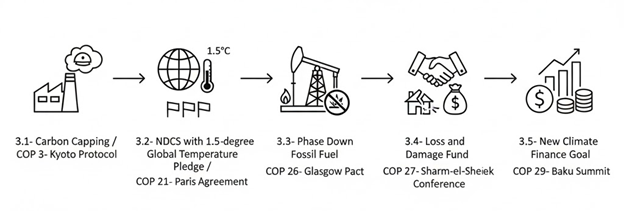
- 3.1- Carbon Capping and COP 3- Kyoto Protocol
- 3.2- NDCs with 1.5-degree Global Temperature Pledge and COP 21- Paris Agreements
- 3.3- Phase Down Fossil Fuel and COP 26- Glasgow Climate Pact
- 3,4- Loss and Damage Fund and COP 27- Sharm-el-Shiekh Conference
- 3.5- New Climate Finance Goal and COP 29- Baku Summit
4- Particular Achievements of COP-30 (THE BELEM PACKAGE)
- 4.1. Global Mutirao Decision to Align with global 1.5-degree Temperature
- 4.2- Global Adaptation Fund to be tripled by 2035
- 4.3- The Launch of Triple Forest Forever Facility (TFFF)
- 4.4- Just Transition, i.e., transitioning fossil fuel without affecting the local community
- 4.5- Community-led Climate Action and Gender Action Plan
- 4..6- The Establishment of an Open Coalition on Compliance Carbon Market
5- Critical Analysis
- Pledges over actions
- The unreachable, slowest global adaptation targets
- Global Powers and Climate Politics
6- Conclusion

Introduction
The annual Conference of the Parties, widely known as COP, has evolved into the central arena of global climate diplomacy, bringing together governments, scientists, civil society, and private actors under the umbrella of the United Nations Framework Convention on Climate Change. Since its first session in 1995, COP has functioned not merely as a diplomatic ritual but as a cumulative negotiation process that shapes the trajectory of global climate governance. The significance of COP meetings lies in their ability to translate scientific warnings into political commitments, economic frameworks, and legal obligations. While critics often emphasize the gap between promises and implementation, the historical record demonstrates that COP negotiations have gradually constructed the architecture of international climate cooperation. This architecture includes emissions reduction regimes, adaptation financing, technology transfer mechanisms, and accountability systems. Within this broader continuum, COP 30 has attracted particular attention because it symbolizes a transition from rulemaking to accelerated implementation, encapsulated in what is often referred to as the Belém Package. Understanding the achievements of COPs in general and COP 30 in particular, therefore, requires a chronological appreciation of how climate diplomacy has matured over time.
An Overview of UNFCCC and the Historical Evolution of COPs
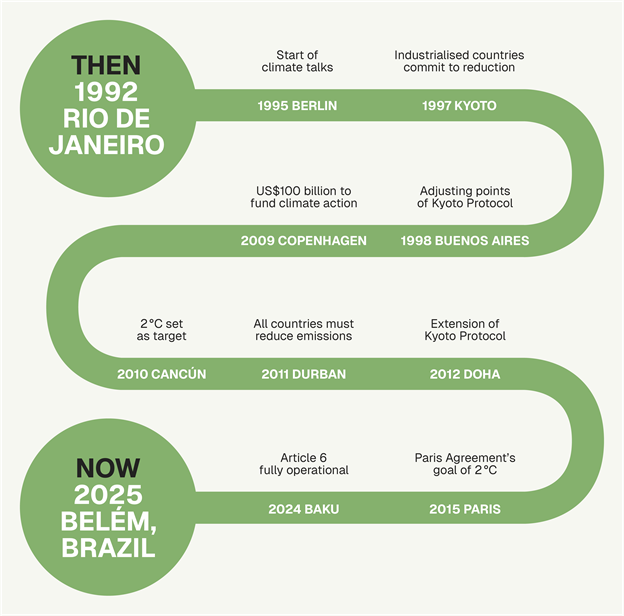
The origins of COP are rooted in the early recognition that climate change constitutes a collective action problem requiring multilateral cooperation. The UNFCCC, adopted in 1992 at the Rio Earth Summit, established the foundational principle of common but differentiated responsibilities, acknowledging that developed countries bear greater historical responsibility for greenhouse gas emissions. The COP mechanism emerged as the governing body responsible for reviewing implementation, negotiating new commitments, and strengthening cooperation. Over three decades, COP meetings have transitioned from tentative political declarations to more sophisticated frameworks integrating law, economics, and science. This progression reflects both the increasing urgency of climate impacts and the growing institutional capacity of international environmental governance.
General Achievements of COPs
- Carbon Capping and COP 3- Kyoto Protocol
One of the earliest and most consequential achievements occurred at COP 3 in Kyoto, where the Kyoto Protocol introduced binding emission reduction targets for industrialized countries. This marked the first time in history that nations collectively agreed to legally enforceable carbon caps, transforming climate policy from voluntary pledges into a quasi-legal regime. It compelled industrialized nations to reduce their greenhouse gas emissions by an average of 5% against 1990 levels during the first commitment period. By establishing a system of international emissions trading and the Clean Development Mechanism, Kyoto laid the groundwork for modern carbon markets. It was the first time the international community moved beyond mere rhetoric to assign quantifiable responsibilities, effectively penalizing carbon intensity and rewarding efficiency. Although it faced criticism for its exclusion of developing nations, it served as a vital precursor to more inclusive future agreements, proving that global carbon regulation was diplomatically feasible.
- NDCs with 1.5-degree Global Temperature Pledge and COP 21- Paris Agreements
Building upon the lessons of Kyoto, the global community achieved a paradigm shift at COP-21 in 2015 with the signing of the Paris Agreement. This treaty transformed the top-down mandate of Kyoto into a bottom-up system of nationally determined contributions (NDCs). The central achievement of Paris was the unanimous pledge to limit global temperature rises to well below 2 degrees Celsius, with a fervent pursuit of the 1.5-degree Celsius threshold. This goal has since become the “North Star” of climate policy, guiding legislative actions and corporate strategies worldwide. The Paris Agreement’s transparency framework and the “ratchet mechanism,” which requires nations to enhance their climate targets every five years, ensured that the momentum for decarbonization would remain perpetual. It fostered a sense of collective accountability, bridging the divide between the Global North and South by recognizing that while responsibilities are common, they are also differentiated based on national circumstances.
- Phase Down Fossil Fuel and COP 26- Glasgow Climate Pact
As the physical impacts of climate change intensified, the focus of the COPs expanded from mitigation to the systemic phasing out of the drivers of warming. At COP-26 in Glasgow, the world witnessed the birth of the Glasgow Climate Pact, which for the first time in the history of the UNFCCC explicitly mentioned the phase-down of unabated coal power and the phase-out of inefficient fossil fuel subsidies. This was a watershed moment, breaking a long-standing diplomatic taboo and signaling the inevitable twilight of the hydrocarbon era. Glasgow also saw a surge in private sector commitment, with the Glasgow Financial Alliance for Net Zero (GFANZ) mobilizing over $130 trillion in private capital to accelerate the transition. The emphasis on “keeping 1.5 alive” became the rallying cry, driving a renewed urgency to halve global emissions by 2030.
- Loss and Damage Fund and COP 27- Sharm-el-Shiekh Conference
The narrative of climate justice took center stage at COP-27 in Sharm-el-Sheikh, where the historic Loss and Damage Fund was established. For decades, vulnerable nations on the frontlines of climate disasters, those least responsible for historical emissions—had demanded financial compensation for the irreversible destruction caused by rising seas and extreme weather. The operationalization of this fund represented a profound moral victory and a significant shift in climate diplomacy, acknowledging the inequities inherent in the climate crisis.
- New Climate Finance Goal and COP 29- Baku Summit
The momentum continued into COP-29 in Baku, which centered on the New Collective Quantified Goal (NCQG) for climate finance. The Baku Summit was instrumental in redefining the financial architecture needed to support developing nations, aiming to scale up the previous $100 billion annual commitment to reflect the trillions of dollars required for a global green transition. These summits underscored that without robust financial mechanisms, the pledges made in Paris and Glasgow would remain unattainable for the majority of the world’s population.
Particular Achievements of COP-30 (THE BELEM PACKAGE)
- Global Mutirao Decision to Align with the global 1.5-degree Temperature
Transitioning to the contemporary era, COP-30, held in Belém, Brazil, emerged as a definitive turning point, culminating in what is now hailed as the Belém Package. This comprehensive suite of decisions was designed to align global actions with the stark realities of the 1.5-degree limit through the Global Mitigation Decision. The term “Mutirao,” rooted in Brazilian culture as a call for collective community work, symbolized a new era of radical collaboration. Under this decision, parties agreed to a rigorous alignment of their 2035 NDCs with the 1.5-degree pathway, ensuring that the next cycle of climate pledges is not merely aspirational but scientifically consistent with the remaining carbon budget. COP-30 effectively bridged the gap between national ambition and global necessity, emphasizing that the window for action is closing rapidly and requires a synchronized global effort.
- Global Adaptation Fund to be tripled by 2035
One of the most pragmatic triumphs of COP-30 was the commitment to the Global Adaptation Fund, with a mandate to be tripled by 2035. This elevation of adaptation to equal status with mitigation acknowledged that even under the most optimistic emission scenarios, significant warming is already baked into the system. By securing a surge in funding for resilient infrastructure, drought-resistant agriculture, and flood defenses, the Belém Package provided a lifeline to millions in the Global South.
- The Launch of Triple Forest Forever Facility (TFFF)
Furthermore, COP-30 saw the launch of the Triple Forest Forever Facility (TFFF), a pioneering financial mechanism designed to incentivize the conservation of tropical forests. Unlike traditional offset programs, the TFFF focuses on the intrinsic value of standing forests, providing continuous financial rewards to nations that successfully protect their biodiversity and carbon sinks. This initiative represents a sophisticated evolution in nature-based solutions, moving away from reactive conservation toward a proactive, remunerative model for ecological stewardship.
- Just Transition, i.e., transitioning from fossil fuels without affecting the local community
The social dimension of the energy transition was also a cornerstone of the COP-30 negotiations, particularly through the framework of a just transition. The Belém discussions moved beyond technical decarbonization to address the socio-economic vulnerabilities of local communities and workers in the fossil fuel sector. The agreement stipulated that transitioning away from fossil fuels must be inclusive, ensuring that the shift to green energy does not result in economic disenfranchisement or localized poverty.
- Community-led Climate Action and Gender Action Plan
The Just Transition was complemented by the community-led Climate Action and Gender Action Plan, which recognized that women and indigenous peoples are the most effective stewards of the environment. By integrating gender-responsive policies and empowering local leaders, COP-30 ensured that climate action is not a top-down imposition but a grassroots movement.
- The Establishment of an Open Coalition on the Compliance Carbon Market
Finally, the establishment of the Open Coalition on Compliance Carbon Markets provided the regulatory clarity needed to prevent “greenwashing.” This coalition focuses on high-integrity carbon credits, ensuring that every ton of carbon reduced is accurately accounted for and contributes to genuine global cooling.

Critical Analysis
Despite the robust architecture of the Belém Package, a critical analysis of the COP process reveals a persistent and widening chasm between diplomatic rhetoric and atmospheric reality. The most glaring critique remains the phenomenon of pledges over actions; while the UNFCCC has been successful in generating ambitious targets, the UNEP Emissions Gap Report consistently highlights that current national policies put the world on a trajectory for 2.6°C to 3.1°C of warming by the end of the century. This “implementation gap” suggests that the COP process, while excellent at consensus-building, lacks the enforcement mechanisms necessary to hold sovereign states accountable. The Global Stocktake mechanisms, although designed to increase transparency, ultimately rely on “naming and shaming,” a tool that often proves insufficient against the hard economic realities of industrial growth and energy security.
Furthermore, the focus on adaptation at COP-30 highlights a somber reality: the unreachable and slowest global adaptation targets. Despite the commitment to triple the Adaptation Fund, the Adaptation Gap Report indicates that the financial needs of developing countries are five to ten times greater than current international public adaptation finance flows. The delay in mobilizing these funds means that by the time infrastructure projects are greenlit, the climatic baseline has often shifted, rendering the original designs obsolete. This lag creates a cycle of permanent vulnerability where the Global South is forced to spend a disproportionate amount of its GDP on disaster recovery rather than sustainable development, effectively trapping these nations in a state of “climate-induced debt.”
The efficacy of the COP summits is also frequently compromised by the gravity of global powers and Climate Politics. The transition to a green economy is not merely an environmental endeavor but a massive geopolitical realignment. The rivalry between major emitters often turns climate negotiations into a theater for trade wars, particularly regarding the supply chains for critical minerals and solar technology. When domestic political shifts occur in major economies, such as the withdrawal or re-entry of superpower nations into climate accords, it creates a “policy whiplash” that destabilizes global markets and undermines long-term investment certainty. The influence of fossil fuel lobbyists—who were present in record numbers at recent summits—further complicates the path toward a “Just Transition,” as these entities often exert significant pressure to maintain the status quo under the guise of “energy pragmatism.”
Conclusion
In conclusion, the evolution of the COP process from Kyoto to the Belém Package at COP-30 represents the most ambitious attempt at global governance in human history. The significant achievements, from the legally binding carbon caps of COP-3 to the innovative Triple Forest Forever Facility, demonstrate that the international community is capable of sophisticated cooperation. However, the survival of the 1.5-degree goal depends on shifting from a culture of declaration to a culture of delivery. As we move beyond COP-30, the success of global climate action will be measured not by the complexity of the frameworks established in the meeting rooms but by the tangible deceleration of carbon concentrations in the atmosphere and the protection of the world’s most vulnerable populations. The journey of the COPs proves that while the spirit of “Mutirao” is alive, it must be matched by an unprecedented acceleration of political will and financial integrity.
CSS 2026 Solved Current Affairs
| 2- | “Pakistan Stands at a Decisive Turning Point Where Climate Shocks, Rapid Population Growth, Governance Gaps, Non-Traditional Security Threats, and Intense Fiscal Stress Are Converging to Heighten National Vulnerability.” Critically Evaluate the Above Statement and Propose Policy Measures for Building A Stable, Secure, and Disaster-Resilient Pakistan. |
| 3- | “Brain drain threatens Pakistan’s ability to achieve its Sustainable Development Goals (SDGs) by 2030.” Write a comprehensive note on the causes and consequences of brain drain from Pakistan, focusing on its impact on achieving SDGs (you may choose any three SDGs for answering this question). |
| 4- | Critically Appraise the Following Statement with Relevant Examples. Furthermore, draw relevant lessons and Propose a Way Forward for Pakistan. “Natural Resources, Though Desirable for the Development of a Country, Can Become a Source of Conflict and Instability.” |
| 5- | Non-Governmental Organizations (NGOs), once called “force multipliers”, are now having trust issues as public skepticism about the virtues and advantages of NGOs has dropped. Critically examine why NGOs’ space is shrinking in many parts of the world, with specific reference to Pakistan. |
| 6- | COP – the annual climate negotiation, Conference of the Parties to the UN Framework Convention on Climate Change (UNFCCC) is organized every year since 1995. What are the significant achievements of COPs in general and COP-30 in particular |
| 7- | Conduct a critical analysis of the prospects of resolution of the Palestinian conflict with special reference to the UN Security Council’s recently approved US-drafted resolution for peace in Gaza. Can Pakistan play any role in this initiative? |
| 8- | Write short notes on any TWO of the following: (i) Pros and cons of food production through Genetically Modified Organisms (GMOs) (ii) Implications of depopulation (iii) Role of China in evolving world order |
CSS Solved Past Papers’ Essays
Looking for the last ten years of CSS and PMS Solved Essays and want to know how Sir Kazim’s students write and score the highest marks in the essays’ papers? Then, click on the CSS Solved Essays to start reading them.
CSS Solved Essays
CSS Solved General Science & Ability Past Papers
Want to read the last ten years’ General Science & Ability Solved Past Papers to learn how to attempt them and to score high? Let’s click on the link below to read them all freely. All past papers have been solved by Pakistan’s top CSS GSA coach having the highest score of their students.
General Science & Ability Solved Past Papers