CSS 2026 Solved Pakistan Affairs Past Papers | Influence of Afghanistan’s Instability on Pakistan
The following question of CSS Pakistan Affairs 2026 is solved by Miss Iqra Ali on the guided pattern of Sir Syed Kazim Ali, which he taught to his students, scoring the highest marks in compulsory subjects for years. This solved past paper question is uploaded to help aspirants understand how to crack a topic or question, how to write relevantly, what coherence is, and how to include and connect ideas, opinions, and suggestions to score the maximum.

Question Breakdown
In this question, the examiner has mentioned three dimensions of Pakistan Afghanistan relation indicating “continues to influence”. So start with the historical influence of Afghanistan’s instability on Pakistan in a chronology. Then move to the main part, discuss each issue separately and give implementable suggestions. Draw maps where necessary.
Outline
1- Introduction
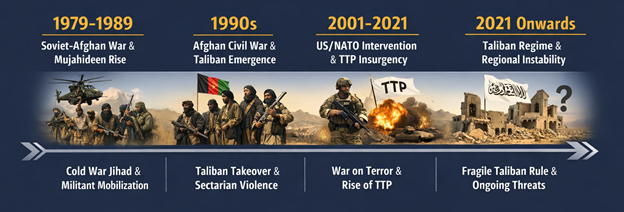
2- An Overview of the Historical Situation of Afghanistan and Pakistan
- 1979 to 1989 Soviet Afghan War and militant mobilization
- 1990s Afghan civil war and Taliban emergence
- 2001 to 2021 US NATO intervention and insurgency
- 2021 onwards Taliban regime with fragile governance
3- The Ongoing instability in Afghanistan with its influence on Pakistan’s internal security, regional diplomacy, and counter terrorism strategy
3.1. Influence on Pakistan’s Internal Security
- Rise of Militancy and Separatism
- Case in Point: Pakistan officially referring to Tehreek-e-Taliban Pakistan as Fitna al Khwarij and BLA as Fitna al Hindustan sponsible for an increase in 70 percent terror attacks in 2024
- Weapons Proliferation and Kalashnikov Culture
- Case in Point: After US withdrawal, Billions of dollars worth of advanced weapons were left behind with Night vision devices, sniper rifles, and thermal scopes reached militant groups
3.2. Influence on Pakistan’s Regional Diplomacy
- Cessation of Regional Energy Projects
- Case in Point: Long-Standing CASA and TAPI gas pipeline still under Constuction
- Alternative Diplomacy Initiatives and Regional Isolation
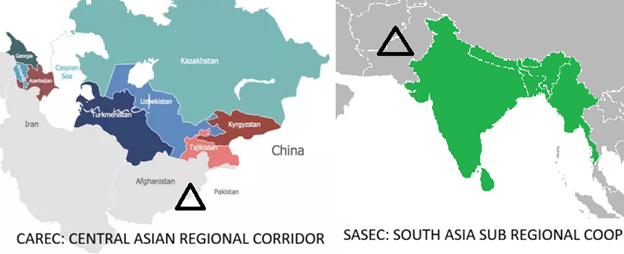
- Case in Point: CAREC constituting all Central Asian Countriesand SASEC constituting all South Asian Countries
3.3. Influence on Pakistan’s Counter Terrorism Strategy
- Shift toward Cross Border Deterrence
- Case in Point: Pakistan’s counter terrorism posture evolved from domestic clearing operations such as Zarb e Azb to Cross border airstrikes in Afghan provinces including Khost and Paktika
- Prisoner Releases and Militant Revival
- Case in Point: After the Taliban takeover, Thousands of prisoners including high profile militants were released from Afghan prisons making Pakistan reorient its National Action Plan (NAP)
4. Suggested Policy Measures for Pakistan to deal with the Chaos in Afghanistan
- 4.1. Continuous Kinetic Counter Terrorism Operation to Deal with the MITNOR militants
- Case in Point: Operations Black Thunder Storm Post Swat 2007 militant occupation remained the only option to deal with terrorists
- 4.2. Smart AI-enabled Border Management Model rather than the Complete Closure of Border to keep its transit route a leverage on Afghanistan
- Case in Point: Complete Closure would allow Afghanistan redirect towards CARS and Iran through its Transport Sector Master Plan 2030
- 4.3. Multilateral Diplomacy and Collective Pressure through China, Turkey and Iran
- Case in Point: Pakistan Saudia Strategic Defence Mutual Agreement is one Solid initiative
- 4.4. Cultural Diplomacy and Soft Power to Revamp the Historical Nostalgia among the Public
- Case in Point: Hippie Trail Tourist Initiative Documentaries on the Turkiye’s footstep through Ertugrul
- 4.5. Institutional Engagement Framework for Military Coordination and Intelligence Sharing
- Case in Point: Afghanistan-Pakistan Action Plan for Peace and Solidarity (APAPPS) has already been working for academic cooperation
- 4.6. International Intelligence Cooperation through Counter Terrorism Monitoring Mechanism
- Case in Point: Intelligence Based Operations (IBOs) preventing more than fifty percent of cross-border militant attacks
5. Conclusion
“Asia yak paikar-e-ab-o-gil ast, Millat-e-Afghan dar aan paikar dil ast”

Introduction
The geopolitical fates of Pakistan and Afghanistan have been inextricably linked by geography, ethnicity, and shared history for centuries, but since the late 20th century, this relationship has been defined more by volatility than by cooperation. The instability in Afghanistan continues to influence Pakistan’s internal security, regional diplomacy, and counter-terrorism strategy as a central dilemma of contemporary policy. As Afghanistan remains a crucible of fragile governance under the Taliban, the spillover effect has manifested in Pakistan as a resurgent wave of militancy, a paralyzed regional economic agenda, and a radical shift in military doctrine. To understand this influence, one must look at the historical trajectory starting with the Soviet-Afghan War from 1979 to 1989. During this period, Pakistan became the frontline state in a global power struggle, facilitating the mobilization of Mujahideen that fundamentally altered the region’s social fabric. This era introduced the “Kalashnikov culture” and a tradition of militant mobilization that would eventually outlive its original purpose, creating a domestic environment where religious extremism could be leveraged for political ends.
An Overview of the Historical Situation of Afghanistan and Pakistan
Immediately after Pakistan’s independence, Afghanistan refused to recognize the country in the United Nations Plenary Meeting of 1947 due to the issue of Durand line despite being the signatory of 1893 Durand Agreement, the Anglo-Afghan Pact of 1905, the Treaty of Rawalpindi of 1919, and the Anglo-Afghan Treaty of 1921.
- 1979 to 1989: Soviet-Afghan War and Militant Mobilization
The genesis of the current crisis lies in the Soviet invasion of 1979. Pakistan, backed by the United States and Saudi Arabia, became the “frontline state” in the jihad against communism. This era saw the birth of the “Mujahideen,” a mobilization of religious fighters that fundamentally altered Pakistan’s social fabric. The infusion of billions in aid and weaponry created a culture of militancy that would eventually outlive its original purpose.
- 1990s: Afghan Civil War and Taliban Emergence
Following the Soviet withdrawal, Afghanistan descended into a brutal civil war. The resulting power vacuum led to the rise of the Taliban in 1994—a movement largely born in the madrassas of Pakistan’s border regions. Islamabad officially recognized the Taliban government in 1996, viewing it as a provider of “strategic depth” and a means to secure its western frontier. However, this period also saw the radicalization of Pakistani sectarian groups.
- 2001 to 2021: US/NATO Intervention and Insurgency
The 9/11 attacks forced Pakistan into a precarious “double game.” While allied with the US-led War on Terror, Pakistan faced a domestic backlash. The formation of the Tehreek-e-Taliban Pakistan (TTP) in 2007 marked a turning point, as militants turned their guns on the Pakistani state for its alliance with Washington. For twenty years, the border became a sanctuary for both Afghan Taliban fighting NATO and TTP militants fighting Islamabad.
- 2021 Onwards: Taliban Regime with Fragile Governance
The chaotic US withdrawal in August 2021 was initially viewed by some in Islamabad as a victory. However, the reality of a Taliban-led “Islamic Emirate” has proven to be a strategic nightmare. The lack of international recognition, a collapsing economy, and the Taliban’s refusal to decouple from foreign militant groups have left Afghanistan as a primary source of instability for its neighbors.
The Ongoing instability in Afghanistan with its influence on Pakistan’s internal security, regional diplomacy, and counter terrorism strategy
- Influence on Pakistan’s Internal Security
One of the most visible impacts of Afghanistan’s instability has been the deterioration of Pakistan’s internal security environment. The resurgence of militant violence, expansion of separatist networks, and ideological radicalization have collectively intensified national security threats.
A- Rise of Militancy and Separatism
The ongoing instability in Afghanistan serves as a primary catalyst for the deteriorating internal security landscape within Pakistan, characterized by a sharp resurgence in organized militancy and ethnic separatism. The vacuum of effective governance in Kabul has empowered groups like the Tehreek-e-Taliban Pakistan (TTP), which the Pakistani state has officially designated as “Fitna al-Khwarij” to highlight their deviation from Islamic principles and their role as a destabilizing force. Simultaneously, the Baloch Liberation Army (BLA), termed “Fitna al-Hindustan” by security circles due to alleged external patronage, has intensified its insurgency, leveraging cross-border movements to target state infrastructure. The toxic security environment culminated in a staggering 70 percent increase in terror attacks during 2024, according to the United Nations Monitory Report.
B- Weapons Proliferation and Kalashnikov Culture
This internal insecurity is further exacerbated by a dangerous era of weapons proliferation that has evolved far beyond the traditional “Kalashnikov culture” of the 1980s. Following the chaotic US withdrawal in August 2021, an estimated $7 billion worth of advanced military hardware was left behind, much of which has filtered through the black market into the hands of non-state actors. Militant groups are now frequently seen utilizing high-tech equipment such as M4 carbines, Night Vision Devices (NVDs), thermal scopes, and advanced sniper rifles in their raids against Pakistani border posts. This technological windfall has narrowed the qualitative gap between the state’s military forces and insurgent groups, leading to higher casualty rates among security personnel and making the management of the western border an increasingly lethal challenge for Islamabad.
- Influence on Pakistan’s Regional Diplomacy
On the diplomatic front, the persistent volatility in Afghanistan has caused a near-total cessation of critical regional energy projects that were intended to cement Pakistan’s role as a geo-economic hub
A- Cessation of Regional Energy Projects
One major consequence is the stagnation of regional energy connectivity projects. Despite years of planning, long-standing initiatives like the CASA-1000 (Central Asia South Asia Electricity Transmission Project) electricity transmission project and the TAPI (Turkmenistan-Afghanistan-Pakistan-India) gas pipeline remain stalled or under construction due to the inability of the Taliban regime to provide international sovereign guarantees or a secure environment for foreign engineers. The lack of a stable Afghan partner has turned Pakistan’s “Gateway to Central Asia” ambition into a strategic bottleneck, depriving the country of much-needed energy security and transit revenue at a time of severe economic crisis.
B- Alternative Diplomacy Initiatives and Regional Isolation
Consequently, Pakistan faces a growing risk of regional isolation as neighboring states and international organizations seek alternative diplomacy initiatives that bypass the Pak-Afghan theater entirely. Organizations such as the Central Asia Regional Economic Cooperation (CAREC), which includes all Central Asian states, and the South Asia Subregional Economic Cooperation (SASEC), are increasingly prioritizing “Middle Corridor” routes or maritime paths that avoid the instability of the Durand Line. As regional players focus on connectivity that does not rely on the volatile geography of Afghanistan, Pakistan’s diplomatic leverage as a transit state is being systematically eroded, forcing the country to compete with new trade architectures that exclude its traditional land-linked advantages.
- Influence on Pakistan’s Counter Terrorism Strategy
Regarding the Pakistan’s counter terrorism strategy,
A- Shift toward Cross Border Deterrence
In response to these multi-faceted threats, Pakistan’s counter-terrorism strategy has undergone a radical shift toward cross-border deterrence and kinetic external operations. While previous decades focused on domestic clearing operations such as Operation Zarb-e-Azb and Operation Radd-ul-Fasad, the state’s posture has evolved to include direct cross-border airstrikes in Afghan provinces such as Khost and Paktika to target militant sanctuaries. This shift signifies a departure from traditional diplomacy, as Islamabad now prioritizes its security interests over the territorial sensitivities of the Afghan Taliban. The proactive use of air power and targeted strikes across the border reflects a new military doctrine aimed at neutralizing threats before they can infiltrate Pakistani soil.
B- Prisoner Releases and NAP Revision
The necessity for this aggressive posture was largely triggered by the mass militant revival that followed the fall of Kabul. Immediately after the Taliban takeover, thousands of prisoners, including high-profile TTP commanders and hardened fighters, were released from Bagram and Pul-e-Charkhi prisons, providing an instant “human capital” boost to anti-Pakistan insurgencies. This influx of veteran militants effectively neutralized the gains of previous decades, forcing the Pakistani government to reorient its National Action Plan (NAP) to address the renewed threat. The sudden replenishment of militant ranks has necessitated a permanent high-alert status for the military and a total overhaul of the country’s internal and external security apparatus to combat a modernized and re-energized extremist threat.
Following are some solved questions relevant to the given topic
Suggested Policy Measures for Pakistan to deal with the Chaos in Afghanistan
Addressing the multifaceted challenges arising from Afghan instability requires a comprehensive and balanced strategy combining military preparedness, diplomatic engagement, technological innovation, and socio cultural initiatives.
- Continuous Kinetic Counter-terrorism Operations
Pakistan must maintain a policy of continuous kinetic counter-terrorism operations as the primary tool for domestic stabilization. History serves as a critical guide in this regard; just as Operation Black Thunderstorm was launched in the wake of the 2007 militant occupation of Swat, the current environment necessitates a proactive military stance to eliminate high-value targets and dismantle sleeper cells. Relying solely on negotiations with groups like the TTP has historically allowed them time to regroup; therefore, a sustained, high-tempo military presence in the border regions remains the only viable option to prevent a repeat of the territorial losses seen in the previous decade. By keeping the militants under constant pressure, the state can ensure that the “Kharijite” elements are unable to establish a governance structure or a permanent base of operations within Pakistani territory.
- Smart Border Management
Simultaneously, Pakistan must evolve its frontier policy from a primitive blockade to a smart AI-enabled border management model that balances security with economic necessity. While complete border closure may seem like an immediate fix for infiltration, it carries the significant risk of driving Kabul further into the arms of regional rivals; if the Durand Line is permanently sealed, Afghanistan will likely redirect its trade towards Central Asian Republics (CARs) and Iran, as outlined in its Transport Sector Master Plan 2030. By utilizing advanced surveillance, biometric verification, and AI-driven monitoring, Pakistan can maintain its transit route as a strategic leverage over the Taliban regime. This approach allows for the flow of legitimate commerce—essential for Pakistan’s own revenue—while creating a “filtered” border that identifies and neutralizes security threats without severing the vital economic ties that keep Kabul tethered to Islamabad.
- Multilateral Diplomacy and Collective Pressure
On the international stage, the pursuit of multilateral diplomacy and collective pressure through key regional stakeholders like China, Turkey, and Iran is essential to moderate the Taliban’s behavior. Pakistan can no longer afford to manage the Afghan crisis in isolation; instead, it must align its security concerns with the broader interests of the regional powers. A significant step in this direction is the Pakistan-Saudi Arabia Strategic Defence Mutual Agreement, which provides a template for solid security initiatives that can be scaled regionally. By creating a unified front with nations that hold significant economic and religious influence over the Afghan leadership, Pakistan can demand verifiable action against cross-border terrorism as a prerequisite for any further regional integration or financial assistance for the Afghan state.
- Cultural Diplomacy and Soft Power
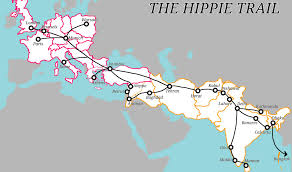
Beyond hard power, Pakistan must utilize cultural diplomacy and soft power to reshape the historical nostalgia and public perception shared by the people on both sides of the border. By focusing on shared heritage rather than recent conflict, the state can counter extremist narratives through initiatives like the “Hippie Trail” tourist project or cultural documentaries, mirroring the success of Turkey’s cultural exports like Ertugrul. This “soft power” approach aims to revive the image of a connected, peaceful region, fostering a sense of common identity that transcends the current militant ideologies. By investing in the media and tourism sectors, Pakistan can rebuild its image as a cultural bridge, potentially diminishing the domestic and regional recruitment appeal of radical groups through the promotion of a more inclusive, prosperous regional history.
- Institutional Engagement Framework
To ensure operational efficiency, the establishment of a robust Institutional Engagement Framework for military coordination and intelligence sharing is paramount. The Afghanistan-Pakistan Action Plan for Peace and Solidarity (APAPPS) provides an existing structure that should be revitalized to include not just academic and diplomatic cooperation, but direct, high-level military communication channels. A formalized framework for sharing real-time data on militant movements can reduce the trust deficit between Kabul and Islamabad. By institutionalizing these contacts, both nations can move away from public blame-shifting and toward a technical, results-oriented partnership that addresses the “spillover” effect of instability through joint monitoring and coordinated border patrolling.
- International Intelligence Cooperation
Finally, the state must deepen its international intelligence cooperation through a dedicated Counter-Terrorism Monitoring Mechanism. The success of modern warfare against non-state actors relies heavily on data, as evidenced by the fact that Intelligence-Based Operations (IBOs) have successfully prevented more than fifty percent of cross-border militant attacks in recent years. By collaborating with global intelligence agencies and utilizing satellite imagery and signals intelligence, Pakistan can identify threats long before they reach the frontline.
This multi-dimensional approach, combining kinetic force, smart borders, regional diplomacy, cultural soft power, and institutional intelligence, forms a comprehensive shield against the chaos in Afghanistan..
Conclusion
In a nutshell, the persistent instability in Afghanistan acts as a structural challenge that dictates Pakistan’s survival, transforming its western frontier into a crucible of resurgent militancy and economic stagnation. To navigate this crisis, Pakistan must move beyond a reactive security paradigm toward a holistic strategy that integrates AI-enabled smart border management, multilateral diplomacy, and hardening the state against external shocks as the peace in Afghanistan is a prerequisite to the Pakistan’s security.

Asia is a body of water and clay,
Allama Iqbal
And the Afghan nation is the heart of that body.
Disorder in Afghanistan brings chaos in the region,
And peace in Afghanistan brings tranquility in the region.
CSS 2026 Solved Pakistan Affairs
| 2- | Conduct a Comprehensive Appraisal of the Similarities and Differences Between Iqbal’s Philosophical Ideas and Jinnah’s Political Interpretation of the Pakistan Ideology. |
| 3- | “The Instability in Afghanistan Continues to Influence Pakistan’s Internal Security, Regional Diplomacy, and Counter Terrorism Strategy”. Critically Examine the Above Statement and Suggest Policy Measures to Address the Issue/Challenge. |
| 4- | To What Extent Does the 27th Constitutional Amendment Strengthen or Weaken Constitutionalism and Rule of Law in Pakistan? Justify Your Stance with Valid Arguments. |
| 5- | Critically Assess How Youth Perspectives, Digital Activism, and Civil Society Movements are Influencing Civil-Military Relations. |
| 6- | Undertake a Concise Assessment of the Key Economic Challenges Currently Confronting Pakistan. Illustrate How the IMF’s Conditions Can Shape the Country’s Path Towards Economic Stabilization and Long-Term Financial Sustainability? |
| 7- | “The Unresolved Kashmir Issue Exposes the Inherent Weakness in the United Nations Security Council’s Architecture.” Critically Examine the Role of the UNSC in Resolving the Kashmir Issue |
| 8- | Critically Assess the Performance of the Health and Education Sectors after Being Handed Over to the Provinces Under the 18th Amendment and Suggest a Way Forward. |
CSS Solved Past Papers’ Essays
Looking for the last ten years of CSS and PMS Solved Essays and want to know how Sir Kazim’s students write and score the highest marks in the essays’ papers? Then, click on the CSS Solved Essays to start reading them.
CSS Solved Essays
CSS Solved General Science & Ability Past Papers
Want to read the last ten years’ General Science & Ability Solved Past Papers to learn how to attempt them and to score high? Let’s click on the link below to read them all freely. All past papers have been solved by Pakistan’s top CSS GSA coach having the highest score of their students.
General Science & Ability Solved Past Papers